The Fortress Monastery of Akhtala, Armenia
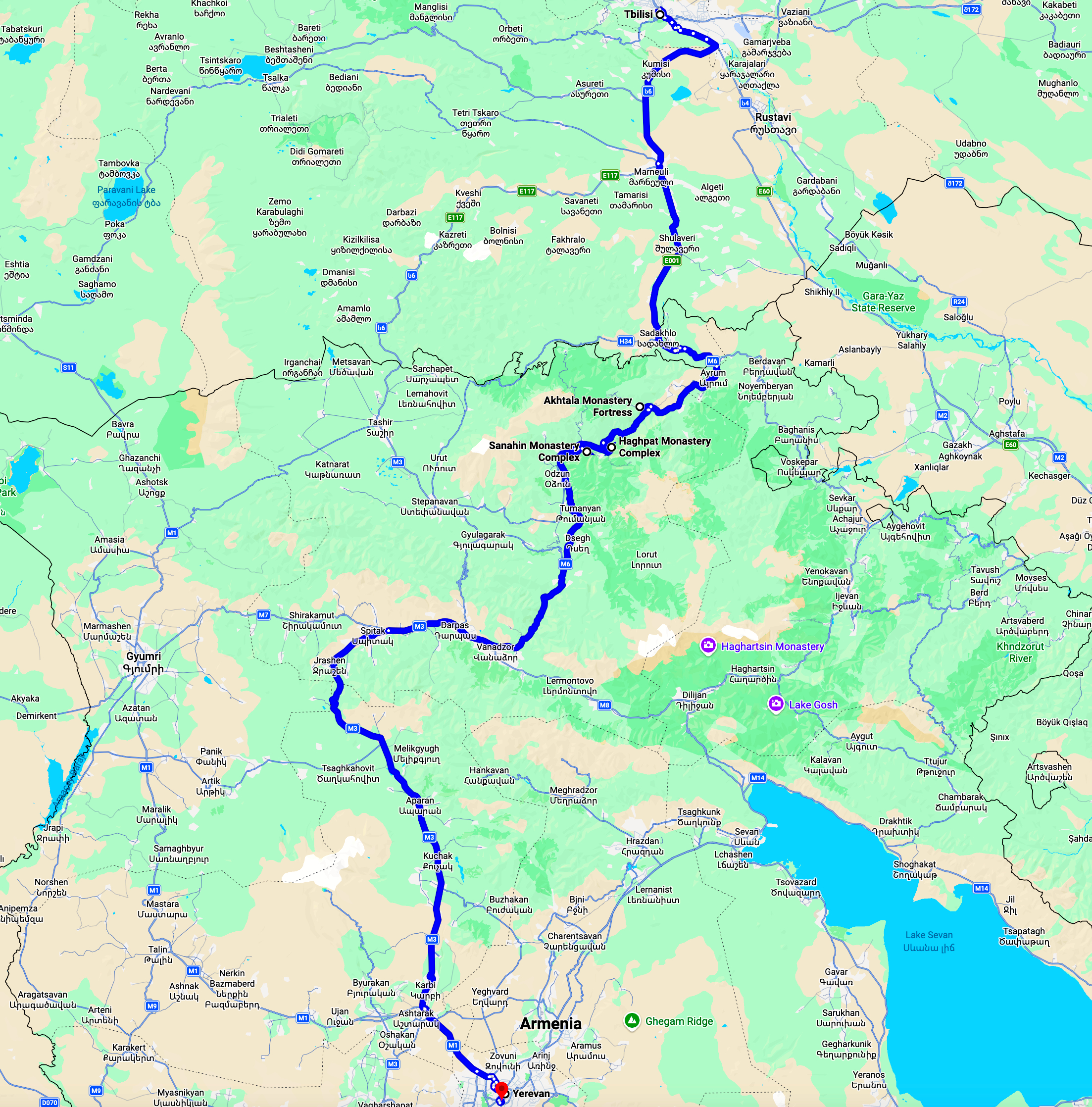
Akhtala Monastery (“Coppermine Monastery”) is a 10th-century fortified Armenian Apostolic Church monastery. The fortress played a major role in protecting the northwestern regions of Armenia and is among the best preserved of all medieval fortress-monasteries in the Caucasus. A visit to this monastery is included during our tour Crossroads of the Caucasus: Azerbaijan, Georgia and Armenia.
Origins of the Fortress Monastery
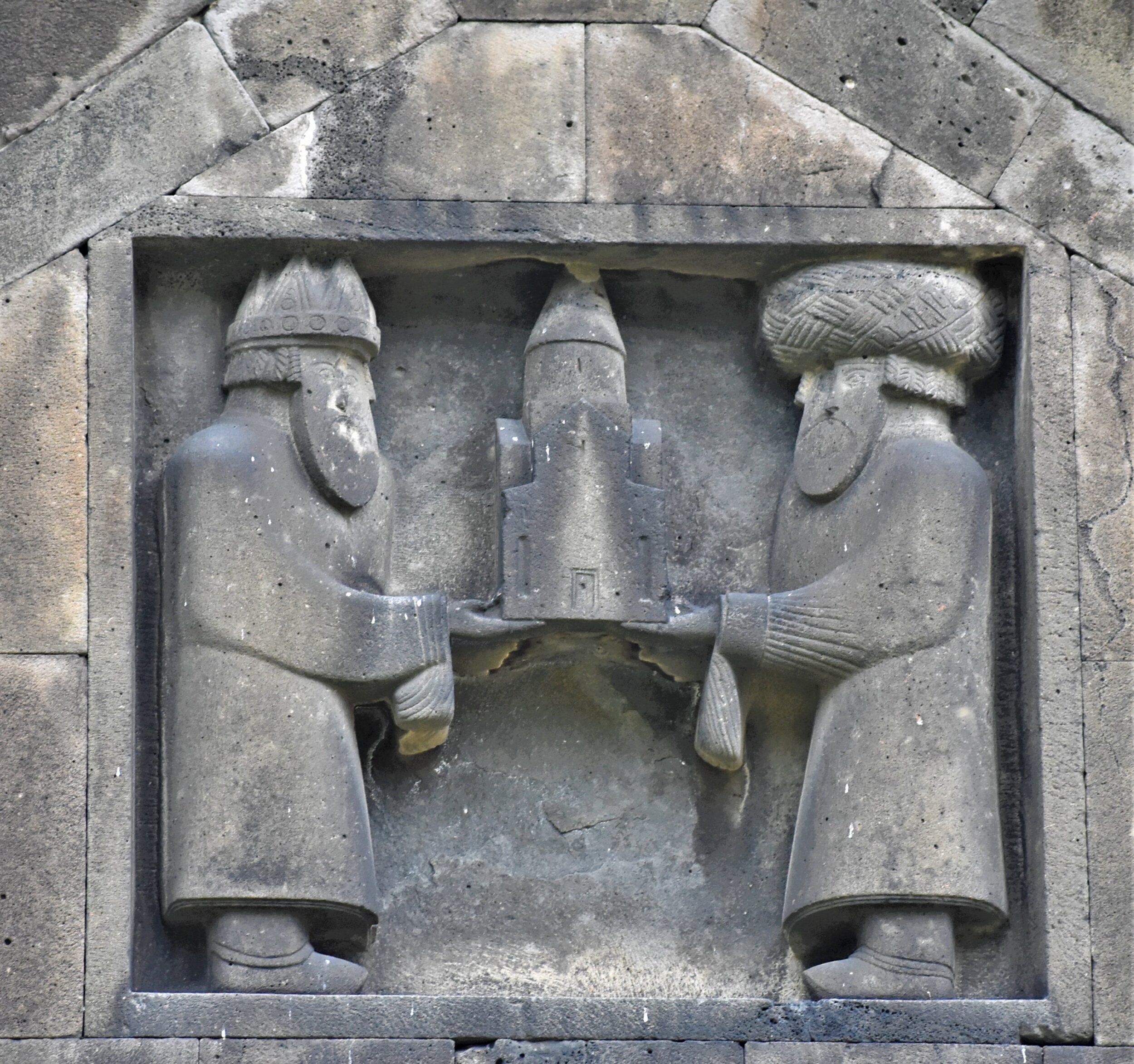
Between 1887 and 1889 French archaeologist Jacques de Morgan discovered 576 rectangular stone sepulchres, alongside Urartian artefacts made of clay, bronze and iron dating back to the 8th century BCE. The Urartian settlement was called Agarak and its fortress was almost certainly built on top of much earlier Bronze and Iron Age settlements. The Armenian Apostolic Monastery was constructed in the 10th century by Prince Gurgan Bagratid, a son of the patrons of the Sanahin and Haghpat monasteries located not far from Akhtala – King Ashot III the Merciful and Queen Khosrovanush. Gurgen’s two elder brothers, King Smbat II the Conqueror and Gagik I Bagratuni, developed the Bagratid Kingdom of Armenia to the apogee of its prosperity.
Ashot III established the subsidiary Bagratid Kingdom of Lori in 982 and both Prince Gurgen and his brother King Smbat are depicted on the patron sculptures at both Sanahin and Haghpat. When the Bagratid Kingdom of Lori fell to Seljuk raids in the 12th century the surviving royal family fled to Tavush and Metsnaberd, but maintained ancestral ties to their fortress and monastery in Akhtala.
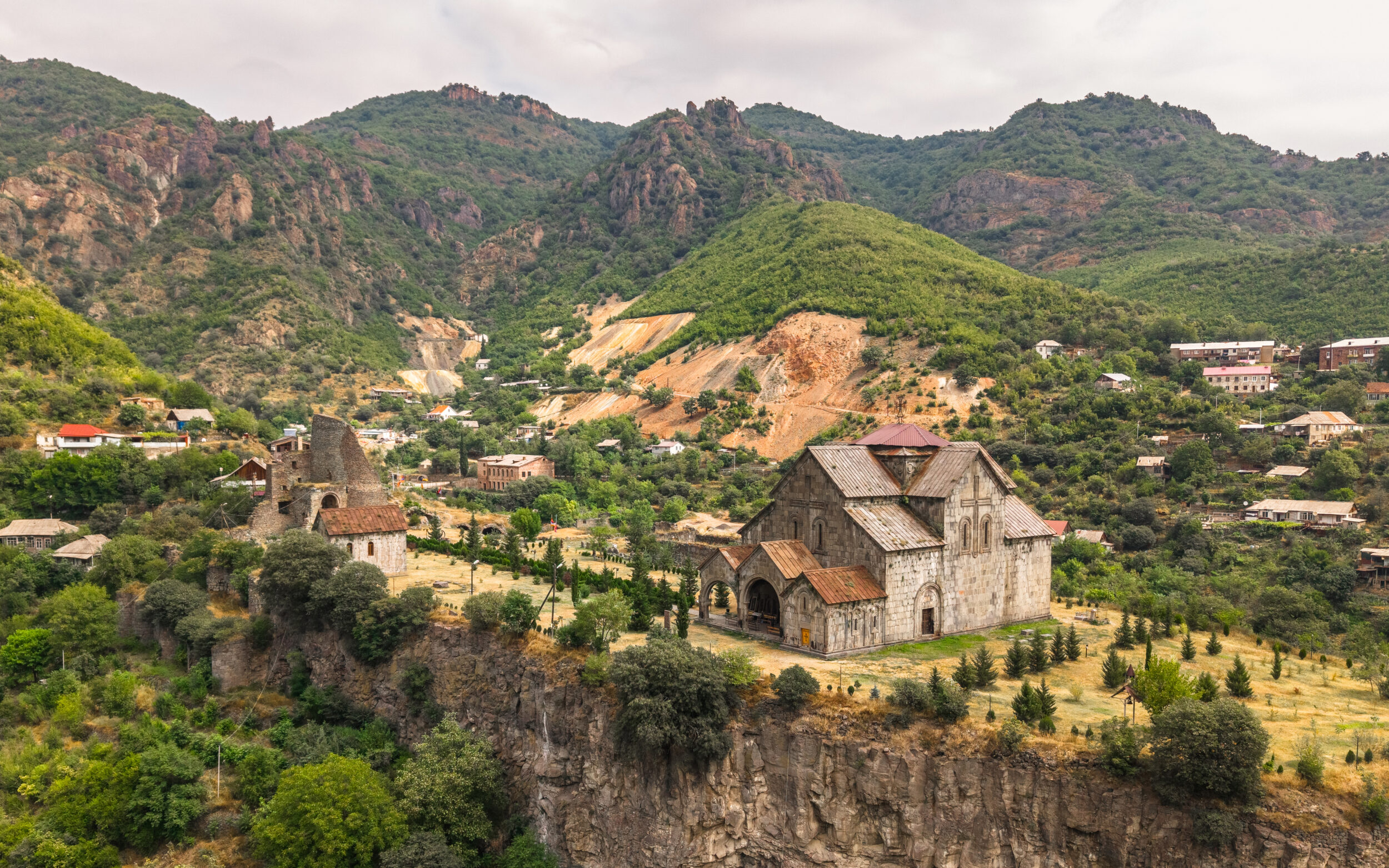
Gurgan built his fortress on an elevated rocky outcrop, surrounded by deep canyons on three sides, in a defensive location not unlike the contemporary Armenian city of Ani (in modern Türkiye). Defensive towers and walls protect the relatively accessible sections of the cliffs, with the only entrance to the monastery on the northern flank, protected by bell-shaped towers and more curtain walls. The walls and towers of the fortress are built of local blue basalt and lime mortar and survived the earthquakes of 1926 and 1988 relatively undamaged.
The monastery was briefly abandoned at the end of the 12th century and revived at the beginning of the 13th century when combined Georgian and Armenian forces liberated much of Armenia. Kartli Bagratids of Georgia gifted Akhtala to Armenian nobleman Ivane Zakarian in the 1180s when Ivane converted to Greek Orthodoxy at the Georgian court. Several monasteries in northern Armenia were converted to Greek Orthodoxy and closely tied the Georgians to the Chalcedonian Armenians living in northern and northwestern Armenia.
Ivane’s son, Avak was forced to recognise the Mongols as overlords after their devastating invasions of the 13th century, but monastic life continued. Mongol rule continued until 1340 when the Turkic confederation of Kara Koyunlu “Black Sheep” tribes began raiding across the Caucasus before seizing control over most of Armenia proper by 1400. The Turkic tribes brought chaos to much of the highlands, which were wracked by raids, blood feuds and dynastic squabbles, resulting in little organized defence against Timur Leng who invaded the region at the end of the 13th century; one of the cliffs at Akhtala is known as Lenktemur where local legend has Timur – falsely – burying one of his wives under the escarpment.
Holy Mother of God Church
The conversion of the monastery complex to Greek Orthodoxy drew many ethnic Greeks to the region at the end of the 18th century to work in the nearby copper, gold, and silver mines. Georgian King Erekle II moved roughly 800 Greek families from Gümüşhane in the Ottoman Empire to Akhtala in 1763 and these Greek miners and their families have left their inscriptions on the monastery walls. In the 19th century, Akhtala was gifted to the Armenian princely family of the Melikovs and converted back to Armenian Apostolic worship. While not a fully functioning monastery, it has pilgrimage days on 20th and 21st September when Armenians, Greeks and Georgians all visit the monastery for collective services.
The primary building in the monastic compound is the Surp Astvatsatsin, (Holy Mother of God church). The precise date of the current church reconstruction is unknown. In the early 11th century it was probably built over an earlier 10th century foundation. The church was said to have been founded to protect the cross, used by John the Baptist to baptise Jesus Christ, but Ivane Zakarian sold it for a huge sum to the monastery of Noravank to pay for the repairs to his expanding complex.
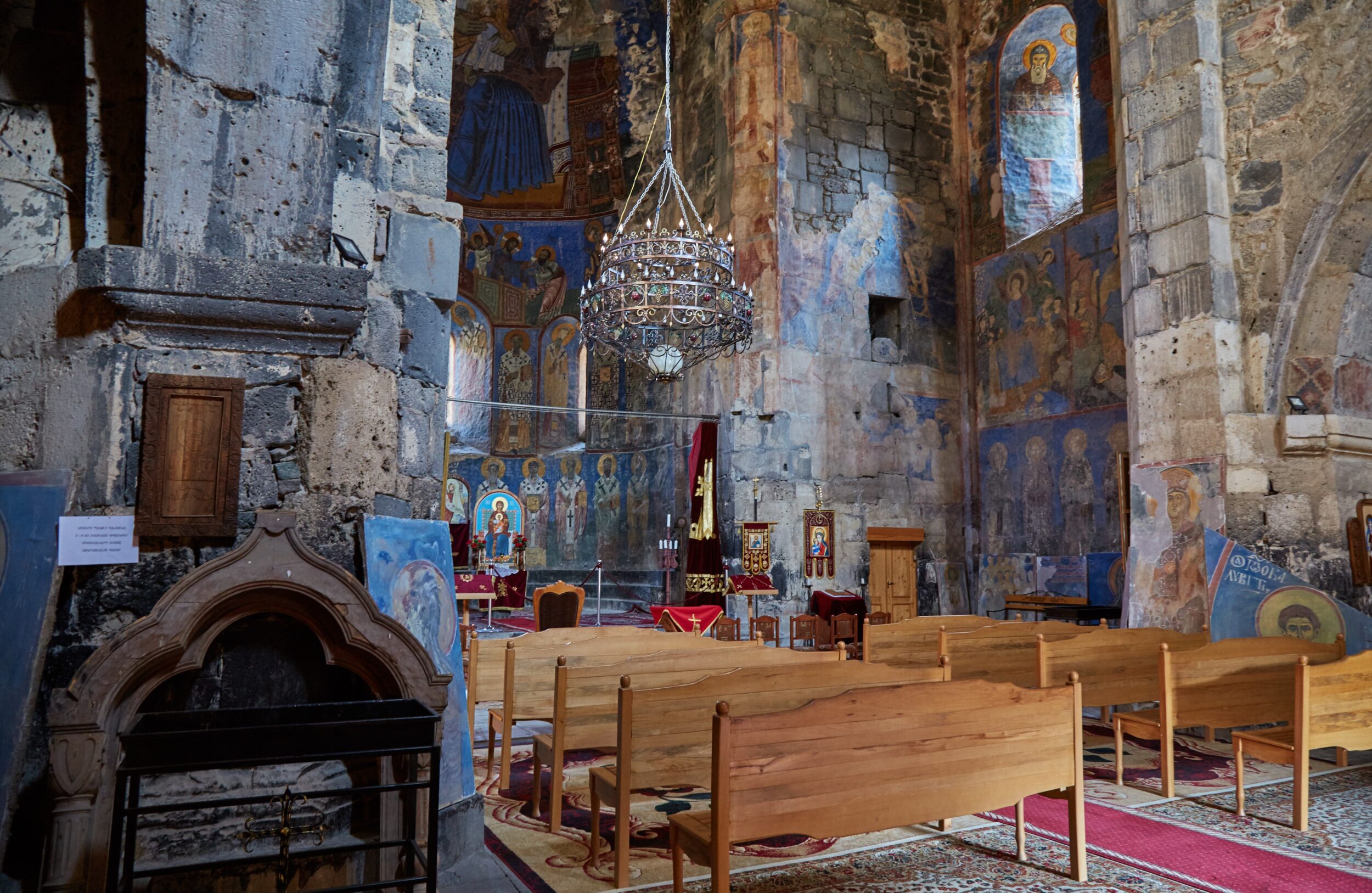
The church stands in the middle of the fortress. It is a domed basilica with side-chapels around the apse. Two arches divide the basilica into three naves, with the central nave attached to double side-chapels and sacristies, and an apse at the eastern end. The interior is lavishly decorated with rich paintings dominated by lapis blue. A massive dome originally crowned the vertical axis of the building, but the supporting cylindrical drum and dome were first badly damaged during Timur Leng’s invasion and then completely demolished in 1784 by Dagestani raiders. The Russian Viceroy of the Caucasus, Prince Mikhail Vorontsov built a semi-spherical wooden dome covered with iron sheets to replace the original dome at the end of the 19th century to protect the interior; this dome was renovated during the Soviet period.
Interior Murals
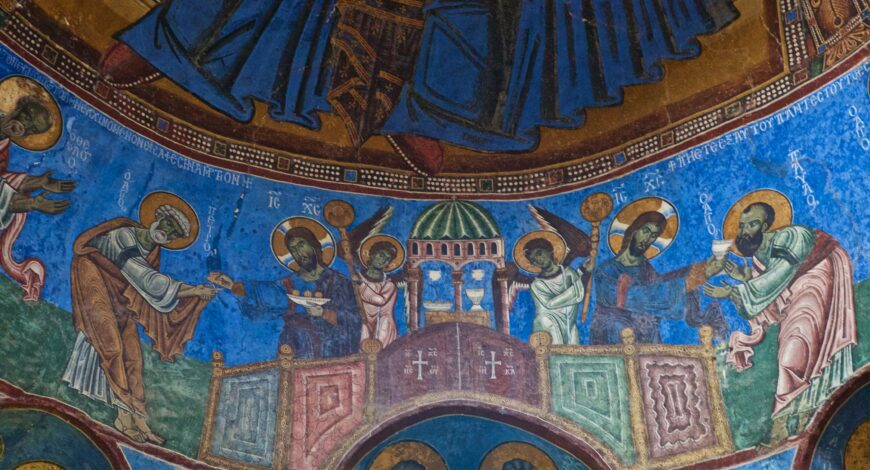
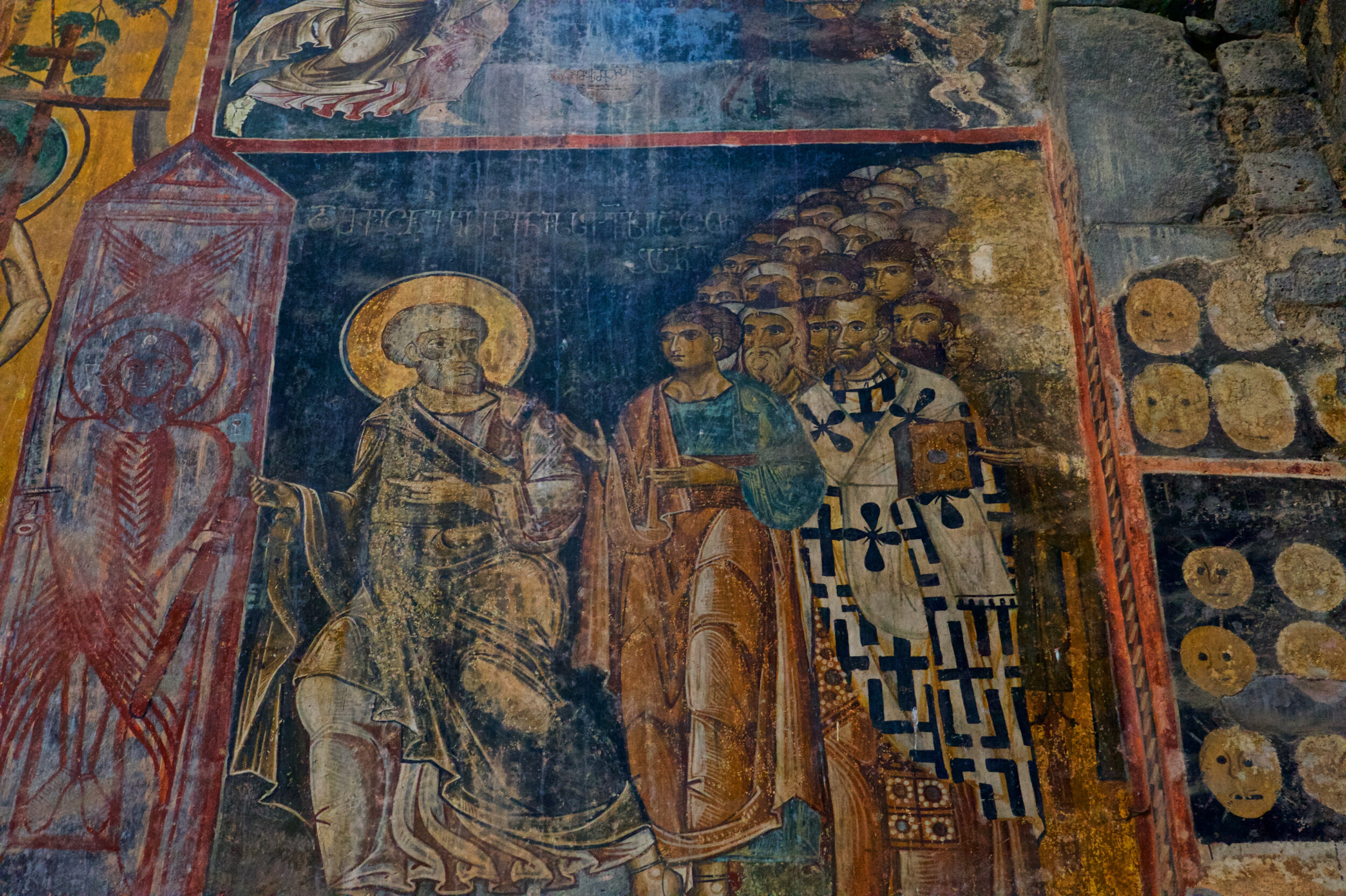
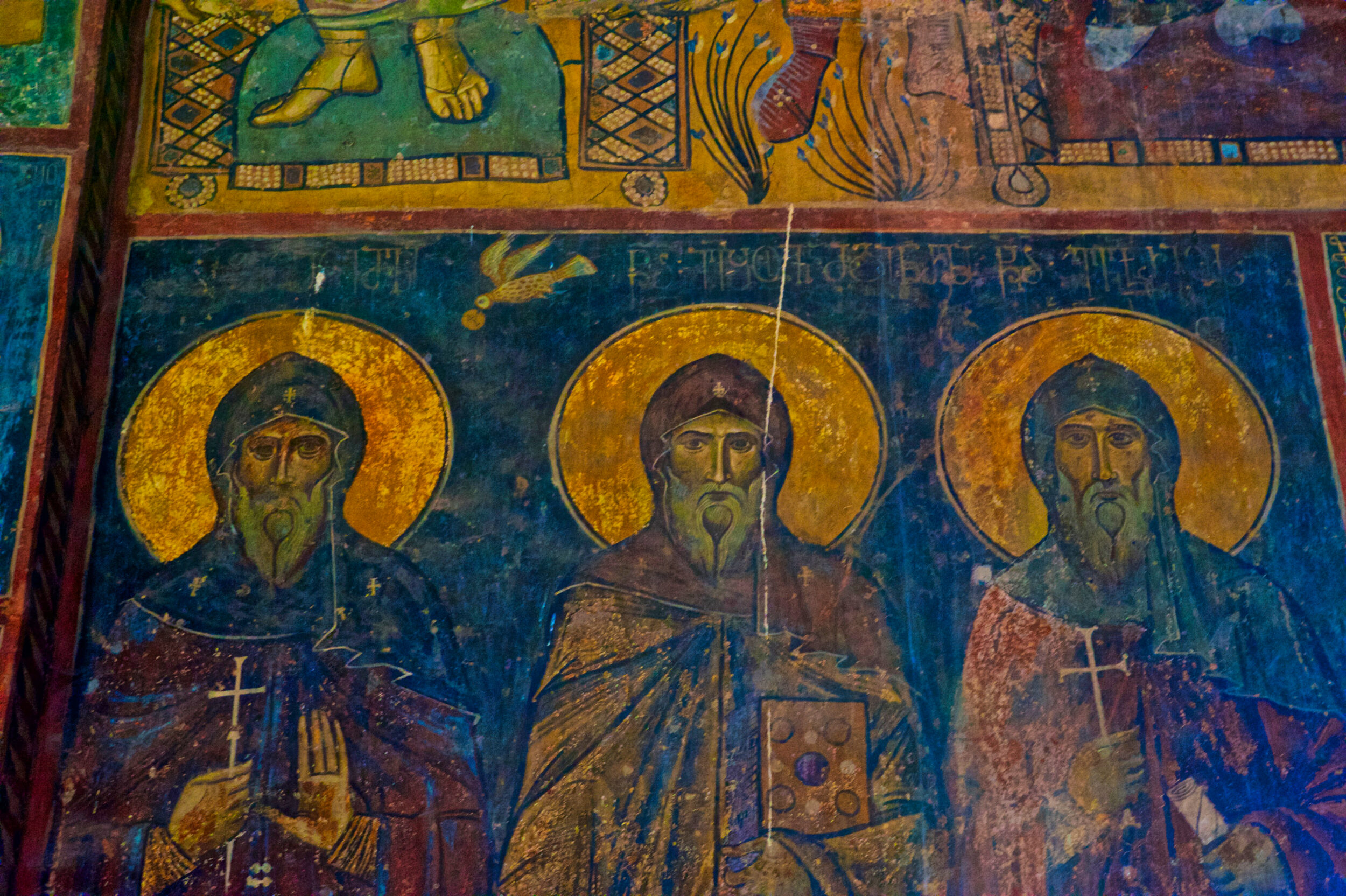
The interior murals are some of the finest examples of Byzantine art beyond the traditional borders of Byzantium. A majority of the murals carry inscriptions in Greek and were painted under the patronage of Armenian Atabek Ivane Zakarian between 1205 and 1216. Art historians have regularly drawn parallels between the Akhtala murals and the 11th century Armenian miniature paintings of the Mugni Gospels, suggesting that the latter drew inspiration from the former. The colouring of the murals is characteristic of Byzantine devotional art while the themes and motifs are Armenian. New and Old Testaments scenes and numerous saints including Saint Gregory the Illuminator are depicted and a badly damaged, if substantial image of the Holy Virgin holding Jesus survives in part in the collar of the dome. Beneath the Holy Virgin, the Communion has been illustrated with Jesus depicted twice, turning to his left and right, sharing bread with the Apostles, while portraits of the Apostles Peter, John the Evangelist, Paul and Matthew have survived. Saints are depicted below the Communion scene and include Pope Sylvester, Saint James the son of Alpheus, Saint John Chrysostom, Basil the Great, Gregory the Illuminator, Jacob of Mtsbin, Clement of Rome, Gregory the Thaumaturgist, Cyril of Alexandria and Eusebius of Caesarea. The mural cycle on the western wall depicts the glories of the Kingdom of Heaven, while the northern wall illustrates the trial of Jesus by the high priest Caiaphas and Pontius Pilate.
To learn more about the history of Akhtala, join our tour Crossroads of the Caucasus: Azerbaijan, Georgia & Armenia and explore the rich history of the Caucasus. Other stunningly located mountain monasteries with fresco paintings include the Gelati Monastery in Kutaisi (Georgia) and the Church of Dormition in the Cave Monastery of Vardzia (Georgia).
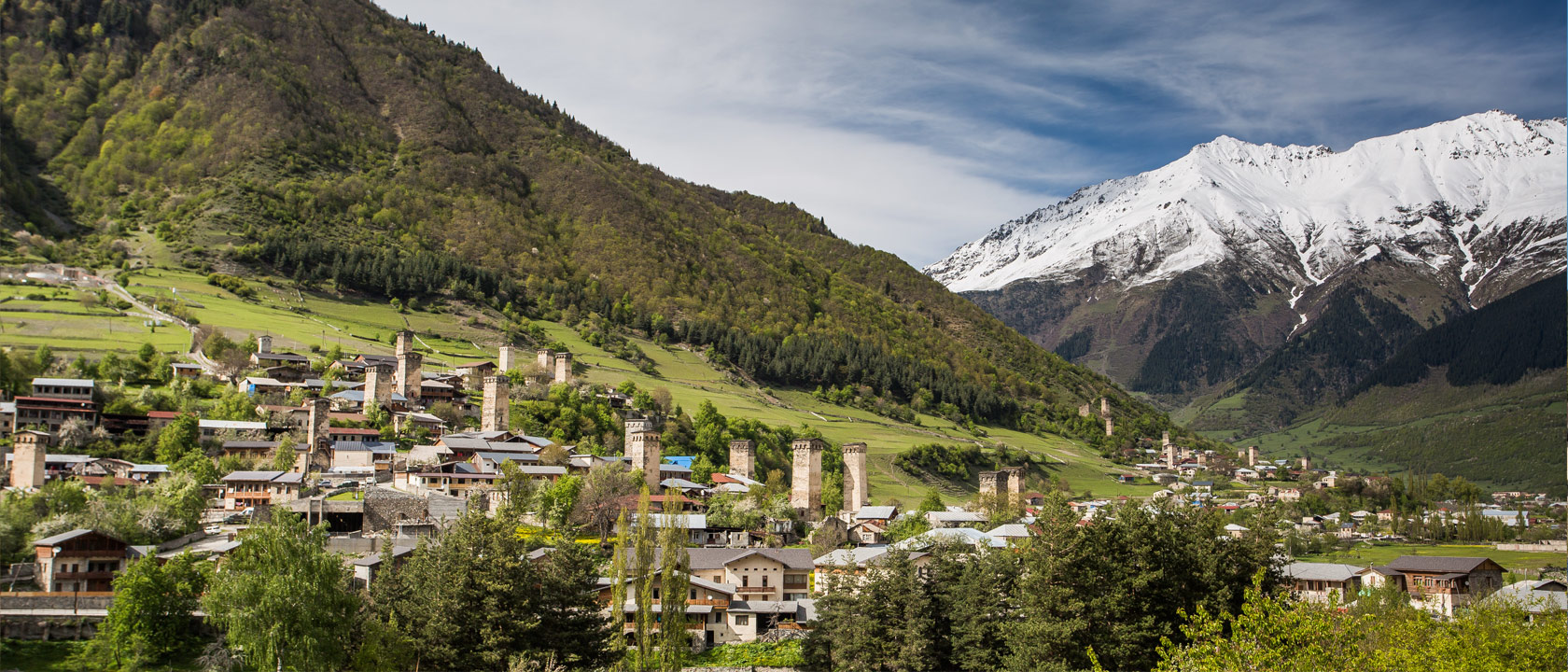 Crossroads of the Caucasus: Azerbaijan, Georgia & Armenia 2026
 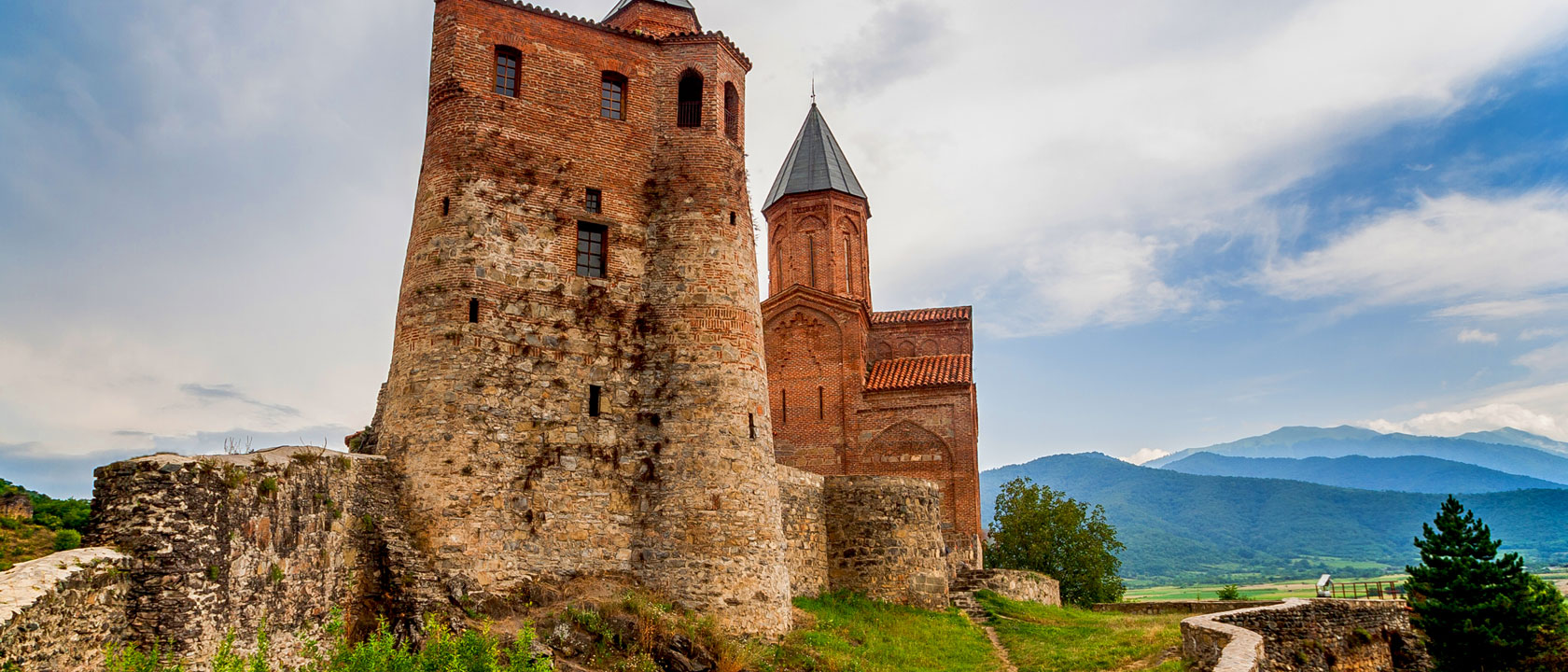 Crossroads of the Caucasus: Azerbaijan, Georgia & Armenia 2027