Art, History and Landscapes of Burgundy and Alsace 2027
Status: Places Available
30 Sep – 15 Oct 2027

Your leaders


Art, History and Landscapes of Burgundy and Alsace 2027
Tour Highlights
Join Véronique Duché, AR Chisholm Professor of French at the University of Melbourne, on a captivating journey through the diverse landscapes of eastern France, from the gentle slopes of Burgundy’s wine country to the Rhine-flanking foothills of the Vosges in Alsace, where centuries-old villages, historic routes, and rich cultural traditions await at every turn.
- Explore the remarkable archaeological remains of Lugdunum, ancient capital of the Three Gauls, showcased in the Gallo-Roman Museum and adjacent theatre and odeon, all part of Lyon’s UNESCO World Heritage–listed historic centre.
- Journey through Burgundy, a land of ancient Celtic heritage and exceptional wines, where rolling hills and forests frame a rich landscape dotted with medieval treasures such as Beaune and its famed Hôtel-Dieu, home to one of the greatest masterpieces of Flemish art – The Last Judgement by van der Weyden.
- Follow the Way of Saint James and marvel at the splendour of Romanesque art and architecture at the pilgrim churches and chapels of Vézelay, Fontenay, Autun, Berzé-la-Ville and Cluny.
- In the Morvan massif, learn about the sophisticated culture of the ancient Gauls at Bibracte, the capital city of the Aedui tribe, considered one of the most typical and best-preserved Gallic oppida (fortified towns).
- Experience masterpieces of art and architecture and explore iconic contemporary works, from Le Corbusier’s Notre-Dame du Haut to the exceptional collections of the Fondation Beyeler and the fine arts museums of Lyon, Dijon, and Strasbourg.
- Discover Alsace’s storybook villages nestled between the Vosges Mountains and the Rhine, where a unique Franco-German heritage shaped its distinctive architecture, cuisine, and language.
- Contemplate the finest treasures of the medieval and Renaissance periods at the Maison de l’Oeuvre Notre-Dame in Strasbourg, and witness the breathtaking Isenheim Altarpiece in Colmar, a masterpiece of religious art.
- Unravel a rich intellectual legacy and delve into the region’s past through extraordinary collections of medieval manuscripts at the Dominican Library in Colmar and the Humanist Library of Sélestat, including the 7th-century Merovingian Lectionary, the oldest preserved book in Alsace.
- In Lyon, the culinary capital of France, savour authentic Lyonnaise gastronomy in a traditional bouchon, and discover the hearty flavours of Alsatian cuisine in a winstub.
- Sample some of the finest wines France has to offer as you wander through the world-renowned vineyards of Burgundy and explore the charming Alsace Wine Route.
- Limited to 18 participants.
Overnight Lyon (2 nights) • Dijon (5 nights) • Colmar (4 nights) • Strasbourg (4 nights)
Itinerary
The following itinerary lists a range of museums, heritage properties and gardens etc. which we plan to visit. Many are accessible to the public, but some require special permission, which may only be confirmed closer to the tour’s departure. The daily activities described in this itinerary may change or be rotated and/or modified in order to accommodate alterations in opening hours and confirmation of private visits. Meals included in the tour price are indicated in the detailed itinerary where: B=breakfast, L=lunch and D=dinner.
Lyon - 2 nights
Day 1: Thursday 30 September, Lyon
- Tour commences at 1 pm in the foyer of the Hotel Mercure Lyon Centre Beaux Arts
- Lugdunum: Gallo-Roman Vestiges and Museum of Lyon Fourvière
- Basilica of Notre-Dame de Fourvière
- Introductory lecture
- Welcome dinner
Meeting Point: The tour commences at 1.00pm in the foyer of the Hotel Mercure Lyon Centre Beaux Arts, which is an 8-minute walk from Lyon Old Town
Today we explore Lyon’s rich past reflecting 2,000 years of history from the Roman hill of Fourvière to the medieval and Renaissance architecture of the Vieux (Old) Lyon. We take the funicular up the hill, to the very site where the Roman city of Lugdunum was founded in 43 BCE. The Romans recognised its strategic location at the convergence of two navigable rivers, and it quickly became the capital of the Gallia Lugdunensis province. Two Emperors were born in this city: Claudius (41-54 CE) and Caracalla (198-217 CE).
We visit Lugdunum – Museum and Roman Theatres, the perfect symbiosis of an archaeological site (theatre, Odeon, roman baths) that is part of a UNESCO World Heritage setting with unique architecture and exceptional collections. Highlights of the collection is the Table Claudienne (Lyon Tablet), discovered in 1528, which reproduces in bronze the speech that Emperor Claudius gave to support Gallic participation in the Senate in the year 48; and a collection of inscriptions, statue bases and epitaphs – one of the largest in France – representing an exceptional source for understanding the inhabitants and their activities.
Before heading back down to the Vieux Lyon, we view the Basilica of Notre-Dame de Fourvière, built between 1872 and 1896 where was once the Roman forum of Trajan, the forum vetus (old forum), from which the word ‘Fourvière’ is derived.
We return to our hotel via the Vieux Lyon area. In 1964, it became the first site in France to be protected under the Malraux law protecting France’s cultural sites. Covering an area of 424 hectares, it is one of Europe’s most extensive Renaissance neighbourhoods. In 1998, Vieux Lyon was inscribed on the UNESCO World Heritage List along with other districts in Lyon because of its historical importance and architecture.
After our introductory lecture, we enjoy dinner at one of Lyon’s traditional restaurants called bouchon. (Overnight Lyon) D
Day 2: Friday 1 October, Lyon
- Walking tour of La Croix Rousse area incl. Maison des Canuts and the traboules of Lyon
- Fine Arts Museum of Lyon
Lyon’s history as a silk-making centre began in the 15th century under King Louis XI, leading to its status as the world’s silk capital by the 18th century, driven by royal monopolies, innovation like the Jacquard loom, and skilled weavers called canuts. The industry saw significant growth but also faced crises, workers’ revolts, and eventual decline after World War I, though some craft traditions, like hand-painted silks, still persist today.
We begin our day with a visit of La Croix Rousse area. Perched on a hill, this historic district overlooks the city, providing a spectacular panoramic view over Lyon’s rooftops. It’s here that the history of the Canut silk weavers began. Today, this former working-class district neighbourhood is particularly popular with its lively atmosphere.
We walk back down to the Place des Terreaux using Lyon’s famous traboules, covered passageways originally used by silk manufacturers and other merchants to transport their products. The walking tour ends opposite the Fine Arts Museum and there is some time at leisure for lunch.
This afternoon we enjoy a guided tour of the Museum of Fine Arts of Lyon. Housed in a former Benedictine convent, the museum boasts one of the largest collections of European works of art (Veronese, Rubens, Rembrandt, Poussin, Géricault, Delacroix, Gauguin…). Its collections range from ancient Egyptian antiquities to the Modern art period, making the museum one of the most important in Europe. (Overnight Lyon) B
Dijon - 5 nights
Day 3: Saturday 2 October, Lyon – Berzé-la-Ville – Cluny – Dijon
- Chapelle des Moines and its exceptional 12th c. frescoes, Berzé-la-Ville
- Former Benedictine Abbey and Monastery of Cluny
- Village of Cluny
We depart Lyon this morning to make our way to Dijon, former capital of the Duchy of Burgundy and today’s prefecture. Burgundy became a significant centre for monastic development and reform in the Middle Ages, especially through the Benedictine Abbey of Cluny.
Our first visit today is the Chappelle des Moines in Berzé-la-Ville. The estate was acquired by the abbey of Cluny during the abbatiate of Hugues de Semur (1049-1109). The buildings and chapel were constructed around 1100, expressly for the abbot, who stayed there regularly. During his stays, he received important religious and lay guests, such as Pope Paschal II for Christmas 1106. Its decorations are a masterpiece of 12th-century mural painting and the only surviving example of Cluniac monumental painting; it is organised into four main levels with an imposing and dominant Christ in Majesty, likely a copy of a lost original from the Abbey of Cluny.
We then travel to the village of Cluny, centre of the most influential monastic network in European history, often considered the “Second Rome” during its heyday. We visit the abbey founded by Duke William I of Aquitaine in 910. The abbey was notable for its stricter adherence to the Rule of St. Benedict, and Cluny became the leader of western monasticism. Although it was the largest church in Christendom until the completion of St. Peter’s in Rome in the early 17th century, little remains of the original buildings. In total, the surviving parts amount to about 10% of the original floor space. These include the southern transept and its belltower, and the lower parts of the two west front towers. Seen as an example of the excesses of the Ancien Régime, the monastic buildings and most of the church were destroyed during the French Revolution. Its extensive library and archives were burned in 1793, and the church was given up to plundering. The abbey’s estate was sold in 1798. Over the following twenty years the Abbey’s immense walls were quarried for stone that was used in rebuilding the town.
After visiting the village of Cluny, we make our way to Dijon, our base for the next five nights. (Overnight Dijon) BL
Day 4: Sunday 3 October, Dijon
- Fine Arts Museum
- Palace of the Dukes of Burgundy
- Cathédrale Saint-Bénigne
- Afternoon at leisure
We begin our day with a visit to the Fine Arts Museum, founded in 1787 and one of the oldest museums of France. It is housed in the former Palace of the Dukes of Burgundy which was their headquarters in the 15th century. When the duchy was assimilated to the Kingdom of France in 1477, the palace became the house of the King. The museum is known for its collections in relation with the dukes, for the richness of its encyclopedic collections stretching from Egyptian art to the 20th century as well as the historical interest of the Palace that holds them.
Its highlight is the famous tombs of the Dukes of Burgundy, Philip the Bold and John the Fearless (assassinated in 1419 during the Hundred Years War), with their mourners; but the museum also holds a collection of Egyptian antiquities with a rare series of Fayum mummy portraits; works from the Renaissance, 17th and 18th centuries by Titian, Veronese, Brueghel the Elder, Georges de La Tour, Rubens; a section of modern art including Géricault, Boudin, Monet, Manet, Sisley and Braque; representative works of the school of Paris (1950-1970), with Charles Lapicque, Vieira da Silva and Nicolas de Staël.
We also visit the Cathedral dedicated to Saint-Bénigne, a Christian martyr from the 2nd century, considered the first herald of Christianity in Dijon. The former abbey church, built in the Burgundian Gothic style, boasts a magnificent Romanesque crypt, the underground remains of a three-storey rotunda. The cathedral, constructed between 1280 and 1325 and consecrated in 1393, is a listed national monument.
The afternoon is at leisure for you to further explore Dijon and its fascinating history and wonderful art de vivre. The historic city centre is listed as a UNESCO World Heritage Site, with a rich medieval architecture ranging from private mansions to Gothic-style churches. (Overnight Dijon) B
Day 5: Monday 4 October, Dijon – Vézelay – Montbard – Dijon
- Abbaye Sainte-Marie-Madeleine de Vézelay
- Lunch in the gardens of Abbaye de Fontenay
- Former Cistercian Abbaye de Fontenay
This morning, we drive to the Yonne département to visit the Abbaye Sainte-Marie-Madeleine in Vézelay. Built between 1120 and 1150, it is one of the great masterpieces of Burgundian Romanesque art and architecture. After surviving Moorish and Norman raids in the 8-9th centuries, it was revived under the guidance of the order of Cluny. Standing at the beginning of the Via Lemovicensis, one of the four major routes through France to Santiago de Compostela, it became an important place of pilgrimage. Around 1050, the monks of Vézelay began to claim to hold the relics of Mary Magdalene translated to their abbey from the Holy Land, though the actual claimed relics were torched by Huguenots in the 16th century.
The abbey also holds a special place in the history of the Crusades; Saint Bernard of Clairvaux preached there in favour of a second crusade at Easter 1146, in front of King Louis VII and his wife Aliénor of Aquitaine; Richard the Lionheart and Philippe II of France spent three months at the Abbey in 1190 before leaving for the Third Crusade; Thomas Becket, in exile, chose Vézelay for his Whitsunday sermon in 1166, threatening the English King Henry II with excommunication. Its decline coincided with the well-publicised ‘discovery’ of the body of Mary Magdalene in Provence in 1279. The church and hill at Vézelay were added to the UNESCO list of World Heritage Sites in 1979 due to their importance in medieval Christianity and outstanding architecture.
Next, we drive to Montbard to visit the Abbaye of Fontenay, another UNESCO World Heritage Site and gem of Romanesque architecture. On arrival, we enjoy lunch in the gardens of the abbey. Founded in 1118 by Saint Bernard, it is a unique witness to the golden age of monasticism. With its church, cloister, refectory, sleeping quarters, bakery and ironworks, it is an excellent illustration of the ideal of self-sufficiency as practised by the earliest communities of Cistercian monks. The church was built between 1139 and 1147, and was consecrated in 1147 by Pope Eugene III, a Cistercian and former disciple of St Bernard. This form of Romanesque Cistercian church is of great simplicity and strict modesty with its basilic design in the form of a Latin cross, its blind nave, and transept devoid of a tower. The perfection of the proportions, the rigour of the wall openings and the science of the vaultings, the beauty of the wall masonry constitute the value of this architecture. The cloister and the chapter house have remained intact and were inspired from the same principles. Within its enclosing wall, the Abbey still retains other communal buildings: monks’ day room and dormitory, warming room, refectory, guest house, bakery and iron works. This last building, dating to the end of the 12th century, recalls the part played by the Cistercians in the technological progress of the Middle Ages, and is one of the oldest industrial buildings in France. (Overnight Dijon) BL
Day 6: Tuesday 5 October, Dijon – Beaune – Nuits-Saint-Georges – Dijon
- Hôtel-Dieu Museum – Hospices de Beaune
- Château du Clos de Vougeot: guided tour of the château & wine tasting
This morning, we drive south to Beaune to visit the Hospices de Beaune (or Hôtel-Dieu de Beaune), a former hospital founded in 1443 by Nicolas Rolin, chancellor of Burgundy, as a charitable almshouse for the poor and sick. The original hospital building is one of the finest examples of 15th-century Burgundian architecture, a Gothic-style building with a distinctive glazed-tile roof that now serves as a museum.
Next, we explore the nearby vineyards of the Côte de Nuits appellation at the Clos de Vougeot. Created by Cistercian monks from the 12th century to the early 14th century, the vineyard was completed in 1336, with a wall built around it. It served as the flagship vineyard of the Cistercians and has been a highly recognised name for centuries. The château, situated inside the wall, was added in 1551 by rebuilding and enlarging a small chapel and some other buildings previously existing at the site. From 1945, it has served as headquarters of the Confrérie des Chevaliers du Tastevin. We shall enjoy a guided tour of the château followed by a wine tasting. (Overnight Dijon) BL
Day 7: Wednesday 6 October, Dijon – Parc Naturel Regional du Morvan – Autun – Dijon
- Gallic Oppidum of Bibracte
- Museum of Bibracte
- Cathédrale Saint-Lazare, Autun
This morning, we drive west to the Morvan area, and our first visit is to the important Gallic site of Bibracte. This oppidum was the capital of the Aedui tribe and one of the most important hillforts in Gaul. Bibracte is mentioned twice in Roman sources; in Julius Caesar’s Commentaries on the Gallic War in the year 58 BCE, and again in 52 BCE, when the Aedui joined (timidly) the revolt and proclaimed Vercingetorix head of the Gallic coalition. After the Roman conquest, the site was abandoned in favour of Autun, and it remained undisturbed and unexamined until the excavations of the late 19th century. Before the Roman conquest in 52 BCE the great celtic city of Bibracte had more than 30,000 inhabitants, protected by a huge stone wall of the Murus Gallicus type. The modern site, known as Mont Beuvray, is an archaeological park at the centre of a protected forest. It is the focus of cooperative European archaeological efforts, a training ground for young archaeologists, and a centre for interpreting Gallic culture. We shall visit the archaeological site and the Museum of Celtic Civilisation.
We then drive to Autun, founded by Augustus as Augustodunum to give a new Roman capital to the Aedui, who previously had Bibracte as their political centre. We visit the Cathedral of Saint Lazarus of Autun, built in the mid-11th century and considered a masterpiece of the French Romanesque of Cluniac inspiration. The Bishop of Autun set forth the construction as a result of the large movement of pilgrims coming to venerate the relics of the saint and travelling to Vezelay as they progressed on the way to Santiago de Compostela. The sculptures by Gislebertus successfully integrate biblical iconography relating to the New and Old Testament with ease and amazing artistic ability. The size and quality of the tympanum of the Last Judgment, and the lintel of the Temptation of Eve are impressive and exquisitely detailed pieces of art. (Overnight Dijon) BL
Colmar - 4 nights
Day 8: Thursday 7 October, Dijon – Ronchamp – Colmar
- Coffee break in Vesoul
- Lunch in the Pilgrim’s Shelter at Notre-Dame du Haut, Ronchamp
- Chapel of Notre-Dame du Haut designed by Le Corbusier, Ronchamp
This morning, we leave Burgundy and make our way East to the region of Alsace. After a coffee break in the lovely town of Vesoul, we reach Ronchamp to visit one of the finest works of Franco-Swiss architect Le Corbusier.
On arrival, we enjoy lunch in the Pilgrim’s Shelter. This is the first building by Le Corbusier on the site. This long house consists of two dormitories, a dining hall, a kitchen and a small apartment for the person in charge. Raw concrete is painted in bright colours by Le Corbusier. The roof gardens are original; by insulating the concrete from bad weather, they help to preserve it. The shelter was first meant for the workers who were building the chapel. Later it was used by the pilgrims who flocked to Notre-Dame du Haut.
After lunch we visit the chapel Notre-Dame du Haut. Built in 1955, it is commonly thought of as a more extreme design of Le Corbusier’s late style. The chapel is a simple design with two entrances, a main altar, and three chapels beneath towers. Although the building is small, it is powerful and complex. In 2016, it was inscribed on the UNESCO World Heritage List in along with sixteen other works by Le Corbusier, because of its importance to the development of modernist architecture.
Following our visit, we continue our journey to reach Alsace and the city of Colmar, our base for the next four nights. (Overnight Colmar) BL
Day 9: Friday 8 October, Colmar
- Walking tour of Colmar
- La Petite Venise area, Colmar
- Musée Unterlinden and its Isenheim Altarpiece
- Dominican Library and its medieval collection of manuscripts
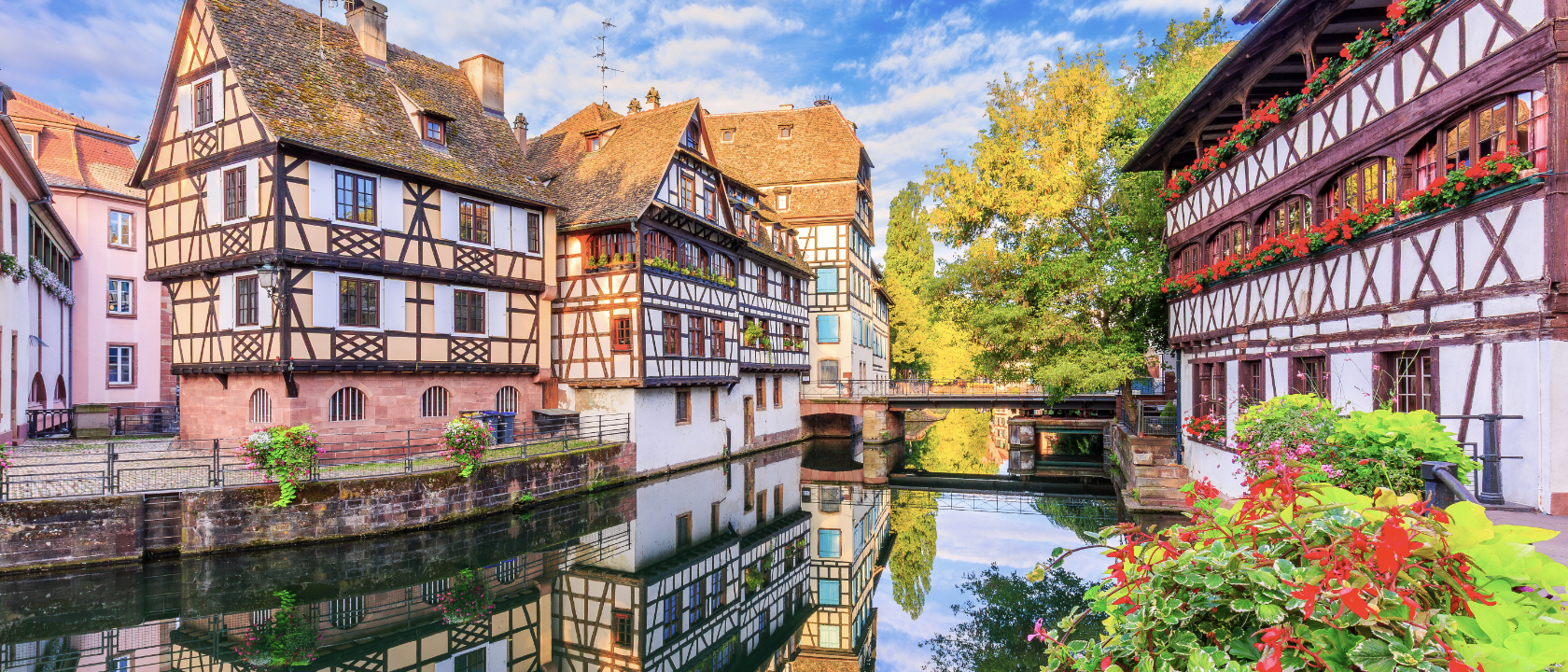
Today we begin with a walking tour of Colmar, known for its well-preserved medieval old town, picturesque canals, and unique blend of German and French architectural styles. We visit the « Petite Venise » district, a name given to the course of the Lauch River. The district was developed during the Middle Ages and was once inhabited by fishermen, boatmen and market gardeners. Most of its quaint, half-timbered houses were built between the 14th and 18th centuries. With its charming, flower-bedecked hotels, restaurants, winstubs, patisseries and shops, Little Venice is one of the best-preserved medieval districts of Colmar and Alsace.
We then visit the Musée Unterlinden and its famous Isenheim Altarpiece. This museum of fine arts covers 7000 years of history from prehistory to 20th century art. Formerly a 13th century convent, it houses collections of ancient art including the restored Isenheim Altarpiece (1512-1516), regarded as a masterpiece of religious art. An underground gallery gives access to the contemporary part where works by major artists such as Monet, Picasso, de Staël, Matthieu, Dubuffet, Dix, Soulages, and more recently Yan Pei Ming are exhibited.
After lunch at leisure in Colmar, we visit the Library of the Dominicans, a cultural gem housed in a beautifully renovated 14th-century convent and the depository of a collection of documents of immense historical value. It houses the second largest collection of incunabula in France (2300 printed works dating from the beginning of the printing press, before the year 1500). Among the most noteworthy works is a copy of the Bible by the printer Johannes Mentel from 1460, thus one of the first books printed in Europe. The library also holds a collection of 1,800 manuscripts, the oldest dating back to the 8th century; there are also 35,000 books from the 16th to the 18th centuries, 21,000 prints and old drawings, and 40,000 “Alsatian” documents. Visitors can explore original documents showcasing the evolution of writing and cartography through the centuries. (Overnight Colmar) B
Day 10: Saturday 9 October, Colmar – Ribeauvillé – Hunawihr – Riquewihr – Colmar
- Village of Ribeauvillé and its Saturday market
- Village of Hunawihr and its Fortified Church
- Lunch in an Alsatian restaurant in Riquewihr
- Afternoon at leisure in Colmar
This morning, we follow the Alsace Wine Route and its quaint villages, sprawling landscapes, and hilly vineyards, which have been in existence since the Middle Ages, that make up the Alsace wine region.
Our first stop is the beautiful village of Ribeauvillé and its Saturday market. The town and neighbouring hills are dominated by the majestic ruins of the Three Castles of the Lords of Ribeaupierre. The Grand-Rue and its picturesque neighbouring streets, lined with 15th- to 18th-century buildings, are scattered with Renaissance fountain-decorated squares. Many buildings are worth a visit, including the Town Hall with its prestigious collection of silver drinking-cups, the Butchers’ Tower (13th century), the former Corn Exchange, the House of the Fiddlers, etc.
Next, we break in the nearby village of Hunawihr, founded in the 7th century. The pilgrimage of Sainte Hune, patron saint of washerwomen canonized in 1520, developed around the fountain situated at the foot of the village, the tradition claiming that she came there to wash the clothes of the poor. Overlooking the village, stands the 15-16th century Church of St Jacques le Majeur (James the Greater), surrounded by a fortified cemetery, which also served as a keep where the inhabitants could take refuge in case of attack. This wine-producing village is composed of well-established winegrowers’ houses, with little narrow courtyards opening onto the street, dating mostly from the 16th- 18th centuries.
Our last stop this morning is the town of Riquewihr. For centuries this magnificent town has managed to combine the quality of its architecture with the quality of its wines, from where it gets its nickname «The Gem of the Alsace Vineyards». Riquewihr has preserved its authentic character behind its city walls, which are now besieged only by the vines. The Alsatian house type reaches in Riquewihr its most accomplished expression in offering all the possible declinations of sculpted half-timbering, oriel windows, inner courtyards embellished by old wells and fountains. We’ll have lunch in Riquewihr and sample some of the best wines Alsace has to offer!
After lunch, we return to Colmar for an afternoon at leisure. (Overnight Colmar) BL
Day 11: Sunday 10 October, Colmar – Riehren – Basel – Colmar
- Fondation Beyeler modern & contemporary art collection
- Walking tour of Old Basel incl. Basel Minster
Today we cross the border into Switzerland and reach the region of Basel. Our first visit is to explore the collection of the Fondation Beyeler. Art dealers Ernst and Hildy Beyeler made all the paintings and sculptures of their world-famous art collection accessible to the public in 1997. Today, it comprises more than 400 works of classic modernism from Claude Monet, Paul Cézanne and Vincent van Gogh to Pablo Picasso, Andy Warhol, Roy Lichtenstein and Francis Bacon. The collection is expanding, particularly in terms of works made after 1950 (recent acquisitions include pieces by Louise Bourgeois, Wolfgang Tillmans, and Gerhard Richter). In 2013, French art collector Micheline Renard donated several artworks to the museum, including by Jean Dubuffet, Jean-Michel Basquiat, Sam Francis, and Sigmar Polke. The garden surrounding the museum also periodically serves as a venue for special exhibitions. In a work called “Wrapped Trees”, Christo and Jeanne-Claude veiled 178 trees in the park around the Fondation between November and December 1998.
We then drive to Basel where lunch is at leisure. After our midday break, we take a walking guided tour of the historic centre of Basel including the medieval city gate Spalentor and Basel’s glorious Cathedral, the most famous landmark of the city, built on a hill overlooking the Rhine, with its red sandstone walls, colourful roof tiles and twin towers.
Following our Helvetic getaway, we drive back to Colmar and reach our hotel in the late afternoon. (Overnight Colmar) B
Strasbourg - 4 nights
Day 12: Monday 11 October, Colmar – Neuf-Brisach – Ottrott – Strasbourg
- Fortified town of Neuf-Brisach, Citadel of the Sun King
- 7th century Abbaye of Mont Saint-Odile, Ottrott
We drive towards the German border this morning to visit Neuf-Brisach, the Citadel of the Sun King founded in 1699 at Louis XIV’s behest. Today, it is considered as the masterpiece of Vauban (1633-1707), one of the most important military engineers in European history. Its architecture is unique in Europe, and the Citadel is listed as part of the World Heritage by UNESCO. Its parade ground, pure lines, 48 quarters forming a perfect octagon and bastion fortifications make it unique in its kind. The fortified town was intended to guard the border between France and the Holy Roman Empire and, subsequently, the German states.
We retrace our steps crossing the Plain of Alsace to reach Ottrott and the Abbaye of Mont Saint-Odile. This former nunnery is a major pilgrimage site and former convent dedicated to St. Odile, patron saint of the region. Located in the Vosges mountains and founded c. 690 by the Duke of Alsace for his daughter Odile, who was its first abbess, it is a sanctuary with a rich history, featuring the tomb of St. Odile, multiple chapels, and panoramic views from its terrace overlooking the plain of Alsace. One noteworthy tradition of the abbey is the production of unicorn images; illustrations of unicorn hunts were particular to female orders. Returning to Strasbourg, the evening is at leisure. (Overnight Strasbourg) BL
Day 13: Tuesday 12 October, Strasbourg – Orschwiller – Sélestat – Erstein – Strasbourg
- Château du Haut-Koenigsbourg, Orschwiller
- Sélestat Humanist Library and its collection of Carolingian Manuscripts
- Musée Würth France Erstein
Situated in a strategic area on a rocky spur overlooking the Upper Rhine Plain, the Château du Haut-Koenigsbourg was used by successive powers from the Middle Ages until the Thirty Years’ War (1618-1648) when it was abandoned. First mentioned in a 774-deed issued by Charlemagne, it became a monastery under the patronage of the Basilica of St Denis in the 9th century. It is not known when the first castle was built. However, a Burg Staufen (Castrum Estufin) is documented in 1147, when the monks complained to King Louis VII of France about its unlawful construction by the Hohenstaufen Duke Frederick II of Swabia. His son Frederick Barbarossa was the first of the Hohenstaufen to become Emperor in 1155 and, by 1192, the castle was called Kinzburg (Königsburg, “King’s Castle”). The castle was rebuilt with a new defensive system at the end of the 15th century. It was besieged by Protestant Swedish forces in 1633 during the Thirty Years’ War and was burned and looted after a 52-day siege. For several hundred years it was left unused, and the ruins became overgrown by the forest. Various romantic poets and artists were inspired by the castle during this time. From 1900 to 1908 it was rebuilt at the behest of the German kaiser Wilhelm II. After World War I, the French state confiscated the castle in accordance with the 1919 Treaty of Versailles.
Nearby is the city of Sélestat where we stop to visit its Humanist Library, one of the most important cultural treasures of Alsace. There are two Renaissance humanist libraries involved, the library of the Humanist School, founded in the mid-15th century, and the private library of the scholar, Beatus Rhenanus (1485-1547). German humanist, religious reformer, classical scholar, and book collector, he bequeathed his entire private library to his home city. This library contained about 670 bound leather volumes at the time of his death in 1547, which Rhenanus had collected during his studies and his work. The library is of inestimable value, since books were only published in small numbers of copies and were extremely expensive. It is the only larger Humanist library preserved virtually intact and its was inscribed in the UNESCO’s Memory of the World International Register in 2011.
On our way back to Strasbourg we visit the Museum Würth France Erstein. Opened in 2008, the museum houses some of the 16,000 works from the personal collection of industrialist Reinhold Würth, one of the most important corporate collections of modern and contemporary art in Europe. The museum brings together masterpieces of German expressionism and surrealism, significant sets of geometric abstraction and neo-figurative paintings of the 1980s, paintings, drawings, engravings and sculptures from Pablo Picasso to Gerhard Richter, including René Magritte, Edvard Munch Max Beckmann, Christo, Max Ernst, Georg Baselitz and Anselm Kiefer. (Overnight Strasbourg) B
Day 14: Wednesday 13 October, Strasbourg
- Walking tour of the Historic Strasbourg incl. La Petite France
- Astronomical Clock at the Cathedral
- Cathédrale Notre-Dame-de-Strasbourg
- Maison de l’Oeuvre Notre-Dame, one of the finest collections of medieval and Renaissance art in Europe
Strasbourg is the capital city of Alsace and the formal seat of the European Parliament. It sits near the German border, with culture and architecture blending German and French influences. We begin the day with a walking tour of its historic centre and La Petite France area. This is the most picturesque district of old Strasbourg. At Petite France, the river Ill splits up into a number of channels that cascade through an area that was home to the city’s tanners, millers and fishermen who once lived and worked in this part of town where the streets have been built level with the waterways. The Ill River breaks up at the Ponts Couverts (Covered Bridges). The bridge and its three high, austere, massive guard towers, vestiges of the medieval wall, are truly awe-inspiring. Alongside the Covered Bridges, the Vauban Dam and its thirteen arches, built during the reign of Louis XIV, was meant to reinforce the defensive wall of the city. When the dam was completely sealed, the Ill River couldn’t flow in its bed, thereby flooding all of the land south of Strasbourg. The enemy armies would get bogged down. The magnificent half-timbered houses date from the 16th and 17th centuries. Their sloping roofs open out onto lofts where hides were once dried. Petite France forms part of the UNESCO World Heritage Site of Grande Île, designated in 1988.
The Cathédrale Notre-Dame-de-Strasbourg is an outstanding masterpiece of Gothic art. The construction of the Romanesque cathedral, of which only the crypt and the footprint remain, began in 1015. The spire of the current building, in a Gothic style, was completed in 1439. Described as “a skilful combination of monumental size and delicateness” by Victor Hugo, its facade offers a fantastic wealth of ornamental features. The 142 m spire is a masterpiece of architectural elegance and intricacy. Up until the 19th century, the cathedral was the highest building in the whole of the Christian world. Viewed from the outside, the cathedral’s facade provides one of the finest picture books of the Middle Ages that you will ever see. The hundreds of sculptures which almost seem to leap out at you from the wall make great use of light and shadow effects. Its Renaissance astronomical clock, (the mechanism of which dates from 1842) is a masterpiece, and visitors can admire a parade by the apostles every day at half past noon.
Next, we visit the Musée de l’Œuvre Notre-Dame hosting one of the finest collections of medieval and Renaissance art in Europe. The museum occupies the house called Frauenhaus, the historic headquarters of the Foundation of the Work of Our Lady, responsible for the construction and restoration of Strasbourg Cathedral. The rich collections bear witness to the glorious past of the city, which was one of the most important art centres of the German Empire from the 13th to the 16th century. The masterpieces of statuary art from Strasbourg Cathedral are on display here alongside the finest testimonies to Upper Rhine art of the 15th and 16th centuries with original sculptures, glass windows, architectural fragments, as well as the building plans of Strasbourg Cathedral. It has a considerable collection of works by Peter Hemmel von Andlau, Niclas Gerhaert van Leyden, Nikolaus Hagenauer, Ivo Strigel, Konrad Witz, Hans Baldung and Sebastian Stoskopff. Be sure to see the 12th-century Tête de Christ (also known as the Christ de Wissembourg), one of the oldest known stained-glass windows. (Overnight Strasbourg) B
Day 15: Thursday 14 October, Strasbourg
- Palais Rohan: Fine Arts Museum
- Afternoon at leisure
- Farewell dinner in a traditional Winstub
This morning we visit the Palais Rohan, former residence of the prince-bishops and cardinals of the House of Rohan, an ancient French noble family originally from Brittany. It is a major architectural, historical, and cultural landmark in the city. Built next to Strasbourg Cathedral in the 1730s, it is considered a masterpiece of French Baroque architecture. Since its completion in 1742, the palace has hosted a number of French monarchs such as Louis XV, Marie Antoinette, Napoleon and Joséphine, and Charles X. Located on the first floor of the Rohan Palace, the Musée des Beaux-Arts (Museum of Fine Arts) has an excellent collection of paintings by Italian, Spanish, Flemish, Dutch, and French masters from the Middle Ages to modern times. There are works by Botticelli, Corot, Courbet, Delacroix, Giotto, Goya, El Greco, Rubens, Tiepolo, and Veronese among others.
This magnificent Baroque palace also houses the archaeological museum, with an important collection tracing the history of Strasbourg and Alsace, from the earliest beginnings of Prehistory to the first centuries of the Middle Ages, and Museum of Decorative Arts with the opulent state rooms and appartements of the prince-bishops. There will be time for you to explore at your leisure.
The afternoon is at leisure for you to explore Strasbourg further. We reconvene in the evening for our farewell dinner at a local winstub, a traditional Alsatian restaurant that serves local cuisine and regional wines in a rustic, friendly atmosphere. (Overnight Strasbourg) BD
Day 16: Friday 15 October, Strasbourg
- Tour Ends
Our tour ends in Strasbourg after breakfast. In the morning you will be required to check out of the hotel. Please contact ASA if you require assistance with a transfer to Strasbourg airport or the closest international airport. B
Accommodation
ASA has selected 4-star hotels that are themselves historical buildings and/or are located in historical centres. All hotels provide rooms with en suite bathroom.
- Lyon (3 nights): Hôtel Mercure Lyon Centre Beaux Arts
- Dijon (5 nights): Hostellerie du Chapeau Rouge
- Colmar (4 night): Hôtel Le Colombier
- Strasbourg (4 nights): Hôtel Cour du Corbeau
Note: Hotels are subject to change, in which case a hotel of similar standard will be provided.
Single Supplement
Payment of this supplement will ensure accommodation in a single occupancy throughout the tour. In all hotels on this tour, this will be a double/twin room for single occupancy. The number of rooms available for single use is extremely limited. People wishing to take this supplement are therefore advised to book well in advance.
How to Book
ASA RESERVATION APPLICATION FORM
Please complete the ASA RESERVATION APPLICATION and send it to Australians Studying Abroad together with your non-refundable deposit of AUD $1000.00 per person payable to Australians Studying Abroad.
Practical Information
Fitness Criteria
Level 2 INTERMEDIATE
For people with energetic lifestyles and very good mobilityYou must be able to:
- manage at least five to six hours of physical activity per day with ease.
- walk at a regular to moderate pace on flat or undulating terrain.
- negotiate challenging historic sites with several flights of stairs (e.g. Château du Haut-Koenigsbourg).
- negotiate archaeological sites which may include uneven terrain and wet surfaces.
- stand for one to two hours during visits to galleries and museums without the need to sit.
- manage your own luggage at some hotels.
Fitness Levels
Please also view the fitness criteria required for our tours, graded from Level 1 to Level 3, at www.asatours.com.au/fitness-level/
All ASA tours are active programs suitable for people with a good level of mental and physical fitness and good mobility. They are not suitable for people who lack stamina, have difficulty walking at the group’s pace or who have mobility issues. An unavoidable aspect of every tour is the need to manage walking, stair-climbing and standing for long periods of time.
It is a condition of travel that all participants agree to accept ASA’s directions in relation to their suitability to participate in activities undertaken on the tour, and that ASA retains the sole discretion to direct a tour participant to refrain from a particular activity on part of the tour. Before enrolling on an ASA tour please read the fitness requirements carefully.
Tour Price & Inclusions
AUD $13,980.00 Land Content Only – Early-Bird Special: Book before 30 September 2026
AUD $14,380.00 Land Content Only
AUD $2490.00 Single Supplement
Tour Price (Land Content Only) includes:
- Accommodation in twin-share rooms with private facilities in 4-star hotels
- Meals as indicated in the tour itinerary, where: B=breakfast, L=lunch & D=dinner
- Drinks at welcome and farewell meals. Other meals may not have drinks included.
- Transportation by air-conditioned coach
- Porterage of one piece of luggage per person at hotels where available (not at airports)
- Lecture and site-visit program
- Entrance fees
- Use of audio headsets during site visits
- Tips for the coach driver, local guides and restaurants for included meals
Tour Price (Land Content Only) does not include:
- Airfare: Australia-Lyon, Strasbourg-Australia
- Personal spending money
- Airport-hotel transfers
- Luggage in excess of 20kg (44lbs)
- Travel insurance
Tour Map
Gallery
Deposits
A non-refundable deposit of $1000.00 AUD per person is required to reserve a place on this ASA tour.
Cancellation Fees
If you decide to cancel your booking the following charges apply:
- More than 75 days before departure: your initial deposit of $1000.00 is non-refundable.**
- 75-31 days prior 50% of total amount due
- 30-0 days prior 100% of total amount due
**$500.00 of this amount (ie 50% of your deposit) may be credited to another ASA tour departing within 12 months of the original tour you booked. We regret, in this case early-bird discounts will not apply.
We take the day on which you cancel as being that on which we receive written confirmation of cancellation.
Unused Portions of the Tour
We regret that refunds will not be given for any unused portions of the tour, such as meals, entry fees, accommodation, flights or transfers.
Will the Tour Price or Itinerary Change?
If the number of participants on a tour is significantly less than budgeted, or if there is a significant change in exchange rates ASA reserves the right to amend the advertised price. We shall, however, do all in our power to maintain the published price. If an ASA tour is forced to cancel you will get a full refund of all tour monies paid. Occasionally circumstances beyond the control of ASA make it necessary to change airline, hotel or to make amendments to daily itineraries. We will inform you of any changes in due course.
Travel Insurance
ASA requires all participants to obtain comprehensive travel insurance. A copy of your travel insurance certificate and the reverse charge emergency contact phone number must be received by ASA no later than 75 days prior to the commencement of the tour.
Final Payment
The balance of the tour price will be due 75 days prior to the tour commencement date.
Limitation of Liability
ASA is not a carrier, event or tourist attraction host, accommodation or dining service provider. All bookings made and tickets or coupons issued by ASA for transport, event, accommodation, dining and the like are issued as an agent for various service providers and are subject to the terms and conditions and limitations of liability imposed by each service provider. ASA is not responsible for their products or services. If a service provider does not deliver the product or service for which you have contracted, your remedy lies with the service provider, not ASA. ASA will not be liable for any claim (eg. sickness, injury, death, damage or loss) arising from any change, delay, detention, breakdown, cancellation, failure, accident, act, omission or negligence of any such service provider however caused (contingencies). You must take out adequate travel insurance against such contingencies. ASA’s liability in respect of any tour will be limited to the refund of amounts received from you less all non-refundable costs and charges and the costs of any substituted event or alternate services provided. The terms and conditions of the relevant service provider from time to time comprise the sole agreement between you and that service provider. ASA reserves the sole discretion to cancel any tour or to modify itineraries in any way it considers appropriate. Tour costs may be revised, subject to unexpected price increases or exchange rate fluctuations.
Interested in this tour?
Take the next step
or alternatively Download PDF Reservation Application