Cultural Landscapes of Northern Spain: from the Basque Country to Galicia 2027
Status: Places Available
1 Sep – 19 Sep 2027


Your leaders


Cultural Landscapes of Northern Spain: from the Basque Country to Galicia 2027
Tour Highlights
Archaeologist and historian, Dr Christopher A. Tuttle and author and art curator, Anneli Bojstad, introduce the diverse cultural landscapes of Northern Spain.
- Explore some of the world’s finest Upper Palaeolithic Art (35,000 to 11,000 BCE) in the caves of El Pendo and Tito Bustillo; we also view the facsimile of Altamira.
- Tour UNESCO World Heritage-listed Atapuerca: one of the richest and most important group of archaeo-palaeontological sites in the world, containing fossil remains of the earliest humans discovered in Europe dating from over one million years ago.
- Journey through the Navaresse Pyrenees to enjoy the autumn colour of the Irati Beech-Fir Forest; view Spain’s largest colony of griffon vultures at the Foz de Arbayún; and admire the dramatic Picos de Europa with its lofty peaks, jagged pinnacles and glacial lakes.
- Enjoy a walk atop the 3rd-century Roman walls of Lugo – the finest remaining in Western Europe; and view the fine 4th-century floor mosaics of Villa Romana de la Olmeda.
- View the great Pre-Romanesque art and architecture of Oviedo and the Kingdom of the Asturias.
- Journey sections of the Camino Francés from Puente la Reina to Santiago de Compostela, the reputed burial-place of the apostle James, and the terminus of the Way of St James. Visit great pilgrim churches as well as a myriad other, smaller monuments including shrines, hermitages and monasteries, pilgrim towns and their hospices and inns, bridges, pilgrim crosses and museums.
- In Bilbao and Oviedo view fine art collections with works by famed Spanish artists including Murillo, Zurbarán, El Greco and Goya.
- Explore some of the best Basque avant-garde art and architecture at the Sanctuary of Our Lady of Arantzazu; tour the flamboyant Capricho de Gaudí in Comillas; and study Gehry’s extraordinary titanium-clad Guggenheim Museum Bilbao.
- Explore some of the ‘most beautiful villages of Spain’ including the mountain village of Ochagavía, the medieval hilltop town of Ujué, the half-timbered village of Covarrubias, and the coastal fishing village of Cudillero.
- In Villanueva de Pría visit a private residence, where the owners will host us for lunch and give us a tour of their magnificent gardens. We also enjoy lunch in a private palace in Elorrio.
- Journey through the UNESCO listed Rioja Alavesa Vine and Wine Cultural Landscape; enjoy wine tasting at Bodega Ysios designed by Santiago Calatrava.
- Enjoy the diverse gastronomy of Northern Spain including: pintxos in the Basque Country; Asturian bean stew, Galicia’s excellent seafood, and Navarra’s renowned fresh, high-quality ingredients.
- Limited to 18 participants
Overnight Bilbao (1 night) • San Sebastián (2 nights) • Pamplona (3 nights) • Burgos (3 nights) • Santillana del Mar (3 nights) • Oviedo (3 nights) • León (2 nights) • Santiago de Compostela (2 nights)
Itinerary
Draft Itinerary currently under preparation
The following itinerary describes a range of sites which we plan to include. Some are accessible to the public, but others require special permission which may only be confirmed closer to the tour’s departure. The daily activities described in this itinerary may change or be rotated and/or modified in order to accommodate alterations in opening hours and confirmation of private visits. Participants will receive a final itinerary together with their tour documents prior to departure. The tour includes breakfast daily, lunches & dinners indicated in the detailed itinerary where: B=breakfast, L=lunch and D=dinner.
Bilbao – 1 night
Day 1: Wednesday 1 September, Arrive Bilbao
- Tour commences at 10am in the foyer of the hotel
- Welcome Meeting
- Guggenheim Museum Bilbao
- Museo de Bellas Artes
- Welcome Dinner at a local restaurant
Meeting Point: The tour commences at 10am in the foyer of the hotel.
Following a short meeting, we commence our tour of Bilbao with a visit to Gehry’s extraordinary titanium-clad Guggenheim Museum, whose design took inspiration from the city’s long maritime history.
Nearby we also visit the Museo de Bellas Artes whose fine collection includes works by Murillo, Zurbarán, El Greco, Goya and Van Dyck; contemporary art, featuring works by Gauguin, Francis Bacon and Anthony Caro; and Basque art, with works of the great sculptors Jorge Oteiza and Eduardo Chillida.
This evening, we enjoy a welcome dinner at a restaurant located in city’s old quarter, known as the Casco Viejo. (Overnight Bilbao) D
San Sebastián – 2 nights
Day 2: Thursday 2 September, Bilbao – Oñati – Arántzazo – Elorrio – San Sebastián
- Oñati
- The Sanctuary of Our Lady of Arántzazu
- Lunch in a private palace in Elorrio
Today we journey through the Basque countryside to San Sebastián, the capital of the province of Gipuzkoa. We begin with a visit to the medieval town of Oñati, celebrated for its well-preserved historical architecture. Important monuments include the parish church of San Miguel, which is of Gothic-style construction with a Renaissance tower; the 16th-century Bidaurreta Monastery which combines Gothic, Renaissance and Mudéjar elements; and the Renaissance jewel, Sancti Spiritus University.
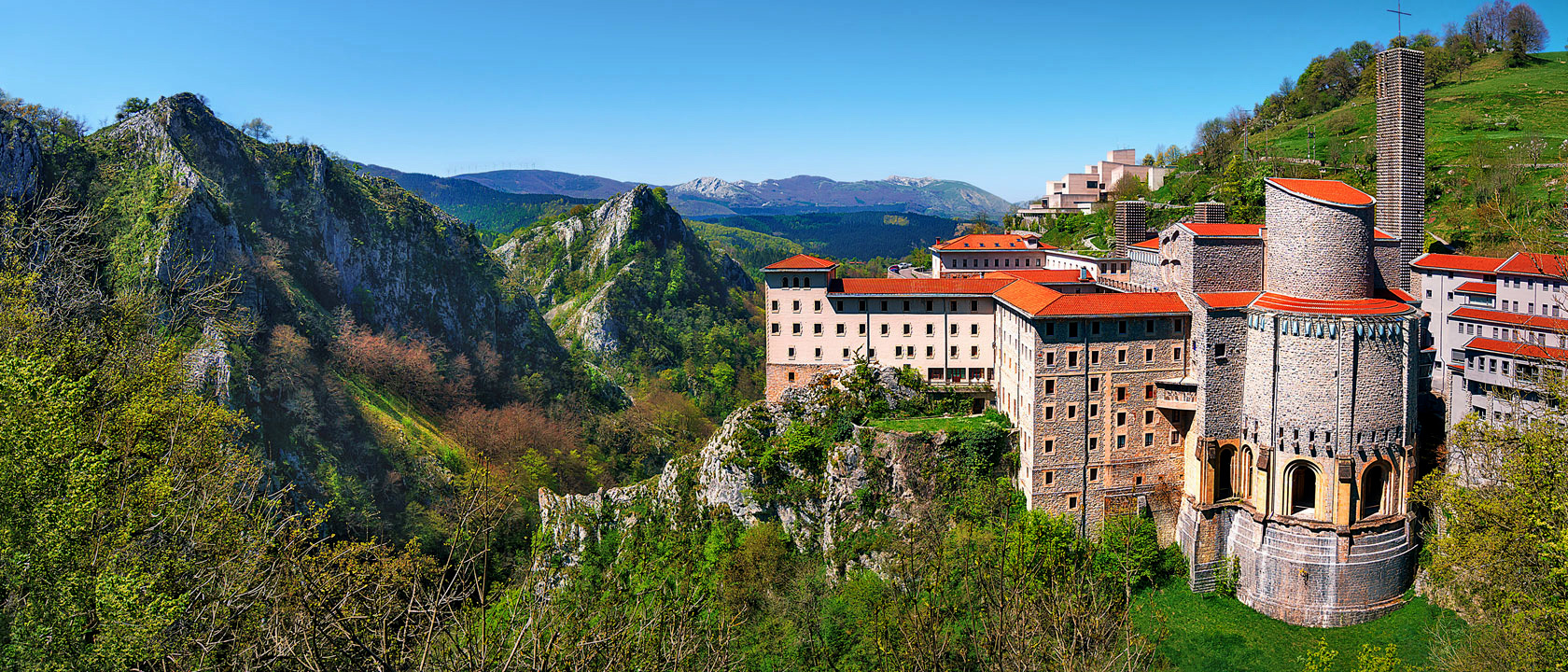
From Oñati we journey ten kilometres south, to the Sanctuary of Our Lady of Arántzazu, a Franciscan church built on the edge of a cliff, deep in the Aikorri Mountains. The original 14th-century church was built on the site, where according to legend, the Virgin Mary showed herself to a shepherd in a hawthorn bush. The current basilica, designed by the famous Spanish architects, Francisco Javier Sáenz de Oiza and Luis Laorga, in 1951, is considered a masterpiece of Basque avant-garde architecture. The basilica also features work by prominent Basque modern artists including 14 apostles by sculptor, Jorge Oteiza; iron gates by Eduardo Chillida, also a sculptor notable for his abstract works; stained-glass windows by Xabier Álvarez de Eulate, a Franciscan friar and artist; and paintings by Néstor Basterretxea and Lucio Muñoz.
We continue to Elorrio, a heritage-listed town, which sits strategically in the Duranguesado Valley where three historical regions of the Southern Basque Country meet. The town was originally surrounded by a stone wall with six gates, of which two remain today. On top of the Kanpokale Gate are the coat of arms of Castile and León, Aragón and Sicily, indicating that the gate dates before the conquest of Granada. The earliest houses in Elorrio were built of wood. Following a fire in 1480, medieval tower houses were built which were gradually replaced by palaces and grand ancestral houses in the 17th and 18th centuries. These traditional Basque buildings, constructed from ashlar stone, reflect the town’s wealthy past, which was boosted by trade with the American colonies and weapon manufacturing in the 16th and 17th centuries. We enjoy lunch in a private palace, hosted by its owners, before continuing our journey to San Sebastián. (Overnight San Sebastián) BL
Day 3: Friday 3 September, San Sebastián
- Orientation walk of Sebastián
- San Telmo Museoa
- Afternoon at leisure
This morning we enjoy an orientation walk of Spain’s gastronomic capital which sweeps around one of the finest beaches on the northern coast. A feature of San Sebastián is its stunning Belle Époque architecture which developed in the late 19th and early 20th centuries when the city became the summer residence of the Spanish Royal Family and a popular resort for the European aristocracy.
We also visit the San Telmo Museoa, considered one of the best museums in the Basque country, whose collection explores the region’s history and culture. There are also murals by local artist José María Sert with stylized depictions of key scenes from Basque history.
The remainder of the day is at leisure for you to explore the city’s historical architecture and Moneo’s arts centre. (Overnight San Sebastián) B
Pamplona – 3 nights
Day 4: Saturday 4 September, San Sebastián – Olite – Ujué – Pamplona
- Palacio Real, Olite
- Lunch in the medieval village of Ujué
- Orientation walk of Pamplona
Today we drive south, past the Aralar Range, into Navarra where we visit a famous royal castle. Olite was the favourite residence of the kings of Navarra in the fifteenth century. This kingdom, which straddled the Pyrenees, adopted French tastes and customs. Charles III of Navarre, who commissioned the castle of Olite in 1406, had been Count of Evreux before inheriting the crown. His French origins are reflected in the layout of the castle, whose spacious interiors – especially galleries and courtyards – are unlike the cramped spaces of massive fortresses of the thirteenth century. This castle marks a transition to the Gothic palaces of the sixteenth century.
From Olite we continue to the spectacularly sited, hilltop village of Ujué which is included in the list of ‘the most beautiful villages in Spain’. The medieval village is dominated by the 12th-century fortified church of Santa María de Ujué which is listed as a National Monument. The church is a fine example of Romanesque architecture with Gothic additions. Interred in the church is the heart of Charles II of Navarra.
Following a rustic lunch at a local restaurant and time to explore the village’s medieval streets, we drive to the capital of Navarra, Hemingway’s city, Pamplona.
In the evening, we take an orientation walk via some of the city’s bustling pintxos bars, which rival those in San Sebastián. (Overnight Pamplona) BL
Day 5: Sunday 5 September, Pamplona – Puenta La Reina – Eunate – Pamplona
- Puente la Reina: Roman Bridge, Iglesia de Santiago & Iglesia del Crucifijo
- Iglesia de Santa Maria de Eunate
- Afternoon at leisure
Santiago de Compostela is located in the extreme north-west of Spain near Iria Flavia, the ancient capital of Galicia. It became arguably the third most important place of pilgrimage in medieval Christendom after the Holy Land and Rome. In the 11th and 12th centuries thousands of pilgrims took the route to Santiago stopping at Saints’ shrines along the way. The pilgrim’s guide in the Codex of Callixtus gives four routes from the north-east, centre and north-west of France. These became two, one passing through the Pyrenees at Roncesvalles and the other at Somport. They converged at Puente la Reina and then a single route, the Camino Francés flowed westward through Logroño, Santo Domingo de la Calzada, Belorado, Burgos, León, Astorga, Ponferrada, Villafranca and Mellid to Santiago.
This morning we visit a number of interesting pilgrim monuments along the route to Santiago. The town of Puente la Reina preserves almost exactly the form of a pilgrim village with medieval houses flanking the pilgrims’ way, which leads to one of the finest pilgrim bridges in Spain (from which the town takes its name).
Many of the buildings in Puenta la Reina attest to the presence of the Knight Templar including the convent of the Reparadoras (an old templar hospital) and the Iglesia del Crucifijo. The later features a beautiful Romanesque façade with rich ornamentation. While its original construction is attributed to the Knights Templar, it later passed into the hands of the Order of Saint John of Jerusalem. It consists of two naves, one Romanesque and the other Gothic. The interior features a large Gothic carving of the Crucifix in the shape of a “Y”. Legend has it that German pilgrims donated the carving to the church upon returning from Santiago de Compostela in gratitude for the care they received at the local pilgrim’s hospital.
Along the main street also lies the Iglesia de Santiago which was built in the 12th century and later extended in the 15th century. The portico and the chapter room still remain from the original Romanesque church. The interior of the church contains a famous Gothic carving of Santiago “beltza”, (meaning black in Basque), named for its dark colour.
We shall then visit Our Lady of Eunate, thought to be one of three surviving funerary churches along the way of St James. An unusual arcade surrounds this centrally planned masterpiece, suggesting that its architect was attempting to copy either the temple or the Church of the Holy Sepulchre in Jerusalem. Next to the church is a tiny pilgrims’ hospice built by the Order of St John, which retains its original function.
The city of Pamplona is renowned throughout the world for the festival of the running of the bulls, is thought to have been founded by Pompey, from whom it is believed to derive its name. It was taken briefly by the Muslims in the eighth century but they were expelled by the Emperor Charlemagne, who dismantled the city’s walls. In revenge, the Basques ambushed and massacred the rearguard of his army, giving rise to the great French epic, The Song of Roland.
The afternoon is free for you to explore Pamplona at leisure. You may wish to visit Pamplona’s Gothic cathedral, which holds Charles III’s alabaster tomb (1416). The cathedral’s Gothic cloister has particularly fine Gothic tracery and the Diocesan Museum holds a very famous reliquary, that of the Holy Sepulchre, which was given to the cathedral by St Louis (Louis IX of France). The present cathedral took the place of a very important earlier Romanesque building. The capitals from this cathedral were an important development of sculpture in many shrines along the pilgrim route to Santiago de Compostela. (Overnight Pamplona) B
Day 6: Monday 6 September, Pamplona: Day excursion to the Navarra Pyrenees
- Beech-Fir Forest of Irati: Autumn Forest Trail
- Medieval mountain village of Ochagavía, Salazar Valley
- Foz de Arbayún and Foz de Lumbier
We depart early this morning for a journey through the Navarrese Pyrenees. Our route takes us to the Irati Forest, the second largest Beech-Fir Forest in Europe; the mountain village of Ochagavía; and the Natural Gorges of Arbayún and Lumbier.
In Navarra, autumn is a season of incredible brilliance. We will enjoy an easy walk through the Irati Forest to enjoy the golden, dun, red and ochre leaves which should be at the height of their splendour.
Next, we continue to Ochagavía, considered the most beautiful village in Navarra. The village, set in the Salazar Valley at the confluence of the Anduña and Zatoya rivers, is surrounded by a green landscape of mountains and dense forests. It features cobblestone streets, old houses and a medieval bridge. Of particular interest are the medieval palaces of Urrutia and Iriarte and the Church of San Juan Evangelista.
Following lunch in the village we continue to the viewpoints over the Foz de Arbayún and Foz de Lumbier – two spectacular gorges which are known for their colony of birds of prey. The Foz de Arbayún has the largest colony of griffon vultures in Spain, which can almost always be seen. (Overnight Pamplona) B
Burgos – 3 nights
Day 7: Tuesday 7 September, Pamplona – Estella – Torres del Rio – Laguardia – Burgos
- Estella: Iglesia San Miguel and the Palace of the Kings of Navarra (exteriors)
- Torres del Rio: Iglesia del Santo Sepulcro
- Laguardia: Santa María de los Reyes & medieval ramparts
- Wine Tasting at Bodega Ysios
Today we travel west from Pamplona to Burgos, following a popular segment of the Camino Francés (The French Way). The route passes through several historic towns, offering a mix of terrain including rolling hills and vineyards of the La Rioja wine region.
At Estella, which probably derives its name (Spanish estrella) from the star which indicated Saint James’ sepulchre to the hermit Pelaio, we shall see the pilgrim church of San Miguel with portal sculptures which narrate the life of Christ in vivid style, and the facade of the 12th-century Palace of the Kings of Navarra, one of the finest examples of Romanesque civic architecture in Europe.
At Torres del Río there is a second funerary church with an octagonal ground plan. The church was built by the Order of the Holy Sepulchre and was probably based on the original in Jerusalem. A vault of the type used by the Muslims in Spain in such monuments as the mosque at Córdoba seems to indicate the hand of Mudéjar builders (Muslims working for the Christians).
Midday we continue our journey through the undulating plains of the wine-growing region of La Rioja- Alavesa to the medieval village of Laguardia. Following lunch at a local restaurant we will view one of Spain’s very few painted Gothic portals at Santa María de los Reyes. The door centres on a lovely, lifelike effigy of La Virgen de los Reyes (Virgin of the Kings), sculpted in the 14th century and painted in the 17th century by Ribera. The village is perched on a hillock within a circuit of fortified walls. There will be time at leisure to enjoy a walk along the ramparts.
Just outside Laguardia we enjoy a wine tasting at Bodega Ysios. This modern winery, designed by Santiago Calatrava, features an undulating aluminium roof which mimics the shape of the surrounding mountains.
In the late afternoon we continue our drive to Burgos. Burgos played an important role in the early military campaigns that slowly won back Spain from the Muslims (711-1492). The city is believed to have been founded by Diego Porcelos, who around 884 built a fortress there. Muslim raiders followed rivers like the Arlanzón into the heartlands of their enemies and it was as a check to invasion that Diego’s fortress was constructed. The city that developed around it remained subject to the kings of León until 926. Burgos then became the capital of Castile until 1087 when Alfonso VI moved his capital to Toledo. Its fortunes were revived in the 15th century when it was a centre for the export of wool to Flanders. Flemish and German artists in consequence travelled south to Burgos and designed many of its opulent chapels and shrines. (Overnight Burgos) BL
Day 8: Wednesday 8 September, Burgos – Covarrubias – Santo Domingo de Silos – Burgos
- Medieval village of Covarrubias
- Abadia de Santo Domingo De Silos
- Catedral de Burgos
- Real Monasterio de las Huelgas
This morning we travel south to the charming medieval village of Covarrubias, one of the best examples of typical Castilian town planning with arcaded streets and half-timbered houses; and the monastery of S. Domingo de Silos. A monastery existed on this site from Visigothic times but was destroyed by the Arabs and a second building was erected in 919 when the area was wrested from the Emir of Córdoba. It became a great centre of Christian revival under Navarra’s St Dominic. The cloister has two storeys with capitals with delicate, mysterious and symbolic plant motifs, suggesting oriental, Byzantine or Persian influences. There is also an early 18th century (1705) pharmacy in the building.
We return to Burgos for lunchtime at leisure and then visit its UNESCO World Heritage-listed Gothic cathedral (begun 1221) to see its splendid portal sculptures, vaults, cloisters, chapels and the coffer of El Cid.
The Real Monasterio de Las Huelgas (Cistercian, 1187) became the pantheon of the kings of Castile. Its architectural style is English and its interior has Muslim decorative motifs of exquisite detail. A treasure of this monastery is a banner captured from the Muslim army at the Battle of Las Navas de Tolosa (1212). It also holds a unique collection of court garb retrieved from the Castilian royal tombs. A number of these are decorated with Muslim motifs and are probably of eastern manufacture. (Overnight Burgos) B
Day 9: Thursday 9 September, Burgos – Atapuerca – Burgos
- UNESCO World Heritage-listed Atapuerca: Sites of Sima del Elefante, Galería and Gran Dolina
- Experimental Archaeology Centre of Atapuerca (CAREX)
- Museo de la Evolución Humana
This morning we drive to Atapuerca, one of the richest and most important group of archaeo-palaeontological sites in the world. This karst complex contains more than 4kms of caves filled with sediments dating from the Early Pleistocene to the Bronze Age. Currently human fossils have been recovered from six sites, dating as far back as 1.4 million years ago. Our tour includes a visit to three of these sites: Sima del Elefante, Galería and Gran Dolina. Sima del Elefante (“Pit of the Elephant”) contains the earliest evidence of humans in western Europe — fragments of a jawbone and teeth date to 1.1–1.2 million years ago. Gran Dolina, which contains human remains dating to about 800,000 years ago, have been ascribed to a new species, Homo antecessor, that represent the last common ancestor of Neandertals and modern humans. At Galería, amongst numerous faunal and floral fossils, jaw and skull fragments which belong to Homo heidelbergensis, date to between 600,000 and 400,000 years.
Following lunch at a local village restaurant, we take a guided tour of CAREX, an outreach facility which focuses on experimental archaeology, which generates knowledge about the way tools, huts, cloth, pottery and works of art were made and used in the past.
In the late afternoon we visit the Museum of Human Evolution. This is an exceptional museum which displays major finds from the sites of Atapuerca, among which the human remains of Homo antecessor and Homo heidelbergensis stand out. There is also a stunning display on “Biological Evolution” of human beings, narrating the origin of the theory of evolution through Darwin and the journey of the Beagle. (Overnight Burgos) B
Santillana del Mar – 2 nights
Day 10: Friday 10 September, Burgos – Aguilar de Campoo – Villanueva de Pría – Santillana del Mar
- Aguilar de Campoo
- Lunch and private gardens, Villanueva de Pría
- Renaissance town of Santillana del Mar
This morning we depart Burgos and journey north to the town of Villanueva de Pría located on the rugged coast of Asturias. En route we make a brief stop at Aguilar de Campoo, a small town located on the St James’ Northern Way (Ruta del Besaya). The town is dominated by a 12th-century castle, perched on a rock above.
In Villanueva de Pría we visit a private residence where the owners will host us for lunch and give us a tour of their magnificent gardens.
We spend the early evening exploring the beautiful town of Santillana del Mar with its golden stone buildings dating from the fifteenth to the eighteenth centuries. Santillana is a contraction of St Juliana, whose relics were held in a local monastery. The town grew to be an important pilgrimage centre and then, as the capital of a marquisate, was adorned with lovely aristocratic mansions. The town is one of the most intact and least touched in Europe. (Overnight Santillana del Mar) BLD
Day 11: Saturday 11 September, Santillana del Mar – Altamira – Comillas – El Pendo – Santillana Del Mar
- Museo de Altamira: facsimile of Altamira Upper Palaeolithic cave art
- Comillas: Palacio de Sobrellano (exterior) & Capricho de Gaudí
- Cueva El Pendo: UNESCO World Heritage Site
This morning, we visit the Museo de Altamira which contains a remarkable facsimile of the original cave. Approximately 35,000 to 11,000 years ago, during the Ice Age, huge flocks of Bison and other wild animals roamed this region. Ancient hunters depicted these animals with a vivid realism which astounds modern art historians. There are bison depicted asleep, stretching, crouched and galloping, as well as other animals like wild boar and an interesting stocky primitive horse. As the icecap receded, the flocks moved north and the great paintings ceased to be made. Archaeologists cannot say for sure what happened to the Magdalenian period hunters.
The town of Comillas is indebted to the first Marqués de Comillas (1817-83) who commissioned leading Catalan Modernista architects to enliven his hometown. Following time at leisure for lunch we take an architectural walking tour to view the exterior of the Palacio de Sobrellano, designed by Joan Martorell; and the flamboyant, Capricho de Gaudí. The later, one of Gaudí’s earliest works (1883-1885), was built for a music-loving aristocrat. It features a tower clad with ceramic bands of alternating sunflowers and green leaves. The interior includes artesonado ceilings, stained-glass windows and intricate wrought iron balconies.
In the afternoon we drive to the heart of the Camargo Valley where we visit the UNESCO World Heritage-listed Cueva El Pendo whose paintings date from around 20,000 BCE. The main panel, known as the ‘Great Frieze of El Pendo’, measures 25 metes in length and features some twenty figures painted in red. There are also numerous animal figures including a cluster of 8 hinds, 12 deer, a goat, a horse and various other symbols, all drawn using the contour technique. (Overnight Santillana del Mar) B
Oviedo – 3 nights
Day 12: Sunday 12 September, Santilana del Mar – Ribadesella – Cudillero – Oviedo
- Paleolithic Rock Art at the UNESCO World Heritage-listed Cueva de Tito Bustillo, Ribadesella
- Village of Cudillero & Quinta de los Seglas
We depart early this morning and journey west along the north coast to Ribadesella, where we visit the Cueva de Tito Bustillo, containing one of the world’s greatest collections of Upper Paleolithic cave art. We will walk past impressive stalagmites and stalactites to reach the cave’s main decorated panel which features painted figures of horses and reindeer using a combination of red, black and rare purple pigment.
After lunch we continue our journey along the coast to Cudillero, a small fishing village, also included in the list of the ‘most beautiful villages of Spain’. Conceived as an amphitheatre-shaped village in the 13th century, Cudillero was painted by its fishermen, who used the same colour as their boats to paint the façades of their homes. On the edge of the village lies the Quinta de Selgas. This palace complex was built between 1880 and 1895 by brothers Ezequiel (1828–1909) and Fortunato Selgas (1839–1921), who belonged to a wealthy family in Cudillero. The palace is home to the Fundación Seglas-Fagalde containing an important art collection including works by Goya, El Greco and Rubens, and is surrounded by well-tended French, English and Italian gardens. (Overnight Oviedo) B
Day 13: Monday 13 September, Oviedo – Picos de Europa National Park – Cangas de Onís – Oviedo
- Picos de Europa National Park: Basíiica de Covadonga & optional walk around Lago de Enol and Lago de la Ercina
- Roman Bridge, Cangas de Onís:
In 722, just eleven years after an army of Arabs and Berbers crossed the Strait of Gibraltar and defeated the king of the Visigoths at the Battle of Guadelete, Pelayo, founder of the tiny kingdom of the Asturias, won a battle against a Muslim force at Covadonga. Although in reality it was probably a mere skirmish, this defence of the nascent Christian kingdom protected by the great Cantabrian Range has been celebrated ever since as the first important event in the gradual ‘reconquest’ of Muslim Spain which culminated in Isabella and Ferdinand’s taking of Granada (1492).
Today we journey into the awe-inspiring mountain range called the Picos de Europa. The Basilica de Covadonga, which we visit, alongside the cave where pilgrims venerate the statue of La Santina, is a place of worship and pilgrimage for the people of Asturias. It is located in an impressive mountain setting; there will be time to enjoy the magnificent panorama of lofty peaks and huge, jagged pinnacles. There will also be the option to take a one-hour guided walk around two beautiful glacial lakes: Lago de Enol and Lago de la Ercina.
From Covadonga we return to Oviedo via the small town of Cangas de Onís which originally situated on a Roman road and has a distinctive Roman hump-backed bridge. (Overnight Oviedo) BL
Day 14: Tuesday 14 September, Oviedo
- San Miguel de Lillo & Palacio de Santa María de Naranco
- San Julián de los Prados
- Catedral de San Salvador & UNESCO World Heritage-listed Cámara Santa
- Museo de Bellas Artes de Asturias
We are now in the region which gave birth to Spain’s first medieval Christian realm, the Kingdom of the Asturias, founded almost immediately after Muslim armies from north Africa had devastated the Visigothic Kingdom of Iberia. The Asturias is consequently a treasure house of early medieval Spanish architecture which forms a bridge between earlier Visigothic forms and the Romanesque style of the pilgrim route to Santiago.
Today we begin with a visit to two tiny, exceedingly rare Visigothic churches, Santa María de Naranco (842-50), thought to have been the audience hall of the palace of King Ramiro I of the Asturias, and S. Miguel de Lillo, which was originally the palatine chapel. Only these two fine churches remain of the original palace complex. We also visit the church of San Julián de los Prados which is an extremely fine example of Asturian art of the first half of the ninth century.
Oviedo is the ancient capital of the kingdom of the Asturias, the first Christian realm founded after the Muslim invasion. Founded in 757 by Fruela I, it remained the kingdom’s capital until the court removed to León (1002). Midday we return to the city centre to visit Oviedo’s fine Gothic cathedral and the UNESCO World Heritage-listed Cámara Santa (Holy Chamber), a pre-Romanesque chapel begun in the 8th century by Alfonso II of Asturias to house important relics. Masterpieces of the collection include the Cruz de los Angeles presented to the cathedral by Alfonso II in 808 CE; and the Cruz de la Victoria, the emblem of Asturias, donated by Alfonso III in 908 CE.
In the afternoon we visit the Museo de Bellas Artes de Asturias, one of Spain’s most important provincial art museums. Founded in 1980, the museum is housed in two of the city’s finest palaces and a modern wing. The collection includes paintings by the most important Asturian and Spanish artists of the 14th to the 21st century including El Greco, Ribera, Zurbarán, Murillo, Carreño de Miranda, Luis Meléndez, Goya, Sorolla, Evaristo Valle, Nicanor Piñole, Picasso, Miró, Dalí, Luis Fernández, Palazuelo, Tàpies and Barceló. There are also fine works by Spanish-Flemish artists of the 15th and 16th century including Tiziano, Veronese, Rubens, John Philip and Foujita. (Overnight Oviedo) B
León – 2 nights
Day 15: Wednesday 15 September, Oviedo – Pedrosa de la Vega – León
- Villa Romana de La Olmeda, Pedrosa de la Vega
Today we drive south across the dramatic Cantabrian Range onto Spain’s great northern meseta, following in the footsteps of Don García, who in 914 moved the capital of his kingdom from Oviedo to the former Roman Legionary centre, which consequently took on new life as the court city of León. This was a daring act because the Cantabrian mountains had protected the tiny Asturian kingdom from the great power of the Caliphate of Córdoba.
Before arriving in León we detour east into the fertile plains of Palencia to visit the Roman agrarian villa at Olmeda which contains some of the most beautiful remnants of a Roman villa anywhere on the Iberian Peninsula. Built in several stages from the 1st to the 4th century CE, the villa complex expands around an elite living quarters containing 27 rooms, 12 of which were tiled with mosaic, centred around a patio and peristyle garden. The villa is best known for its 4th-century mosaics, the most important of which are located in the El Oecus (principal salon). These include a depiction of Achilles discovered by Ulysses in Skyros; and hunting scenes: hunters on foot and on horseback that pursue various animals from the Iberian fauna and some exotic ones from Africa. There are also thermal baths and three cemeteries, of which only two have been excavated. (Overnight León) BLD
Day 16: Thursday 16 September, Leon
- Colegiata de San Isidoro
- Panteon de los Reyes
- Cathedral of Santa Maria de Regia
- San Marcos (subject to opening hours)
- Afternoon at leisure
Of Roman origins, León was the capital of the Kingdom of León from 910 to 1230. It was sacked by the Muslims under Almanzor (al-Mansur) in 988 but was rebuilt and flourished under Alfonso V (999-1027) as a major trading town and a most important stop on the pilgrim route to Santiago. Its fame derived from the possession of the relics of one of Spain’s greatest saints, the historian and encyclopaedist Isidore of Seville, brought north from that Islamised city.
We spend the morning in the city, now capital of its province, visiting such monuments as the Colegiata de San Isidoro, the Panteon de los Reyes and the Cathedral of Santa Maria de Regia. San Isidoro was founded in the 11th century to hold the remains of St Isidore. It is a Romanesque/Gothic construction. The Pantheon of the Kings, the burial place of the early kings of León, holds one of Europe’s finest cycles of Romanesque vault paintings (1180-90) depicting the Lives of Christ and the Apostles, Signs of the Zodiac and the Labours of the Months. León cathedral’s great treasures are its west front, the finest of its kind in Spain, and its stained glass windows, the earliest of which date from the 13th century.
The afternoon is at leisure. (Overnight León) B
Santiago de Compostela – 2 nights
Day 17: Friday 17 September, Leon – Ponferrada – Pedrafita do Cebreiro – Lugo – Santiago
- Castillo de los Templarios (exterior), Ponferrada
- Village of Pedrafita do Cebreiro
- UNESCO World Heritage-listed Roman Walls of Lugo
Today we complete our journey along the pilgrim route. Our first stop is Ponferrada which is dominated by the Castillo de los Templarios. In 1178, Ferdinand II of León donated the city to the Templar order for protecting the pilgrims on the Camino Francés who passed through the region on their way to Santiago de Compostela. The castle, built on the foundations of an earlier fortress, was completed by the Templars in 1282. However, they were only able to enjoy the use of their fortress for about twenty years before the order was disbanded, and its properties confiscated in 1311.
From Ponferrada we climb up across the high mountain passes that lead to the verdant region of Galicia. At the very summit of one pass we stop at the fascinating small town of Pedrafita do Cebreiro, distinguished by its extraordinary cottage-barn, dry stone houses that are of Celtic origin. We then drive across Galicia to Lugo.
Following some time at leisure for lunch, we take the 2.2km circular path running around the top of the World Heritage-listed Roman walls. Dating from the late 3rd and early 4th centuries CE, the walls were built to defend the Roman town of Lucas. Built in the shape of an oblong rectangle, the walls vary in height from 8 to 10 metres and include 85 external towers and 10 gates. They represent the finest example of late Roman fortifications in Western Europe. (Overnight Santiago de Compostela) B
Day 18: Saturday 18 September, Santiago de Compostela
- Cathedral of Santiago de Compostela
- Afternoon at leisure
- Farewell Dinner
The ultimate goal of all pilgrims was what is now the Plaza de España, flanked by stately palaces and the superb Baroque west facade of the great cathedral, one of the most beautiful churches of the Iberian Peninsula. One of the most magnificent buildings facing the Plaza is Santiago de Compostela’s Parador, the Hostal dos Reis Católicos.
We shall spend the morning in the cathedral and its subsidiary buildings. The present cathedral (completed 1211) is built upon an earlier shrine of 899. Construction began before 1105 and the choir and transept were completed in 1112. A clock tower was added in 1325, the bell tower and cloister around 1521. The building later gained a baroque facade. The complex with its myriad chapels is a treasure house of sculpture and painting, precious silver work and glass from the Romanesque and Gothic periods.
The afternoon will be at leisure to explore the many churches and palaces of the pilgrim city. (Overnight Santiago de Compostela) BD
Day 19: Sunday 19 September, Tour Ends Santiago de Compostela
- Tour concludes in the morning
- At leisure/Check out
As Cervantes said, “Neither good nor evil can last for ever…”, and our tour must come to an end. Our tour ends in Santiago de Compostela after breakfast. In the morning you will be required to check out of the hotel. Please contact ASA if you require assistance with a transfer to the airport. B
Accommodation
All hotels are rated 4-star locally and are comfortable and conveniently situated. All rooms include en suite bathroom.
- Bilbao (1 night): details to be confirmed
- San Sebastián (2 nights): details to be confirmed
- Pamplona (3 nights): details to be confirmed
- Burgos (3 nights): details to be confirmed
- Santillana del Mar (3 nights): details to be confirmed
- Oviedo (3 nights): details to be confirmed
- León (2 nights): details to be confirmed
- Santiago de Compostela (2 nights): details to be confirmed
Note: hotels are subject to change, in which case a hotel of similar standard will be provided.
Single Supplement
Payment of this supplement will ensure accommodation in a double (or twin) room for single occupancy throughout the tour. The number of rooms available for single occupancy is extremely limited. People wishing to take this supplement are therefore advised to book well in advance.
How to Book
ASA INTENTION TO TRAVEL APPLICATION FORM
Some ASA tours fill almost immediately. Don’t miss out! You can register your ‘Intention to Travel’ by completing this application and returning this to ASA with a AUD $200.00 per person deposit. Once the tour price has been published, the itinerary and ASA Reservation Application Form will be sent to you. From the time you receive the itinerary you will have two weeks to either:
- Send us a completed ASA Reservation Application Form together with an additional deposit of AUD $800.00 per person. On receipt of this Reservation Application and deposit, ASA will process your booking and if approved, send you a tour confirmation. At this time your deposit of AUD $1000.00 is subject to the tour’s Booking Conditions.
Or
- CANCEL your Intention to Travel in writing. ASA will refund your AUD $200.00 per person deposit, less a $66.00 service fee (including GST).
Practical Information
Fitness Criteria
Level 2 INTERMEDIATE
For people with energetic lifestyles and very good mobilityYou must be able to:
- manage at least five to six hours of physical activity per day with ease.
- walk at a regular to moderate pace to explore towns extensively on foot. Some days include walking tours of at least 5-7kms. Many walks include uneven terrain, cobbled streets and steep ascents/descents.
- keep up with the group at all times.
- negotiate challenging historic monuments, archaeological sites and prehistoric caves which may include poor lighting, low ceilings, steep stairs or uneven terrain.
- stand for one to two hours during visits to galleries and museums without the need to sit.
- contend with a shower over a bath; walk-in showers may not be available at all hotels.
- manage your own luggage at some hotels.
- cope with tour schedule which is planned around the siesta (midday break):
- Length of days: Regional museums are often closed between 1 and 4pm; many days therefore include early-morning departures (between 8.00-8.30am), concluding in the late afternoon (between 5.30-6.30pm).
- Late meal times: lunch is usually between 1 and 2pm. Evening meals are generally not served until 8-8.30pm.
Fitness Levels
Please also view the fitness criteria required for our tours, graded from Level 1 to Level 3, at www.asatours.com.au/fitness-level/
All ASA tours are active programs suitable for people with a good level of mental and physical fitness and good mobility. They are not suitable for people who lack stamina, have difficulty walking at the group’s pace or who have mobility issues. An unavoidable aspect of every tour is the need to manage walking, stair-climbing and standing for long periods of time.
It is a condition of travel that all participants agree to accept ASA’s directions in relation to their suitability to participate in activities undertaken on the tour, and that ASA retains the sole discretion to direct a tour participant to refrain from a particular activity on part of the tour. Before enrolling on an ASA tour please read the fitness requirements carefully.
Tour Price & Inclusions
AUD $TBA Land Content Only – Early-Bird Special: Book before 30 Sep 2026
AUD $TBA Land Content Only
AUD $TBA Single Supplement
Tour Price (Land Content Only) includes:
- Accommodation in twin-share rooms with private facilities in 4-star hotels
- Breakfast daily, lunches and evening meals indicated in the tour itinerary, where: B=breakfast, L=lunch & D=dinner
- Drinks at welcome and farewell meals. Other meals may not have drinks included.
- Transportation by air-conditioned coach
- Porterage of one piece of luggage per person at hotels (not at airports)
- Lecture and site-visit program
- Tour notes
- Light refreshments as indicated in the itinerary
- Entrance fees
- Use of audio headsets during site visits
- Tips for the coach driver, local guides and restaurants for included meals.
Tour Price (Land Content Only) does not include:
- Airfare: Australia-Seville, Córdoba-Australia
- Airport transfers
- Personal spending money
- Luggage in excess of 20 kg (44 lbs)
- Travel insurance
- Visas (if applicable)
Tour Map
Gallery
Deposits
A non-refundable deposit of $1000.00 AUD per person is required to reserve a place on this ASA tour.
Cancellation Fees
If you decide to cancel your booking the following charges apply:
- More than 75 days before departure: your initial deposit of $1000.00 is non-refundable.**
- 75-31 days prior 50% of total amount due
- 30-0 days prior 100% of total amount due
**$500.00 of this amount (ie 50% of your deposit) may be credited to another ASA tour departing within 12 months of the original tour you booked. We regret, in this case early-bird discounts will not apply.
We take the day on which you cancel as being that on which we receive written confirmation of cancellation.
Unused Portions of the Tour
We regret that refunds will not be given for any unused portions of the tour, such as meals, entry fees, accommodation, flights or transfers.
Will the Tour Price or Itinerary Change?
If the number of participants on a tour is significantly less than budgeted, or if there is a significant change in exchange rates ASA reserves the right to amend the advertised price. We shall, however, do all in our power to maintain the published price. If an ASA tour is forced to cancel you will get a full refund of all tour monies paid. Occasionally circumstances beyond the control of ASA make it necessary to change airline, hotel or to make amendments to daily itineraries. We will inform you of any changes in due course.
Travel Insurance
ASA requires all participants to obtain comprehensive travel insurance. A copy of your travel insurance certificate and the reverse charge emergency contact phone number must be received by ASA no later than 75 days prior to the commencement of the tour.
Final Payment
The balance of the tour price will be due 75 days prior to the tour commencement date.
Limitation of Liability
ASA is not a carrier, event or tourist attraction host, accommodation or dining service provider. All bookings made and tickets or coupons issued by ASA for transport, event, accommodation, dining and the like are issued as an agent for various service providers and are subject to the terms and conditions and limitations of liability imposed by each service provider. ASA is not responsible for their products or services. If a service provider does not deliver the product or service for which you have contracted, your remedy lies with the service provider, not ASA. ASA will not be liable for any claim (eg. sickness, injury, death, damage or loss) arising from any change, delay, detention, breakdown, cancellation, failure, accident, act, omission or negligence of any such service provider however caused (contingencies). You must take out adequate travel insurance against such contingencies. ASA’s liability in respect of any tour will be limited to the refund of amounts received from you less all non-refundable costs and charges and the costs of any substituted event or alternate services provided. The terms and conditions of the relevant service provider from time to time comprise the sole agreement between you and that service provider. ASA reserves the sole discretion to cancel any tour or to modify itineraries in any way it considers appropriate. Tour costs may be revised, subject to unexpected price increases or exchange rate fluctuations.
Interested in this tour?
Take the next step
or alternatively Download PDF Reservation Application