
Fresco Painting in Italy and the Venetian Tradition
by David Henderson
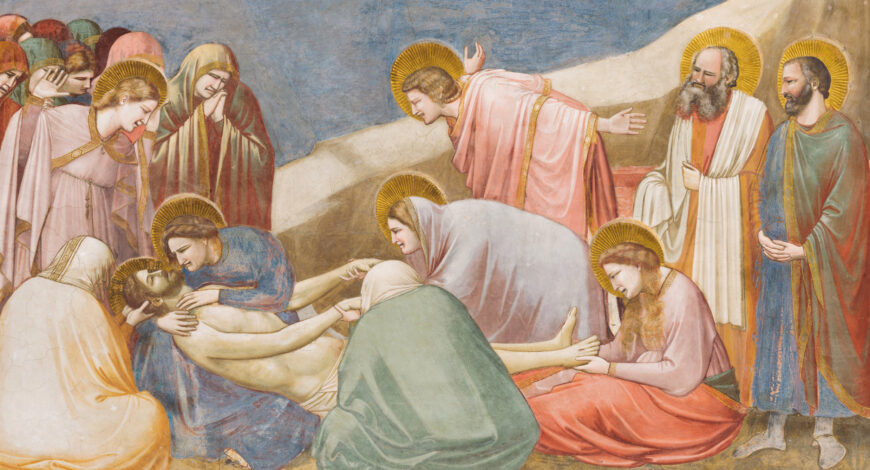
Fresco, whereby paintings are made onto damp plaster walls is one of the most ancient of all pictorial techniques; examples dating to the Bronze Age attest to its durability. Competence in this medium has long been considered a gold standard of artistic skill: its scale, and requisite speed of execution leave little scope for corrections or second thoughts.
Fresco is an Italian word meaning ‘fresh’, or ‘cool’, from which the word ‘affresco’ – as the technique is known in Italy – is derived. As the name suggests, this kind of painting should be carried out on freshly laid plaster, and it is in the chemical process through which pigment bonds with the wall surface as it dries that the painted image attains its permanency. While this method guarantees a stable, lasting result, the circumstances of its execution are unforgiving. Plaster applied in the morning may be too dry to work on by the end of the day, and any areas left bare should be removed. Similarly, corrections can only be made to a section of painting which has dried by destroying the entire layer, and starting again from scratch.
However, it is in some cases possible to paint on a dry plaster wall, and in fact art historians identify two main types of fresco technique: ‘buon fresco’, true, or literally ‘good’ fresco as described above – and ‘fresco a secco’: ’dry’ fresco. In the latter method, pigments are mixed with a binder such as egg yolk and applied to a wall whose plaster has already set. While the painter is not constrained by drying time, the result is less durable and lacks the brilliance of the true fresco technique. Most fresco paintings combine the two methods, with ‘a secco’ reserved for certain colours, or for final details where careful precision is required. While the surface of the finished decoration will be relatively tough it is however, vulnerable to moisture, particularly if the building within which it is made is poorly constructed or maintained.
Below: Giotto, Lamentation (detail), Scrovegni Chapel 1304-1306, Padua Public domain, via Wikimedia Commons. The shapes of areas corresponding to the ‘giornate’ or days’ work are faintly visible in the discoloured sky.
 Ideally, at least three layers of plaster should be applied to the interior wall, each more finely textured than the previous one. The last of these is only a few millimetres thick and is prepared at the beginning of each session of work. The technical name for this area is a ‘giornata’ or ‘day’, and it is often possible to detect in some frescoes the faint lines which circumscribe it, indicating the extent of a day’s work.
Due to the risks posed by its damp, salty atmosphere, the city of Venice proper did not have a well-developed tradition of fresco painting until the 18th century. Before then, the best examples of this technique were to be found in the city’s mainland territories. The most prolific era of fresco painting in the city, often referred to as a ‘second golden age of painting’ began with the ascendancy of Giovanni Battista Tiepolo (1696-1770). Tiepolo’s unerring facility of execution, sense of atmospheric colour and gift for design meant that he was naturally disposed to excel in this technique. His commissions were primarily undertaken on the upper levels of well-constructed Venetian palaces and churches, and their location combined with a thorough understanding of the the medium’s requirements has meant that his work remains in a good state of preservation today.
 Traditionally, painters would first prepare, and then transfer the outline of their subjects using large drawings known as cartoons to the plaster surface before beginning work. This would enable them to utilise their brief window of time in developing their image. Such was Tiepolo’s painterly bravura that he more or less dispensed with cartoons, preferring to work directly onto the surface, making occasional reference to small oil sketches and drawings. The painter’s legendary energy and rapidity are in part what bring his ambitions schemes for the ceilings of Venetian palazzi or the palaces at Wurzburg or Madrid to life.
Venice by the 18th century was a society in decline. Its ruling class, suspicious of the new ideas emanating from Enlightenment Europe turned inwards, preferring to reflect on past glories and to immerse themselves in a world of fantasy. This city of islands containing a population of some 100,000 people at that time boasted seven full time opera houses, and a masked carnival which lasted for six months of the year. Tiepolo was the ideal painter of this febrile, dreamlike world. Above the ballrooms and salons of the city’s palaces he depicted gods and goddesses mingling with doges and their families, suspended beneath an infinity of pallid air.
Above: The Banquet of Cleopatra, Giovanni Battista Tiepolo, CC BY-SA 4.0 <https://creativecommons.org/licenses/by-sa/4.0>, via Wikimedia Commons
Venice is a very different city today, and rather than ignoring the international scene, every other year hosts the world’s artistic innovators at its Biennale. It is also home to a first-rate fine arts academy, the Accademia di Belle Arti di Venezia, of which Tiepolo was its first president.
Conegliano resident Claudia Piasentin is a multi-award-winning student of the Accademia, and already highly proficient in a variety of media and styles. Together with her friend and collaborator Gioele she will provide a comprehensive demonstration of the exacting technique of fresco, starting with the application of a layer of intonaco. As Gioele says, ‘the painting of a fresco really begins with the construction of the wall’.

Learn about the history of Venice on our tour Venice: Jewel of the Adriatic from a highly experienced tour lecturer, David Henderson. David, is an award-winning artist & Royal Academy graduate who paints half the year in Italy. He has been leading ASA tours since 1996.
 Venice: Jewel of the Adriatic 2026
  Venice: Jewel of the Adriatic 2027