
The Alpine Sublime
by Dr Lisa Beaven & Assoc. Prof. David Marshall
by Dr Lisa Beaven and Assoc. Prof. David Marshall
For much of the early modern period, the Swiss-Italian Alps were regarded as a barrier: a treacherous region that had to be traversed in order to reach Italy. Grand tourists in the 18th century were justly apprehensive at the prospect of any one of the passes through the Alps. The most popular of these was over the Col du Mont-Cenis by way of Susa and Lanslebourg, where the travellers’ coaches were either dismantled and packed into separate pieces on the backs of mules or stored in a large shed until their return. The trip then had to be undertaken by mule or in sedan chairs carried by porters, and usually took about four days. There were multiple hazards. John Evelyn, for example, lost his luggage when the horse carrying it plunged through a bank of loose snow and slid down a precipice.

The St. Gotthard Pass could be equally frightening (Fig. 1 J. M. W. Turner, The Pass of Saint Gotthard, Switzerland, 1803-4). As Thomas Nugent wrote: ‘the most hazardous part is the bridge on the Russ, called the bridge of hell from the horrid noise the water makes as it tumbles from the rocks, and from the slipperiness of the bridge which renders it difficult even to foot passengers who are obliged to creep on all fours, lest the fury of the wind should drive them down to the rocks’.
At the same time, high lonely places untouched by civilization held a growing fascination for the European elite. Geologists were attracted to the mystery of the great glaciers that filled Swiss valleys with rivers of ice. In the latter part of the 18th century the Alps came to be seen as embodiments of the sublime, a concept developed by Edmund Burke’s in A Philosophical Enquiry into the Origin of our Ideas of the Sublime and Beautiful, published in 1757, which enjoyed enormous popularity in Britain. Burke sought the sublime, not in rhetoric, where the concept originated, or in literature, but in the natural world: high mountains, jagged rocks, dizzying heights, powerful waterfalls and panoramic vistas. A new cultural sensibility emerged which emphasised subjective experience and the emotions of awe, fear and terror, prompted by confrontation with the power of nature. Travellers were thrilled by the scale of the Alps and found in them a new exoticism.
Mountaineers, Poets, Painters & Writers
Mountaineers began to climb alpine peaks and their journals and books described their experience in terms of being suspended between earth and sky, a sensation perhaps best captured by Caspar David Friedrich in his painting Wanderer above the sea of fog, 1817 (Fig. 2). The greatest challenge for climbers was the Matterhorn, which was long considered to be too perilous to climb (The first ascent took place in 1865). John Ruskin wrote in 1862: ‘the effect of this strange Matterhorn upon the imagination is indeed so great that even the gravest philosophers cannot resist it’. Neither could artists. Albert Bierstadt memorably depicted the Matterhorn at sunrise, sharply facetted and tinged with pink, rising above conifers silhouetted against the mist (Fig. 3 Albert Bierstadt Sunrise on the Matterhorn, after 1875).


Poets, painters and writers were all drawn to the region. Joseph Mallord William Turner crossed the Alps in 1802 which provided him with visual material for many years, transformed later into highly emotive landscapes of storms and mountain avalanches. Mary Shelley’s Frankenstein: or the Modern Prometheus, written during a cold summer in 1818 in Geneva, has an important scene set on the Mont Blanc glacier, the Mer de Glace. Alpine themes and peaks were also prominent in the poetry of Byron and Percy Bysshe Shelley and helped contribute to the craze for the Alps in Victorian culture.
As a result of these cultural phenomena, tourists flocked to the Alps, creating new tourist infrastructure in the form of railways and hotels. The first alpine railway was opened under the Gotthard Pass in 1882, and the second under the Simplon Pass in 1906. The high, cold air of the Alps was considered to be pure and healthy. Sanatoria for those afflicted by tuberculosis were built at high altitudes, often reached by a series of alpine branch lines. Thomas Mann’s The Magic Mountain (1924) is set in a sanatorium modelled on the Berghotel Schatzalp above Davos. The protagonist of the book, Hans Castorp, describes evocatively the alien and frozen world around the building. On entering the establishment, he starts to lose his orientation, to the point that time becomes elastic. One of the most influential novels of the 20th century, The Magic Mountain has transformed the Berghotel into a place of cultural pilgrimage. A Thomas Mann path has been created, allowing visitors to walk between the Waldhotel (the original forest sanatorium where Mann’s wife received treatment) and the Schatzalp hotel, while reading extracts from the book which are displayed at intervals on panels.
Alpine Journeys by Train: Northern Lakes and Medieval Castles
Another way that Switzerland has tapped into this historical cultural capital of the sublime is by leaning into experiential tourism by means of a series of alpine journeys by trains that wind through dramatic alpine landscapes. The most famous of these is the Glacier Express, which runs from St Moritz to Zermatt (Fig. 4). This journey takes in the Engadine Lake district, spectacular viaducts like the Landwasser Viaduct, which extends on five towering piers in a curve over the rugged Landwasser valley, the Overalp Pass (2032 metres) with its dizzying vertical views, and the Rhine Gorge (Switzerland’s Grand Canyon) with its white cliffs and strange rock formations, ending at Zermatt below the Matterhorn.

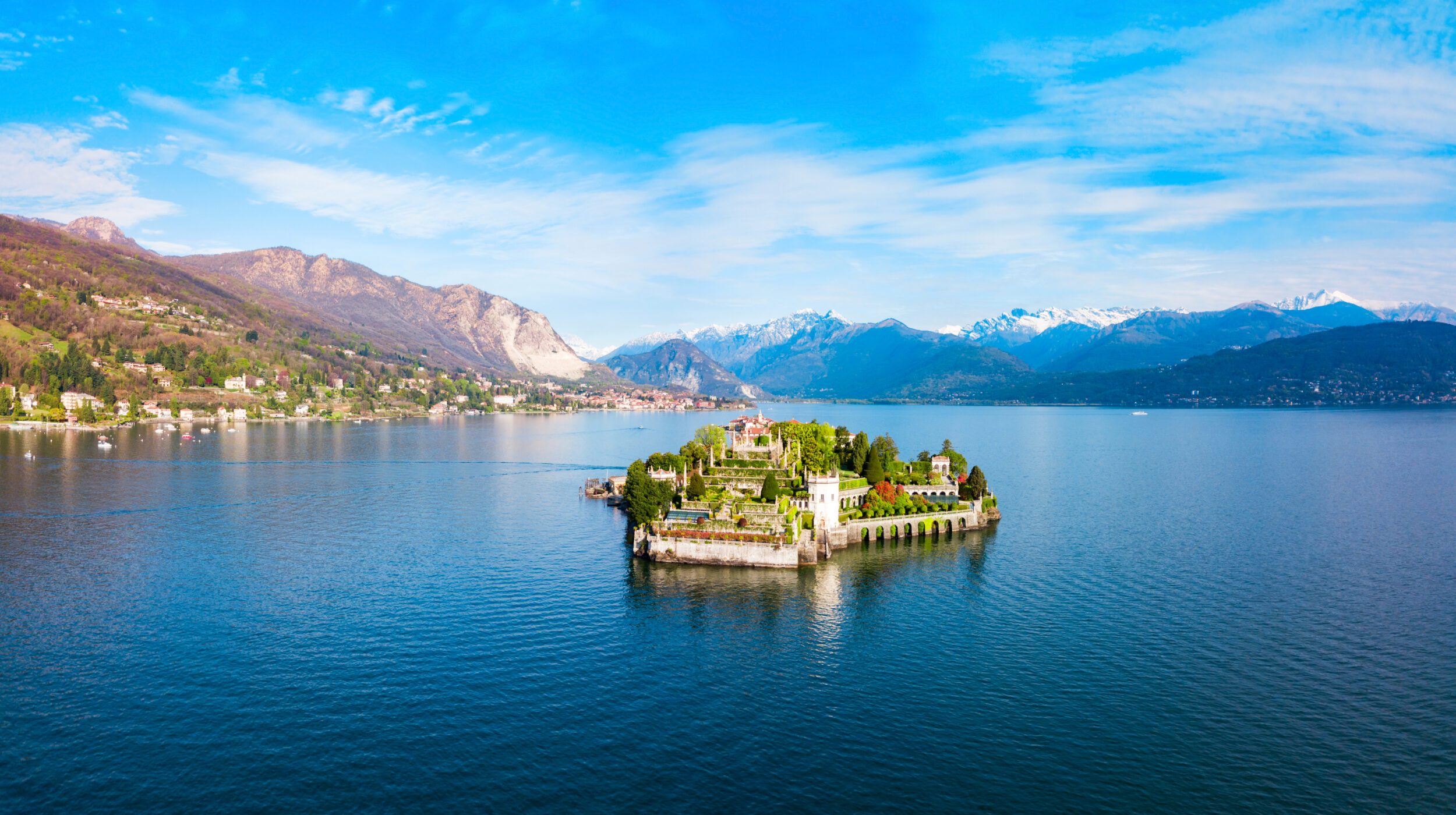
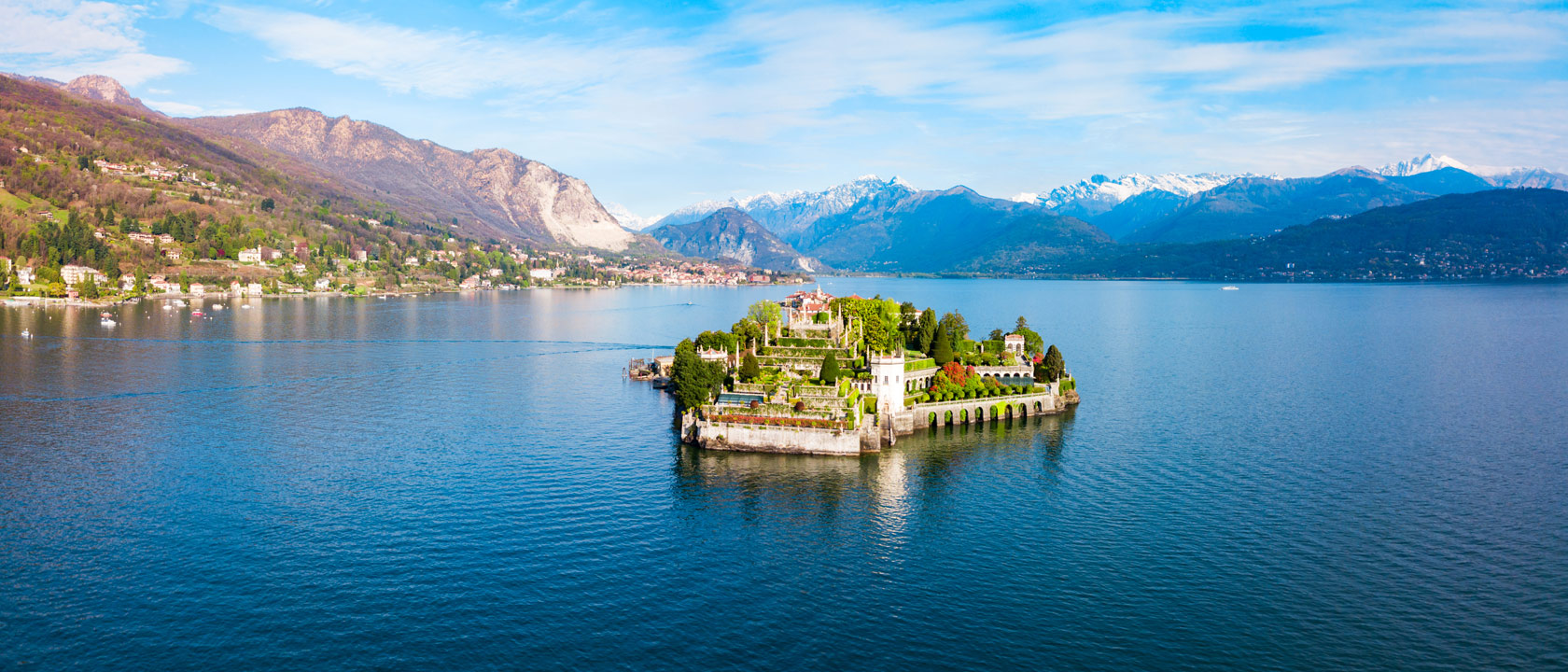
Every journey over the Alps in the 18th and 19th centuries ended in the welcoming plains of Northern Italy, and many tourists made their way to the Italian lakes to recover. From the middle of the 19th century, Lake Maggiore began to experience strong tourist development, particularly after Queen Victoria’s stay in Baveno in 1879 and the opening of the Simplon tunnel in 1906, which gave direct access from Milan to Swizterland and France. The greatest attraction of Lake Maggiore were the Borromean islands, particularly Isola Bella, whose unique garden of terraces was built between 1632 and 1671 by Count Carlo Borromeo III, who wanted it to resemble a great galleon on the lake. With time, the 17th century geometry has been softened by changing garden styles, resulting in what is arguably the world’s most perfect garden, immacutely maintained and planted, surrounded on all sites by water, and animated by white peacocks and a forest of stone figures. (Fig. 5).
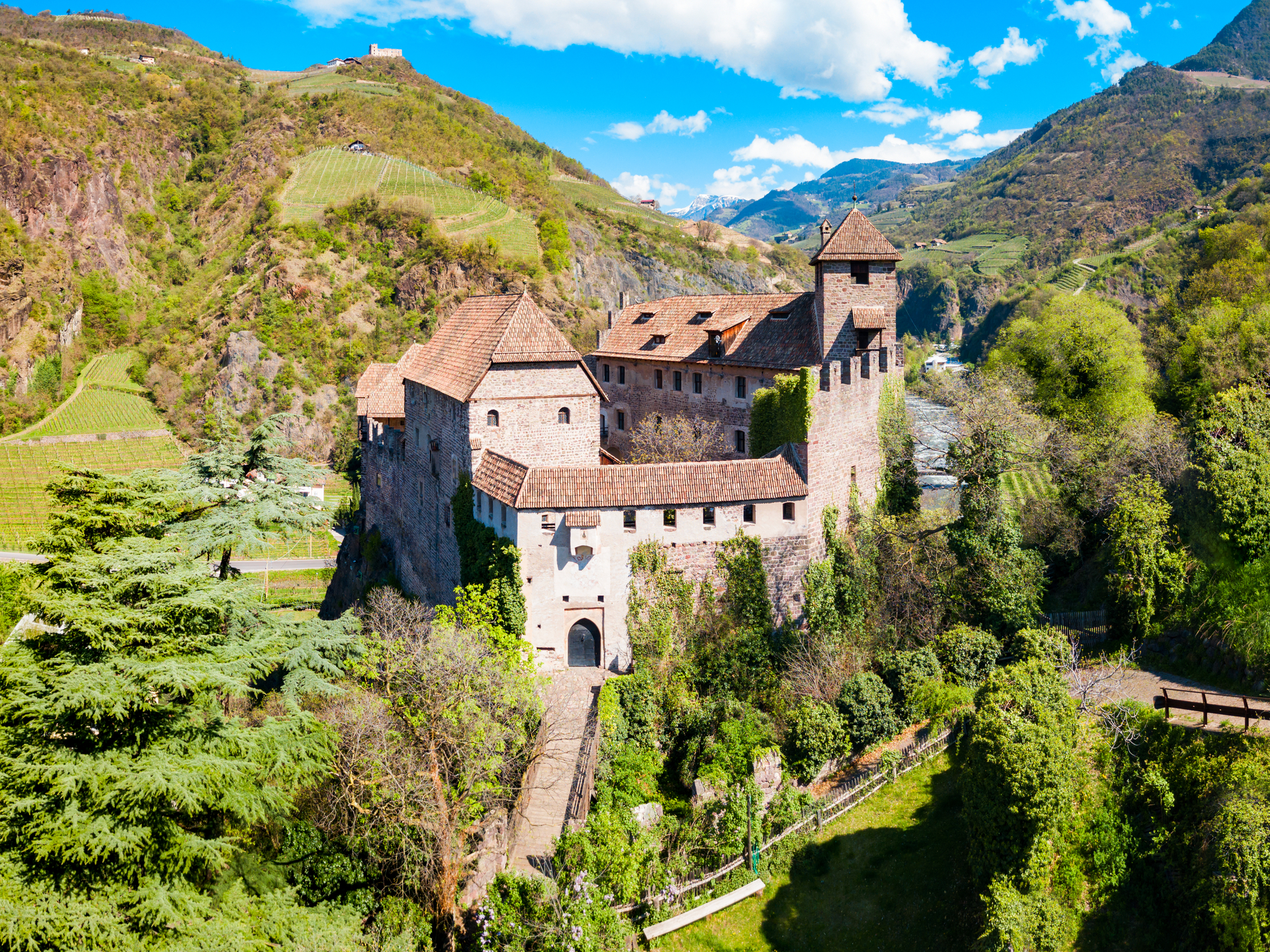
At the other end of the Alps, the railway through the Brenner pass, from Bolzano to Innsbruck in Austria, was opened in 1867. This had long been the easiest route into Austria, as the lowest of the Alpine passes, and as a result, features a dense network of medieval castles, positioned at the head of narrow valleys and passes. Many of these were destroyed by intense fighting in the Friuli region in World War I, but some survive, including the Castello di Udine, defending the main city of the region; the Castello Strassoldo, complete with its medieval borgo and, most romantically picturesque of all, Schloss Runkelstein just outside Bolzano (Fig. 6). With a name suggestive of German folk tales, improbably perched on a rocky outcrop guarding the entrance to the Sarntal Valley, Schloss Runkelstein is sometimes known as the painted castle, because of its extensive medieval wall-paintings, which include a room depicting the story of Tristan and Isolde. (Fig. 7 & 8)

Ötzi the Iceman: Insights into the European Copper Age

Another aspect of the contemporary sublime in Northern Italy unknown to historical travellers, but a huge drawcard today, is Ötzi, the mummy of a man discovered frozen in ice in 1991 in the High Alps who lived between 3350 and 3105 BCE (Fig. 9).
Now housed in the South Tyrol Museum of Archaeology in Bolzano, the public’s fascination with the mummy has only increased with the recent discovery that he was in fact, one of the world’s earliest murder victims, in all likelihood ambushed at his campsite in the snow at high altitude by someone who was stalking him. The Alps were always a dangerous place.
Travel with art and cultural historians Assoc. Prof. David Marshall and Dr Lisa Beaven on this journey from Udine in Friuli Venezia Giulia, through the majestic Dolomites and Swiss Alps to the beautiful Italian Lakes district, on our tour Art, Gardens and Landscapes of Northern Italy and the Swiss Alps.
Images
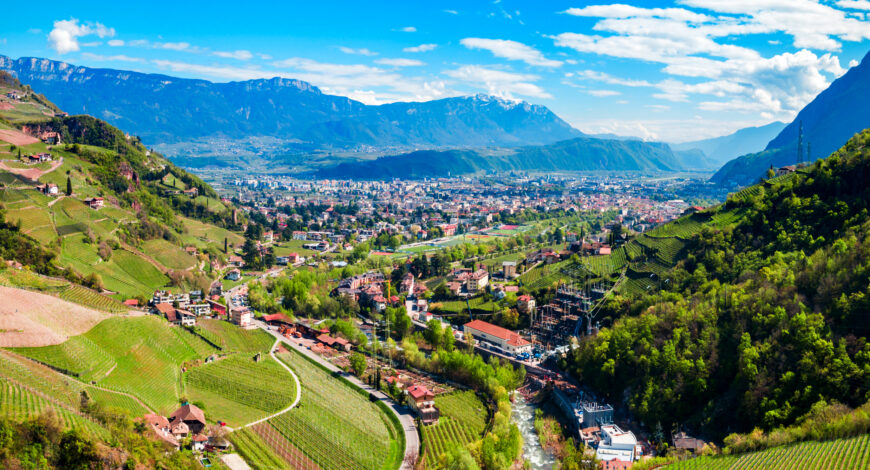
Top photo: Bolzano and Dolomite mountains, South Tyrol province in northern Italy. ID 335730660 © Saiko3p | Dreamstime.com
Fig. 1 J. M. W. Turner, The Pass of Saint Gotthard, Switzerland, 1803-4, oil on canvas, 80.6 x 64.2 cm, Birmingham Museum Trust.
Fig. 2 Caspar David Friedrich in his painting Wanderer above a sea of fog, 1817, oil on canvas, 94.8 x 74.8 cm, Hamburger Kunsthalle, Hamburg
Fig. 3 Albert Bierstadt Sunrise on the Matterhorn, after 1875, oil on canvas, 148.6 x 108.3 cm, Metropolitan Museum of Art, New York
Fig. 4 The Matterhorn in Zermatt, Switzerland ID 187154130 | © Gbern31 | Dreamstime.com Fig. 5 Isola Bella, Lago Maggiore, Italy ID 166237098 © Saiko3p | Dreamstime.com
Fig. 6 Runkelstein Castle or Castel Roncolo is a medieval fort on a rocky spur in Bolzano city in South Tyrol, Italy ID 220796884 © Saiko3p | Dreamstime.com
Fig. 7 Anton Kaiser, View of Schloss Runkelstein, etching (Schloss Runkelstein museum).
Fig. 8 Tristan and the Lion, detail of medieval terra verde mural, Schloss Runkelstein. Photo©David R. Marshall.
Fig. 9 Model of Ötzi by Adrie and Alfons Kennis, South Tyrol Museum of Archaeology. Photo©Lisa Beaven.
 Art, Gardens and Landscapes of Northern Italy and the Swiss Alps 2026