Art and Landscapes of Italy’s Piedmont, Emilia-Romagna and the Ligurian Coast 2027
Status: Places Available
20 Apr – 7 May 2027

Your leaders


Art and Landscapes of Italy’s Piedmont, Emilia-Romagna and the Ligurian Coast 2027
Tour Highlights
Join David Henderson, on a captivating journey through the diverse landscapes of Northern Italy from Turin to Bologna.
- Discover Turin, capital of Piedmont, where the city’s powerful past is evident in its fine palaces, villas, cathedral and art collections.
- Explore the hills of Piedmont where beautifully preserved and seldom visited castles and churches display medieval and early Renaissance frescoes, and enjoy lunch at a Piedmontese winery to experience the wine and cuisine for which the region is renown.
- Stroll along Genoa’s UNESCO-Listed Le Strade Nuove, the main street of the old town lined with palaces, some now hosting galleries, restaurants and boutiques. Visit some of the finest palaces and museums – the Palazzo del Principe, Palazzo Real and the Palazzi dei Rolli.
- Enjoy the exquisite scenery of the Ligurian Coast. Visit charming villages including Portofino and Porto Venere, the gardens of La Cevara Abbey with views over the Ligurian Sea and the Abbazai San Fruttuoso nestled in a secluded cove.
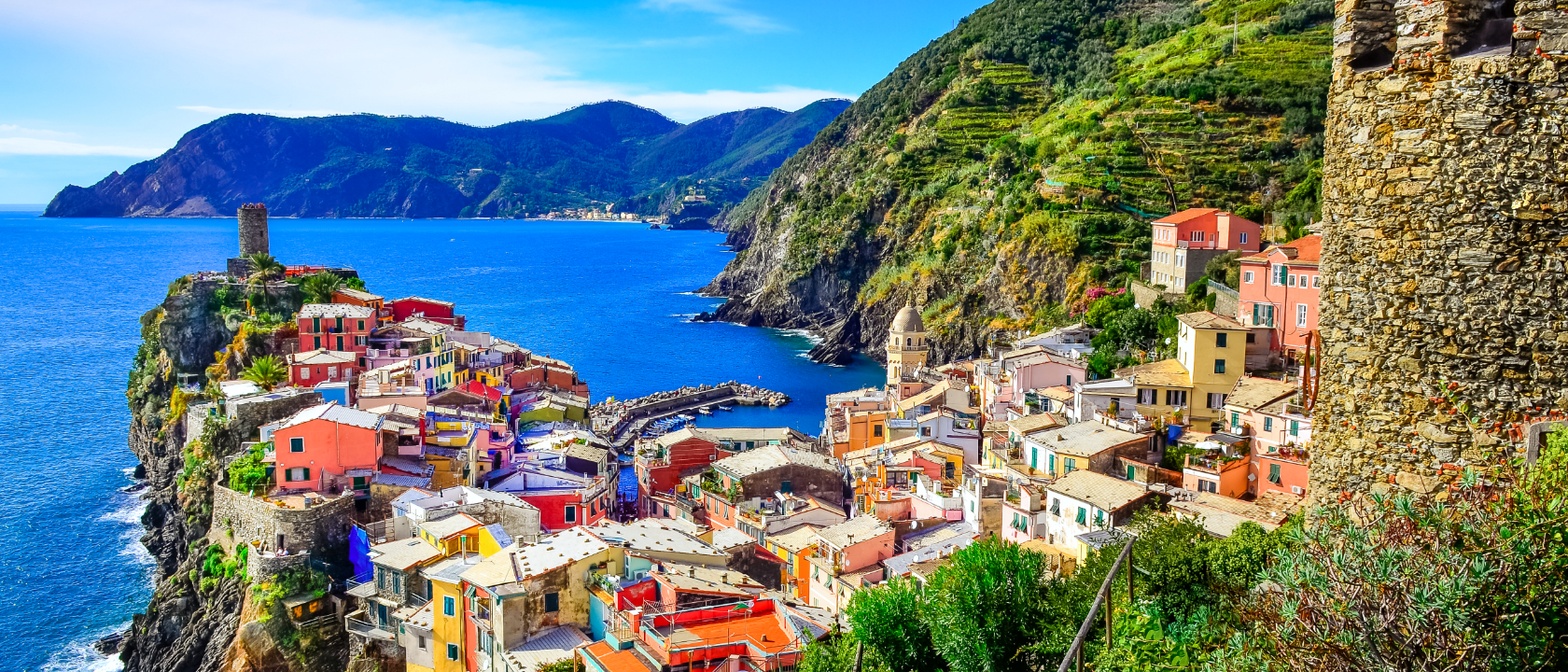
- Travel by boat and spend a leisurely day visiting the Cinque Terre, the famed villages that cling to the Ligurian Coastline.
- Visit the towns of Emilia-Romagna, each with outstanding treasures. Tour the Castello Fontanellato home to Parmigianino’s fresco cycle depicting Diana and Actaeon; visit the Museo Violino in Cremona and hear the unforgettable sound of their Stradivarius violin; walk in ancient Roman footsteps at Bescia’s archaeological park; visit the jewel that is Parma’s Teatro Farnese; and explore Mantua’s mannerist Palazzo del Te and the Ducal Palace, home to the powerful Gonzaga family.
- Enjoy rejuvenated Bologna, capital of Emilia-Romagna and home to fine galleries, churches and a thriving food scene that proudly promotes the fine produce of the region, from prosciutto to parmigiana, balsamic vinegar and tortellini.
- This tour is limited to 16 participants.
Overnight Turin (4 nights) • Genoa (4 nights) • La Spezia (2 nights) • Cremona (3 nights) • Mantua (2 nights) • Bologna (2 nights)
Overview
While not as well-known as Rome, Venice or Tuscany, the cites of Genoa and Turin and the regions of Piedmont, Liguria, Emilia-Romagna and Lombardy boast immense patrimonies; they have made global contributions to the arts, sciences and industry far out of proportion to their sizes.
Since the time of classical antiquity, the urban populations of northern Italy have been understood as iterations of a fundamental and enduring political unit: the civitas. Relationships of power and status were negotiated within the context of the civitas which remains to this day the primary reference point for cultural identity. Most importantly, Italy’s vibrant urban centres evolved into spaces which enabled the conditions under which the extraordinary creative energy of the Italian genius was able to flourish.
The largest of the cities of the north are today regional capitals, governing areas which still follow the broad outlines of the administrative subdivisions established by the Emperor Augustus. Our tour will focus on four of modern Italy’s regions, the landscapes of which are also inextricably linked with local cultural identity, and present a remarkable variety within a relatively small area. From the pre-alpine hills to the north of Turin to the fertile plains of the Po Valley, and from the headlands and bays of Liguria to its thickly wooded hinterland, each speaks of distinctive, centuries-old traditions of agriculture, cuisine, vernacular building and artistic expression.
Itinerary
This itinerary lists a range of sites which we plan to visit, some of which require special permission and therefore may only be confirmed closer to the tour’s departure. The daily activities described in this itinerary may change or be rotated and/or modified to accommodate alterations in opening hours and confirmation of private visits. Meals included in the tour price are indicated where: B=breakfast, L=lunch and D=dinner.
Turin - 4 nights
Day 1: Tuesday 20 April, Arrive Turin
- Meet in the hotel foyer at 2pm
- Orientation walk of the city
- Palazzo Reale
- Turin Cathedral
- Church of San Lorenzo
- Welcome Dinner at a Local Restaurant
Meeting Point: The tour commences at 2pm in the foyer of the Grand Hotel Sitea which is located in the historic centre.
The city of Turin’s moment of fame in the history of modern Italy arrived in 1861 when it briefly took on the role of both national capital and residence of its first king, Victor Emmanuel II, heir to the throne of Savoy. Prior to this Turin had been the capital of a small but prosperous sovereign nation, and as such retains to this day a grandeur normally associated with larger cities, its squares and monuments confidently proclaiming its royal status.
This afternoon’s guided walking tour of the historic centre will take in the royal palace, cathedral and church of San Lorenzo. The itinerary provides an opportunity to become acquainted with the work of one of the greatest of all Baroque designers: Guarino Guarini. The brilliantly original schemes of this architect, mathematician, priest and philosopher look back to Gothic and Moorish structures while anticipating the rational, geometric designs of the 20th century. Our welcome dinner will be in a local restaurant. (Overnight Turin) D
Day 2: Wednesday 21 April, Turin
- Mole Antonelliana
- Palazzo Madama
- Egyptian Museum
Our morning’s itinerary begins at the Mole Antonelliana, a monumental structure begun in 1863 in which we see a kind of fusion of the forms of both dome and spire. Originally commissioned as the city’s synagogue, the Mole was later adapted to a variety of uses and now houses a museum of cinema. Its distinctive silhouette has made it an immediately recognisable symbol of the city of Turin.
Our next visit is to the Palazzo Madama, named for one of its most distinguished residents, a Savoy regent popularly known as ‘Madama Reale’. While its reconstruction by architect Filippo Juvara was never fully realised, the building’s high vestibule containing a grand staircase is considered to be a masterpiece of late Baroque design. Today it is the home of the Museum of Ancient Art, containing a fine collection of works from the 8th to the 18th centuries.
This afternoon we will be looking at Turin’s Egyptian Museum, the oldest of its kind in the world, containing a collection second only to that of the Cairo Museum. Founded by King Carlo Felice of Savoy in 1824, it represents an invaluable resource for scholars and Egyptologists to this day. (Overnight Turin) B
Day 3: Thursday 22 April, Turin
- Sacra di San Michele
- Villa Venaria Reale
Today’s exploration by private bus of the area surrounding the city of Turin begins at the Sacra di San Michele monastery. As befits its association with Michael, the warrior-saint, the complex is thought to have begun its existence in the Roman era as a military stronghold located on a strategic point on the mountain road between Gaul and Italy. It later flourished as a Benedictine monastery, and today its picturesque silhouette, said to have inspired Umberto Eco, evokes the world described by the writer in ‘The Name of the Rose’.
From here, we will be transferred to the Villa Venaria Reale, which represents another dimension to the splendid world of the Savoy dukes and kings. Begun in the mid 17th century as a hunting lodge, by the 18th century this estate had became a stately residence conceived along the lines of Versailles: a place where the court could gather against a backdrop of spacious galleries and formal gardens. This transformation was undertaken by the leading architects of the day including Fillipo Juvarra. Following extensive renovations begun in 1999, the complex now incorporates an impressive range of functions and activities including a conservation centre, space for contemporary art, and nature reserve. (Overnight Turin) B
Day 4: Friday 23 April, Turin
- Galleria Sabauda
- Pinacoteca Agnelli
The morning’s program begins with a visit to the Galleria Sabauda, Turin’s main art museum, containing an important collection of works amassed by the Savoy family over the years. It includes paintings by Botticelli, Titian, Van Dyck, and Rembrandt. Highlights include a luminous Madonna by Fra Angelico, Van Eyck’s St Francis receiving the Stigmata, and a dramatic Annunciation by Orazio Gentilleschi.
Our afternoon visit to the Pinacoteca Agnelli enables us to enjoy a first-rate private collection of works by artists as diverse as Canaletto, Manet, and Picasso while marvelling at the highly successful adaptation of an industrial building as a space for culture. Transformed by Renzo Piano in 2002, the original Fiat factory of the 1920s is now an exhibition and events centre. This historic building has retained many of its original features including a rooftop testing area which once gave drivers the experience of circumnavigating its inclined track at exhilarating speeds. (Overnight Turin) B
Genoa - 4 nights
Day 5: Saturday 24 April, Turin – Castello Della Manta – Bastia Mondovi – Genoa
- Castello della Manta
- Lunch at a local Winery
- San Fiorenzo in Bastia Mondovi
Leaving Turin, our journey towards Genoa enables us to pause to visit two remarkable sites which present themselves as something of a complementary pair, each providing a fascinating window onto the moral and intellectual universe of Piedmont in the 15th century. At the Castello della Manta we shall immerse ourselves in the enchanting world of a late Gothic court. The frescoes showing heroes, heroines, and the fountain of youth reflect a moment of transition between Medieval and Renaissance: even as they they celebrate a rarefied ambience of courtly refinement, the incipient vision of antiquity of the humanists makes itself known.
After lunch at a local winery, we travel a little further along the road to the Church of San Fiorenzo where the emphasis in the near-contemporary frescoes is on the next world rather than this one. With the unadorned directness of a demotic sermon, the vast and elaborate story of sin and redemption familiar to Christians is shown, culminating in vivid and engaging depictions of Heaven and Hell. (Overnight Genoa) BL
Day 6: Sunday 25 April, Genoa
- UNESCO-Listed Le Strade Nuove
- The Palazzi dei Rolli: Palazzo Rosso, Plazzo Bianco, Palazzo Doria Tursi
- Afternoon at Leisure
In the early Middle Ages, the political, social and economic recovery of Italy following the collapse of the Roman empire was led by its maritime republics, as testified by the ensign of modern Italy which bears symbols of the cities of Amalfi, Pisa, Venice and Genoa. Of these, it was the last pair which emerged in the later Medieval period as mercantile centres of immense wealth – and with with a rivalry to match. Atlantic trade and the domination of the eastern Mediterranean by the Ottomans later meant each suffered a gradual decline, although the fortunes of the Genoese took an unexpected turn for the better when they reinvented themselves as bankers in the 16th century. It was in this period that some of Europe’s almost magnificent streetscapes were constructed in the Ligurian capital’s centre. Here, the Baroque and Mannerist facades of the palaces of Genoa’s noble families simultaneously proclaim patriotic virtue and dynastic pride.
We spend today investigating the architecture, history and artistic treasures contained within this unique urban landscape, now classified as a UNESCO world heritage site. The afternoon is at leisure. (Overnight Genoa) B
Day 7: Monday 26 April, Genoa – Portofino Peninsula – Genoa
- La Cervara Abbey
- Portofino
- Abbazia San Fruttuoso
With its rugged coastline, the region of Liguria was always going to look to the sea rather than inland. This dramatic natural environment, closely integrated with human settlement has resulted in some of the Mediterranean coast’s most striking landscapes. Today we visit three of these: two relatively unknown, the other justly celebrated. The first, La Cervara began as a monastic foundation in the 14th century, and is now in private hands. While its chapel is now more likely to accommodate a celebrity wedding than the requirements of a monastic community, La Cervara’s wild and lovely setting overlooking the Gulf of Tigullio is unchanged.
The second, the town of Portofino similarly presents a beguiling image to the visitor: rows of houses painted in warm colours are reflected in the waters of an inlet, in turn surrounded by verdant hills. The image of a safe enclosure is reinforced by a castle perched high above its entrance. Like so many settlements along the Ligurian and adjoining French coasts, this town retains an authentic charm which transcends its present day identity, one sitting uneasily between sleepy fishing village and high-end resort.
Our third visit today is to San Fruttuoso, an abbey founded in the uncertain period of the 8th century. San Fruttuoso’s location beneath rocky headlands overlooking a secluded bay would have made it all but invisible to the crews of Saracen raiding ships while at the same time protecting it from potential land-based threats. Embellished with additional defensive works provided by the wealthy Doria family in the 16th century, this abbey today represents one of the happiest juxtapositions of topography and architecture to be seen along this stretch of the coast. (Overnight Genoa) B
Day 8: Tuesday 27 April, Genoa
- Palazzo del Principe
- Palazzo Reale
This morning we visit the Villa del Principe, the grandest of all of Genoa’s noble dwellings, dating to the early 16th century. Like so many of his contemporaries among Italy’s elites, its owner Andrea Doria intended to emulate the ancient Romans by constructing a ‘villa suburbana’, a country house located just outside the city – although this has since been absorbed within the fabric of present-day Genoa. Doria, the republic’s supreme naval commander sought to distance himself from local political intrigues, and his villa became the centre of a vital Renaissance culture. Decorated by some of the period’s leading artists, it was once a venue for princely receptions and events, hosting such geopolitical titans as the Emperor Charles V and King Phillip II of Spain.
Begun in 1643, the magnificent Palazzo Reale underwent numerous additions throughout its history under the ownership of the Balbi and Durazzo families. It was eventually acquired by the Savoy family on the occasion of the annexation of the territories of Genoa to the Kingdom of Sardinia in 1815, a date marking the definitive end of this once-mighty republic. Our visit to the interiors of this palace provides an insight into the extravagant tastes of the Genoese during the city’s golden age. The collection of paintings includes a portrait by the young Anthony Van Dyck whose depictions of the local nobility in attitudes of effortless grandeur would contribute to his subsequent international fame. (Overnight Genoa) B
La Spezia - 2 nights
Day 9: Wednesday 28 April, Genoa – Porto Venere – Lerici – La Spezia
- Church of San Lorenzo, Porto Venere
- Church of San Pietro, Porto Venere
- Museo Amedeo Lia, La Spezia
Our exploration of Liguria continues as we journey south to some of the most evocative of the region’s coastal towns. On the coast of Porto Venere, the bell tower, defensive walls and striped facade of the Romanesque church of San Pietro seem to have grown out of the rocky headland. The legendary exploits of the Romantic poets are enshrined in these landscapes: Byron spent time in Porto Venere and once swam some eight kilometres across the Gulf of La Spezia to visit his friend Shelley in Lerici.
After lunch, we visit the town of La Spezia to view the Amadeo Lia Museum. While little known, this private collection contains works by some of the greatest names in Italian art including Giotto, Pietro Lorenzetti, Salvator Rosa and Canaletto. (Overnight La Spezia) BD
Day 10: Thursday 29 April, La Spezia – Cinque Terre Villages – La Spezia
- Boat excursion along the Ligurian Coast to the Cinque Terre Villages
We shall be acquainting ourselves with some of the most extraordinary of all of the landscapes of the Ligurian littoral today as we visit the famous Cinque Terre – the ‘Five Lands’ – a string of towns perched above the sea to the north of Porto Venere. The remarkable state of preservation of the traditions as well as architecture of this area is largely due to the fact that until relatively recently its all but impenetrable topography prevented access from the inland. While a railway was built in the 19th century, it was not until the postwar period that a modern road was established. Trade was always possible by sea however, and the Cinque Terre have been famous for their wines since the Middle Ages. The ‘vernaccia’ mentioned by Boccaccio in the 14th century is still grown today on a vast complex of stone terraces built into the vertiginous hinterland. Our exploration of the area by boat and on foot will focus on the unique combination of fishing and wine making which has sustained the local economy for centuries. (Overnight La Spezia) BD
Cremona - 3 nights
Day 11: Friday 30 April, La Spezia – Mamiano – Fontanellato – Cremona
- Magnani Rocca Foundation
- Castello Fontanellato (Rocca Sanvitale)
Today’s visit to the Fondazione Magnani-Rocca provides not only an opportunity to enjoy a collection of paintings to rival those of many public museums, but also to reflect on the economic strength associated with the rich farming and agricultural lands of Emilia-Romagna. Heir to an empire based on sugar beet, Parmesan cheese and other products associated with this region, Luigi Magnani-Rocca bequeathed works by Titian, Goya, Renoir, and many others to a private foundation, now open to the public. In addition to this generous legacy, the foundation includes a garden unlike any other in Italy, constituted as it is by a fusion of its this country’s three principal garden types. Here, a classic Italian scheme characterised by manicured parterres is juxtaposed against its historical successor, one based on the park-like expanses of an English ‘romantic’ garden. The third kind of garden is represented by a contemporary layout with its emphasis on originality of design and effects derived from botanical variety.
The Castello di Fontanellato was begun in the period characterised by struggles between supporters of the Holy Roman Empire and those who backed Papal and communal factions in the 12th century. Additions were regularly made by its many inhabitants over the following 600 years, and the complex we see today is both functional military structure and luxurious aristocratic residence. A highlight of our tour of the castle is a room decorated with a fresco cycle representing the myth of Diana and Actaeon, an early masterpiece in the Mannerist style by Parmigianino dating to the mid 1520s. (Overnight Cremona) B
Day 12: Saturday 1 May, Cremona
- Cremona city tour
- Museo Violino
- Chiesa Parrocchiale di Sant’Agostino
- Museo Civico Ala Ponzone
Walking amongst its elegant inhabitants and fine civic buildings, the modern-day visitor to Cremona sees a prosperous, medium-sized city like many others in northern Italy. Cremona is distinguished however by its status as home to makers of the world’s finest stringed instruments. Our guided tour of the historic centre of the city will introduce us to the traditions associated with its lutieri, including of course the most celebrated of all, Antonio Stradivari. The improvement of violins with age is said be enhanced by regularly playing, and our morning tour of the Museo Violino includes a brief recital on one of these priceless instruments.
Among the artistic highlights to be discovered after lunch are a fine altarpiece by Perugino, and a painting by Caravaggio showing St Francis in meditation. The latter is a particularly moving work, as much a self portrait revealing the inner turmoil of the troubled genius who made it as a depiction of the saint in anguished prayer. (Overnight Cremona) B
Day 13: Sunday 2 May, Cremona – Brescia – Cremona
- Santa Giulia Museum
- Archaeological Park, including Roman Theatre and Capitoline Temple
- Duomo Vecchio
- Pinacoteca Tosio Martinengo
The region of Lombardy in which Brescia is located takes its name from the Lombards or Longobards, a tribe of fierce Germanic warriors who took control of much of the Italian peninsula in the 6th and 7th centuries. Today’s visit to the monumental Santa Giulia Museum UNESCO & Archaeological Park provides an unparalleled introduction to this fascinating period in European history. Located in a monastery which incorporates a church dating to the Lombard era, this complex includes an archeological area in which the remains of Roman-era houses can be seen, along with a museum.
The town of Brescia is unique in that it contains not one, but two cathedrals. The first is a monumental Baroque structure, the other a round building in the Romanesque style, thought to be the largest of its kind in Italy. Our afternoon’s visits will also take in the local art museum whose collection of works by lesser-known painters such as Moretto and Francesco Hayez provides an insight into the extraordinary range and quality of art produced in this region from the 16th century onwards. (Overnight Cremona) B
Mantua - 2 days
Day 14: Monday 3 May, Cremona – Sabbioneta – Mantua
- Palazzo Ducale, Sabbioneta
- Teatro all’Antica, Sabbioneta
- Galleria degli Antichi, Sabbioneta
- Parmigiano tour dairy production & tasting
Established by Vespasiano Gonzaga at the end of the 16th century, Sabbionetta is a rare example of the principles of Renaissance urban planning brought to their full realisation. Located precariously between a number of more powerful city states, its fortified walls and military structures are a testament to the delicate balance of trade and military power in this region. Containing a ducal palace, antique theatre designed by Palladio’s pupil Vincenzo Scamozzi, and gallery of antiquities, Sabbionnetta’s great stylistic integrity and architectural clarity have assured its place as a UNESCO World Heritage site.
The farming area around Parma is of course celebrated, and not least of all for one of the world’s best known cheeses: Parmesan, or Parmigiano. This afternoon’s program includes a tour of a dairy followed by a cheese tasting. (Overnight Mantua) B
Day 15: Tuesday 4 May, Mantua
- Ducal Palace
- Palazzo del Te
Mantua’s foundation dates to Etruscan times; under the ruling Gonzaga family it would become one of the most influential centres of the Renaissance in Italy. The Gonzaga used the prestige of high art to reinforce their authority as diplomats and soldiers as they negotiated the perilous arena of Italian statecraft. Our tour of this most evocative of historic city centres begins in the ducal palace. While virtually all of the legendary Gonzaga collection was sold off or plundered centuries ago, the ‘Camera degli Sposi’, the room frescoed by court painter Andrea Mantegna remains as perhaps the most vivid depiction of a cultivated humanist prince and his entourage in existence. Equally groundbreaking was Leon Battista Alberti’s design for the nearby church of Sant’ Andrea. Alberti’s brilliant adaptation of the vaults and triumphal arches of Roman architecture to a place of Christian worship would be a point of reference for Italy’s most innovative designers for centuries to come.
After lunch, our tour of Mantua continues at the Palazzo del Te, completed in 1534. This villa was conceived by its builder Federico Gonzaga as both a retreat from the city and place to throw lavish parties for high-ranking guests. Its architect and decorator Giulio Romano interpreted the intentions of his patron with great insight, creating a building whose audacious re-imagining of the classical language of architecture reconciles high seriousness with playful caprice. Similarly, Giulio’s boldly conceived frescoes are by turns comical, lewd and dignified. Palazzo del Te is considered to be one of the most significant buildings of its time, and represents an important moment in the genesis of the Mannerist style. (Overnight Mantua) B
Bologna - 2 nights
Day 16: Wednesday 5 May, Mantua – Parma – Bologna
- Galleria nazionale di Parma
- Teatro Farnese, Parma
- Duomo and Baptistry, Parma
Just as Mantua is identified with the Gonzaga, so the history of Parma is inextricably linked with the powerful Farnese clan. The origins of the Farnese as petty strongmen with territories to the north of Rome give little hint of their subsequent status. Not only would they produce one of history’s most influential popes, Paul III, but they would also go on to establish themselves as lords of Parma, eventually marrying into some of Europe’s most illustrious families. The Farnese were major patrons of art, much of it conserved in Parma’s Galleria Nazionale. Our visit to the Palazzo Pilotta’s rich collection provides an opportunity to look closely at work by the city’s two greatest artists, Correggio and Parmigianino, and to see the Teatro Farnese, a rare example of a 16th century theatre.
Our afternoon visit to the city centre of Parma takes in the cathedral whose dome is decorated with frescoes by Correggio. This artist’s visionary scheme showing a profusion of figures borne aloft on clouds represents a milestone in the history of art. Correggio’s dome is the ancestor of innumerable airy scenes painted on the domes and ceilings of palaces and churches throughout Europe. We shall also pause to admire Parma’s famous baptistery, begun in 1196, and clad in glowing pink stone. (Overnight Bologna) B
Day 17: Thursday 6 May, Bologna
- City walking tour
- Basilica of S. Stephano
- Palazzo Magnani Salem (Carracci frescoes)
- Pinacoteca Nazionale
- Afternoon at leisure
- Farewell Dinner at a Local Restaurant
There are many reasons why the city of Bologna can claim to be one of the most distinguished in Italy. It is home to Europe’s oldest continuously operating university, and is considered to be the country’s food capital. Our morning walking tour of its historic centre will take us through atmospheric streets of harmonious red brick flanked by fine churches and lofty medieval towers. Bologna’s artistic heritage is also noteworthy. In the late 16th century, an ambitious family of painters known as the Carracci established an art academy which fostered an innovative approach to painting based on a close study of the most prominent Italian artists to date. The most flamboyantly gifted of these, Annibale Carracci would play a central role in the development of the Baroque, a style which would come to define European art in the 17th century. Our afternoon visits to the Palazzo Magnani and Pinacoteca Nazionale will enable us to trace the course of these important threads in art history.
Bologna’s contribution to the visual arts did not end with the Carracci. It was also home to Giorgio Morandi, often named as Italy’s greatest 20th century artist. Emerging as an exponent of the ‘Pittura metafisica’ movement around the time of the First World War, Morandi is best known for his still lifes and landscapes. A painter of great economy and directness, Morandi’s biscuit-coloured objects and silent farmhouses convey a powerful sense of the strange beauty of the everyday. An afternoon at leisure will provide an opportunity to explore works and places associated with this most enigmatic of artistic personalities, including a reconstruction of his studio. Our farewell meal this evening at a local restaurant will provide us with the opportunity to sample Bologna’s famous cuisine. (Overnight Bologna) BD
Day 18: Friday 7 May, Depart Bologna
- Tour concludes in the morning
Our tour ends in Bolongna after breakfast. In the morning you will be required to check out of the hotel. Please contact ASA if you require assistance with a transfer to Bologna Airport. B
Accommodation
ASA has selected 4- and 5-star hotels many of which are themselves historical buildings and/or are located in historical centres.
- Turin (4 nights): 5-star Grand Hotel Sitea – located in the historic centre with a garden sanctuary and refined Carignano restaurant.
- Genoa (4 nights): 5-star Grand Hotel Savoia – a Belle Époque hotel located in the historic centre, within walking distance to Palazzo del Principe.
- La Spezia (2 nights): 4-star NH La Spezia – a contemporary hotel, located on the promenade, in front of the departure point for boats headed to the Cinque Terre.
- Cremona (3 nights): 4-star DelleArti Design Hotel – winner of the 2002 Award for best new design hotel in Europe, located near the Cathedral and the Violin Museum.
- Mantua (2 nights): 4-star Grand Hotel San Lorenzo – housed in a historic building with a roof terrace overlooking Piazza delle Erbe and the Rotonda di San Lorenzo.
- Bologna (2 nights): 4-star Art Hotel Orologio – a boutique hotel overlooking Piazza Maggiore square in Bologna’s historic centre.
Note: Hotels are subject to change, in which case a hotel of similar standard will be provided.
Single Supplement
Payment of this supplement will ensure accommodation in a double room for single occupancy throughout the tour. The number of rooms available for single use is extremely limited. People wishing to take this supplement are therefore advised to book well in advance.
How to Book
ASA RESERVATION APPLICATION FORM
Please complete the ASA RESERVATION APPLICATION and send it to Australians Studying Abroad together with your non-refundable deposit of AUD $1000.00 per person payable to Australians Studying Abroad.
Practical Information
Fitness Criteria
Level 2 INTERMEDIATE
For people with energetic lifestyles and very good mobilityYou must be able to:
- manage at least five to six hours of physical activity per day with ease.
- walk at a regular to moderate pace on flat or undulating terrain.
- negotiate challenging historic sites with several flights of stairs
- stand for one to two hours during visits to galleries and museums without the need to sit.
- manage your own luggage at some hotels.
Fitness Levels
Please also view the fitness criteria required for our tours, graded from Level 1 to Level 3, at www.asatours.com.au/fitness-level/
All ASA tours are active programs suitable for people with a good level of mental and physical fitness and good mobility. They are not suitable for people who lack stamina, have difficulty walking at the group’s pace or who have mobility issues. An unavoidable aspect of every tour is the need to manage walking, stair-climbing and standing for long periods of time.
It is a condition of travel that all participants agree to accept ASA’s directions in relation to their suitability to participate in activities undertaken on the tour, and that ASA retains the sole discretion to direct a tour participant to refrain from a particular activity on part of the tour. Before enrolling on an ASA tour please read the fitness requirements carefully.
Tour Price & Inclusions
AUD $13,890.00 Land Content Only – Early-Bird Special: Book before 30 June 2026
AUD $14,290.00 Land Content Only
AUD $2440.00 Single Supplement
Tour Price (Land Content Only) includes:
- Accommodation in twin-share rooms with private facilities in 4- and 5-star hotels
- Meals as indicated in the tour itinerary, where: B=breakfast, L=lunch & D=dinner
- Drinks at welcome and farewell meals. Other meals may not have drinks included.
- Transportation by air-conditioned coach
- Porterage of one piece of luggage per person at hotels where available
- Lecture and site-visit program
- Entrance fees
- Use of audio headsets during site visits
- Tips for the coach driver, local guides and restaurants for included meals
Tour Price (Land Content Only) does not include:
- Airfare: Australia-Turin, Bologna-Australia
- Personal spending money
- Airport-hotel transfers
- Luggage in excess of 20kg (44lbs)
- Travel insurance
Tour Map
Gallery
Deposits
A non-refundable deposit of $1000.00 AUD per person is required to reserve a place on this ASA tour.
Cancellation Fees
If you decide to cancel your booking the following charges apply:
- More than 75 days before departure: your initial deposit of $1000.00 is non-refundable.**
- 75-31 days prior 50% of total amount due
- 30-0 days prior 100% of total amount due
**$500.00 of this amount (ie 50% of your deposit) may be credited to another ASA tour departing within 12 months of the original tour you booked. We regret, in this case early-bird discounts will not apply.
We take the day on which you cancel as being that on which we receive written confirmation of cancellation.
Unused Portions of the Tour
We regret that refunds will not be given for any unused portions of the tour, such as meals, entry fees, accommodation, flights or transfers.
Will the Tour Price or Itinerary Change?
If the number of participants on a tour is significantly less than budgeted, or if there is a significant change in exchange rates ASA reserves the right to amend the advertised price. We shall, however, do all in our power to maintain the published price. If an ASA tour is forced to cancel you will get a full refund of all tour monies paid. Occasionally circumstances beyond the control of ASA make it necessary to change airline, hotel or to make amendments to daily itineraries. We will inform you of any changes in due course.
Travel Insurance
ASA requires all participants to obtain comprehensive travel insurance. A copy of your travel insurance certificate and the reverse charge emergency contact phone number must be received by ASA no later than 75 days prior to the commencement of the tour.
Final Payment
The balance of the tour price will be due 75 days prior to the tour commencement date.
Limitation of Liability
ASA is not a carrier, event or tourist attraction host, accommodation or dining service provider. All bookings made and tickets or coupons issued by ASA for transport, event, accommodation, dining and the like are issued as an agent for various service providers and are subject to the terms and conditions and limitations of liability imposed by each service provider. ASA is not responsible for their products or services. If a service provider does not deliver the product or service for which you have contracted, your remedy lies with the service provider, not ASA. ASA will not be liable for any claim (eg. sickness, injury, death, damage or loss) arising from any change, delay, detention, breakdown, cancellation, failure, accident, act, omission or negligence of any such service provider however caused (contingencies). You must take out adequate travel insurance against such contingencies. ASA’s liability in respect of any tour will be limited to the refund of amounts received from you less all non-refundable costs and charges and the costs of any substituted event or alternate services provided. The terms and conditions of the relevant service provider from time to time comprise the sole agreement between you and that service provider. ASA reserves the sole discretion to cancel any tour or to modify itineraries in any way it considers appropriate. Tour costs may be revised, subject to unexpected price increases or exchange rate fluctuations.
Interested in this tour?
Take the next step
or alternatively Download PDF Reservation Application