
Treasures of Thrace: Exploring the Magnificent Tombs of a Forgotten People
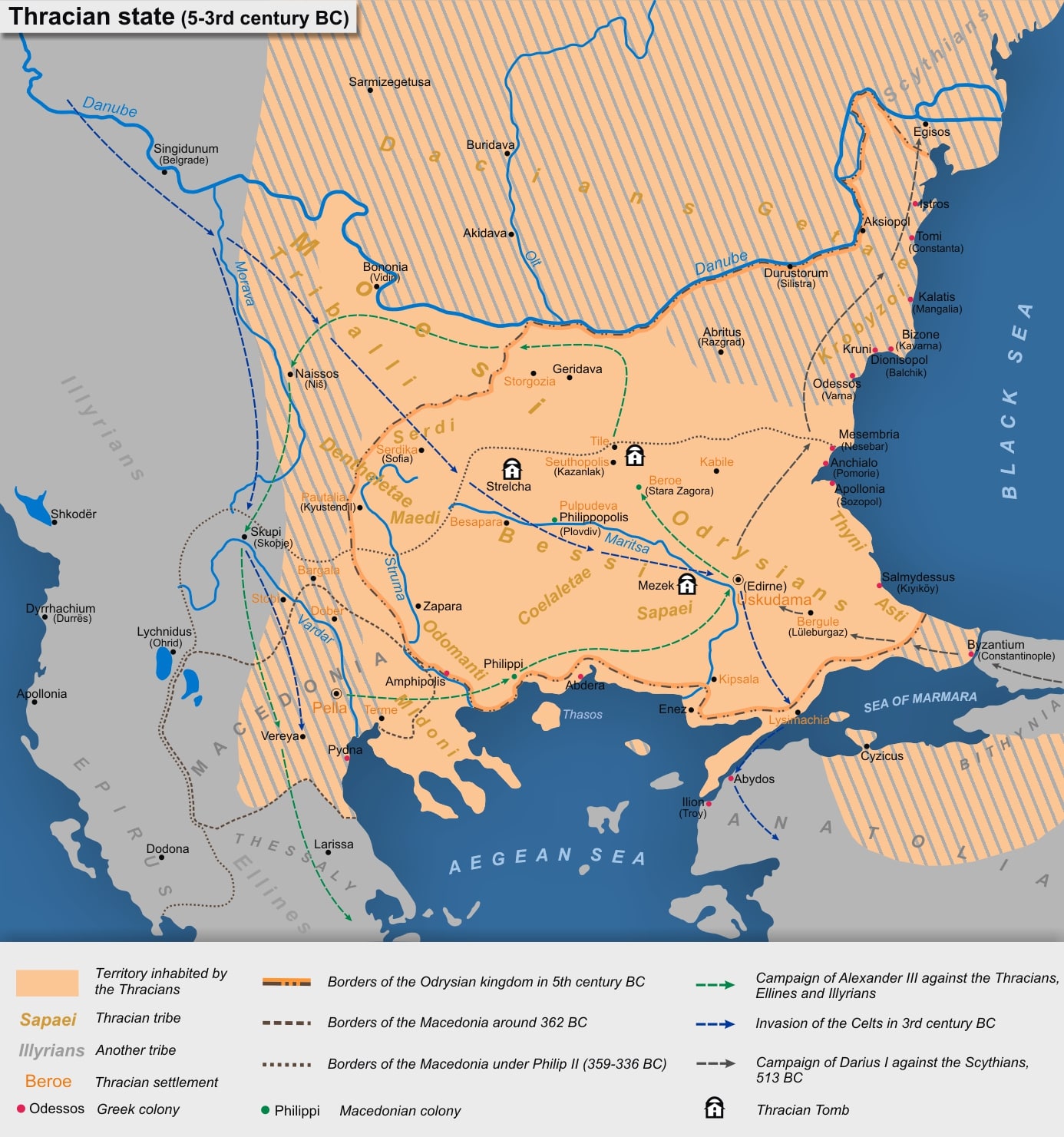
Around 1500 BCE, Thracians emerged to dominate much of Southeastern Europe, especially what is now Bulgaria. In the absence of written historical records their origins remain obscure. The Proto-Thracians are thought to have descended from a mixture of an Indo-European people who came from the Pontic steppe and an indigenous people of Anatolian origin, farmers who had settled there since the 7th millennium BCE. Greeks first founded colonies in Thracian lands in the 8th century BCE, and there was an intense interaction between the Greeks and the Thracians by the 5th century. They remained divided into tribes until they formed the Odrysian kingdom in the 5th century BCE.
The most famous Thracian in history is the gladiator Spartacus, who led a slave revolt in the 1st century BCE. Greek and Roman authors considered them to be barbarians with primitive morals because of their rustic lifestyle, their unwalled villages, and their oral culture. The Thracians nevertheless possessed sophisticated cultural traits, with richly ornamented necropolises for example, while music and poetry occupied an important place in their culture.
Tracing the Thracians: Early History and Ancestry
The ethnonym “Thracian” is a somewhat imprecise term, that like “Hellene” or “Roman” both describes a composite population with a shared culture and simultaneously obfuscates the complexity of the relationship. For ease of description, “Thracian” has been applied by scholars to a people, and their material culture, inhabiting a territory stretching from the Carpathians in the north, to the Black Sea in the east, from to the Vardar River in the west, to the shores of the Aegean Sea in the south. It’s in the pages of Homer that we first read the earliest semi-contemporary mention of the Thracians, in line 434 of Book 10 of the Iliad:
“If you are fearful to enter the throng of Trojans, lo, here apart stand the Thracians, the newcomers, the outermost of all, and amongst them is their king Rhesus, son of Eïoneus. His are the fairest horses that I have ever seen, and the greatest, whiter than snow, and speed like the winds. And the king’s chariot is cunningly wrought with gold and silver, and armour of gold he has brought with him, huge of size, and a wonder to behold.”
In light of the archaeological discovery and excavation of Thracian tombs at sites including Kazanluk (admittedly much later than any proposed date for the composition of the Iliad), filled as they are with beautiful grave goods and gloriously coloured frescoes depicting martial cavalrymen and hunters, it is not surprising that it’s the wealth and horse-based martial culture of the Thracians that Homer emphasized.
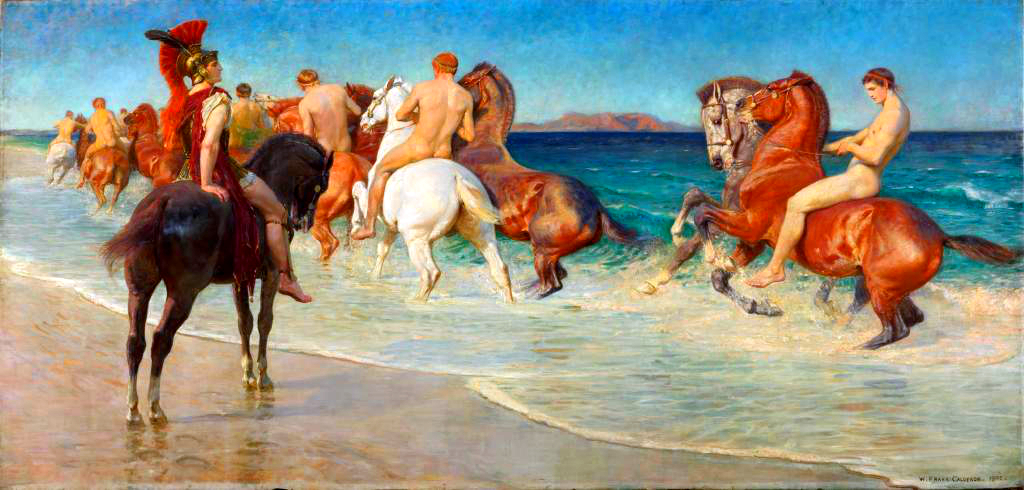
Similarly, Herodotus (Book V, II; Histories) wrote of the Thracian polity of the 5th century BCE: “The Thracian ethnos is the most numerous after the Indian. The Thracians are differently named in each separate region of their country, but the manners and customs of the whole nationality remain just the same everywhere in their rich lands.”
These Thracians that Herodotus was writing about, were very familiar to his Hellenic audience following centuries of interaction, trade, and warfare between Greek colonies on the Black Sea and the Hellenised Macedonians.
The Odrysian Kingdom and its capital Seuthopolis
The Thracian tribe known as the Odrysians inhabited the region around Plovdiv between the 5th – 1st centuries BCE and were the only grouping of all 46 known Thracian tribes to set up an organised polity around a hereditary monarchy, complete with an urban capital. This Odryssian state included all of modern Bulgaria, the modern European chunk of Turkey, and much of modern Greek Thrace and Macedonia, from the beginning of the 5th century to the beginning of the 4th century BCE.
The concentration of Thracian tombs near Plovidv reflects the location of the Thracian capital city of Seuthopolis, which was constructed on a low terrace on the Tundzha river, protecting the city from the south and southwest, while the Goliama Varovita river protected the city’s eastern flank. Seuthopolis was discovered during the construction of the Koprinka Dam, with excavations of the site between 1948 and 1954.
Seuthopolis was laid out on an irregular pentagonal plan and covered over 50 hectares. The city was surrounded by a fortified wall, complete with rectangular towers and bastions reinforcing the city’s relatively unprotected northwestern and northeastern flanks. The city appears to have been laid out in one phase with two main gates in the northwest and southwest leading onto the primary axial streets, crossing each other at right angles at the city Agora, the political centre, with its shrine dedicated to Thracian Dionysius. The northern part of the town contained a royal citadel with a monumental entrance (propylon) where archaeologists excavated a structure tentatively identified as the royal palace. A vast number of imported goods have been found at both Seuthopolis and from earlier Thracian tombs across modern Bulgaria, including amphora and storage vessels containing oil, grain, fine wines and beautiful red-on-black ware. Numerous coins minted by Macedonian kings including Phillip II (r. 359 – 336 BCE), Alexander III “The Great” (r. 336 – 323 BCE), together with coins from Hellenic polis reflect the complex interactions between the Thracian kings and neighbouring and often subjugated Hellenic cities. Thracian kings from Seuthes III (r. 331 – 300 approx.) onwards minted their own coinage, examples of which have been found across the territory of the Thracian kingdom of the 4th century BCE and beyond, in numerous Aegean and Black Sea Hellenic cities.
The Odrysians dominated a united Thracian kingdom for a relatively short period of less than a century – initially weathering political subjugation to the mighty Achaemenid Persian empire – before the centrifugal, political fractiousness of the Thracian tribes split the kingdom into three. The still-dominant Odrysian kingdom was made a vassal of the Macedonian king Phillip II in 347 – 342, only for the Thracians to go into revolt against his son Alexander the Great. For this temerity they were resoundingly trounced in a lightening campaign in 335 – 334 BCE that once again made vassals of the Thracians. The Odrysian king Seuthes III constructed his new capital at Seuthopolis in the manner of Macedonian kings, and his dynasty successfully navigated the chaos of the 4th century, as Alexander’s Companions founded their own successor Hellenistic kingdoms.
The Thracian Tombs: Funerary Rituals and Architecture
The Odrysian aristocracy were interred within stone sepulchres covered by huge kurgan burial mounds (a type of tumulus) of varying internal architecture, and whose walls were covered by rich mural paintings. The earliest sepulchres, dating from the 5th century BCE, are located near Kaloyanovo, around 20 km north of modern Plovdiv, and featured cist burials beneath kurgan mounds, decorated with glorious multi-coloured murals. These tombs were constructed by the heirs and senior tribal aristocrats of the first Odrysian king Teres I (r. 480 – 440 BCE). During the reign of the later Thracian king Kotis I (r. 383 – 359 BCE), at the beginning of the 4th century BCE, monumental masonry-built tombs complete with dromos (antechambers) and burial chambers accessible via a door for ceremonial visits to the dead first appeared. These more complex tombs have been discovered at numerous sites around modern Plovdiv.

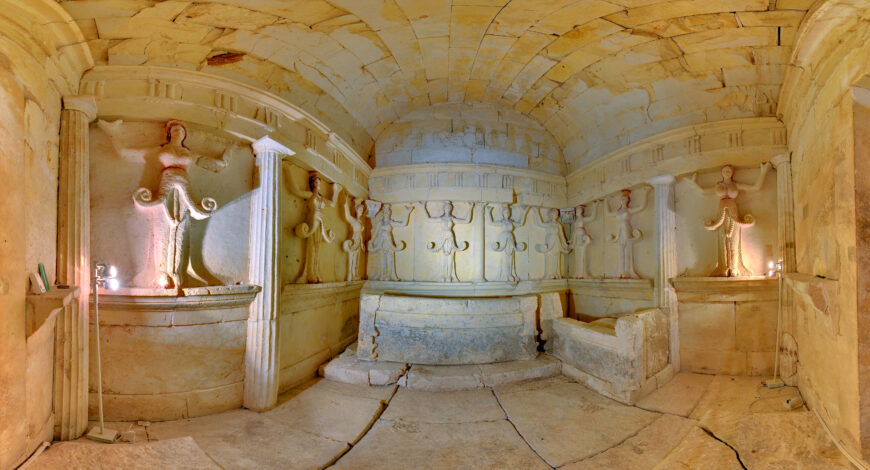
The kurgan of Sveshtari was discovered in 1982 and this 4th century BCE Getic-Thracian inhumation reflects the fundamental underlying structural principles of Thracian cult buildings. The tomb’s architectural decor is unique, with polychrome half-human, half-plant caryatids and numerous painted murals. Ten female figures are carved in high relief on the walls of the central chamber and the decoration on the tympanum is the only example found so far in Thracian lands. It has been suggested by some archaeologists that this may have been the tomb of the earliest known Getic ruler, Cothelas who swore vassalage to Phillip II of Macedon in 341 BCE and married his daughter Meda of Odessa to the father of Alexander. Following Phillip’s assassination, Meda committed suicide and was interred with her husband at Vergina. In 2012, archaeologists uncovered a significant hoard near the tomb, including a golden ring, 44 female figurines, a number of snake-headed bracelets, and 100 golden buttons – further tangible evidence of the solid cultural and mercantile links between Thracian and Hellenic worlds of the mid-1st millennium BCE.
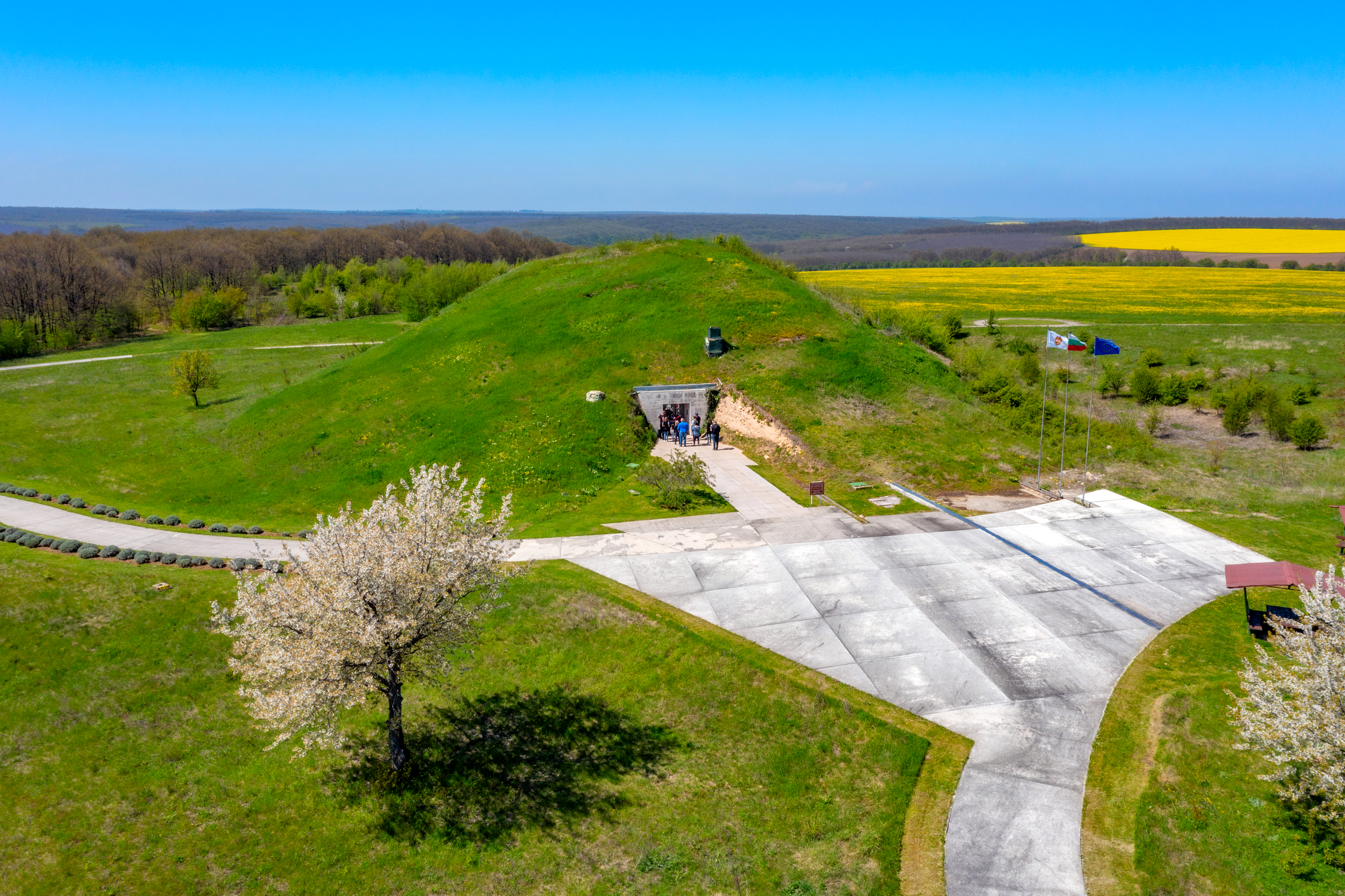
The village of Starosel hosts the largest and most elaborate monumental tomb in ancient Thrace. Discovered in 2000, it is believed that the tomb was built between 350 and 330 BCE, most likely for Sitalkes I, one of the last Odrysian rulers before Philip II of Macedon’s conquest of Thrace in 341 BCE. Besides its significance for understanding the development of monumental architecture in Thrace, the Starosel tomb is particularly important for providing new insight into the process of hybridisation of building traditions that came to define Hellenistic architecture.


The tomb was originally a monumental temple at Golyama Kosmatka mound, built in the second half of the 5th century BCE. After extended use as a temple, around 300 BCE, Seuthes lll was buried inside. Inside is situated one of the most majestic and rich Thracian tombs with a completely preserved grave of a Thracian king, buried with his horse. It was built in the 5th century BC and consists of three chambers and a corridor with a total length of 26 metres. The first room is rectangular, and a skeleton of a horse has been discovered in it. The second room is round, with a beautiful 450-centimetre-tall dome-shaped roof. There is a marble door with images of people at the entrance of this room. The third room is actually a monolithic granite block – a sarcophagus weighing about sixty tons. There is an inner room, carved into it with great precision, and inside it is the stone bed of the Thracian ruler who was buried here. More than twenty gold objects with great artistic value have been discovered inside the sarcophagus as well as numerous silver and bronze vessels. Of no lesser value is the iron sword with golden application, a bronze sword, a helmet, an armour-plate, as well as other weapons. The life-size bronze head of a bearded man with eyes made of precious minerals is quite intriguing and believed to represent Seuthes III.
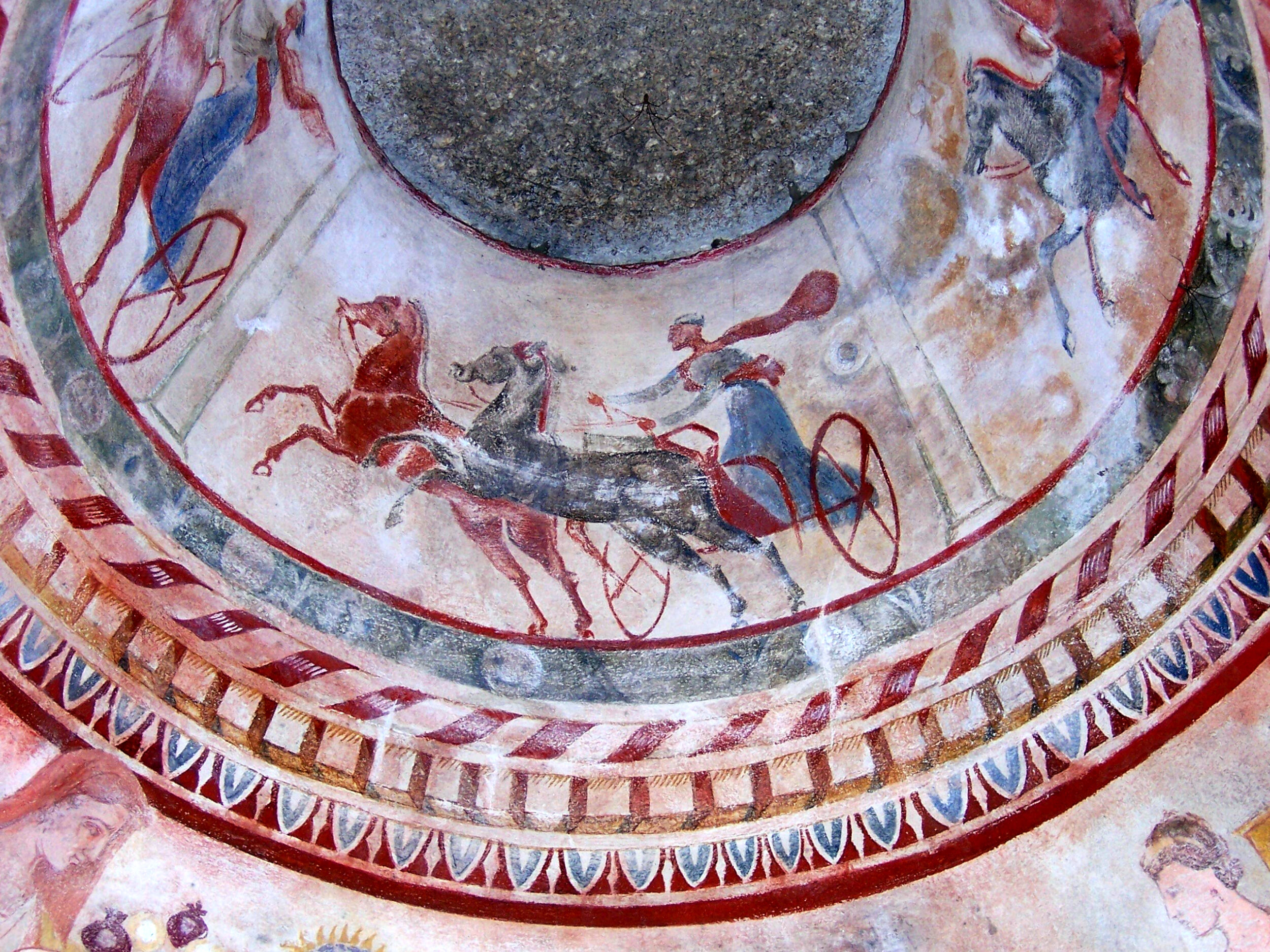
The Thracian Tomb in Kazanluk (replica) is decorated with beautiful 4th-century BCE frescoes. This mausoleum of the 4th century BCE was discovered in 1944. The style is typical of Thracian tombs from that period, with a vaulted entrance corridor and a chamber topped by a beehive dome. The tomb has fine reliefs and interesting early paintings. The reliefs depict architectural and plant motifs and battle scenes. The dome paintings are the greatest treasure of the tomb. They are a masterpiece of Hellenistic art and depict a funeral feast and racing chariots
Repeated invasions of the Balkans by Romans, Celts, Huns, Goths, Scythians, Sarmatians and Slavs, accompanied by hellenization, romanization and later slavicisation, remade the ethnicity, language, and culture of Thrace. Regardless, writers continued to speak of a separate Thracian nationality until the Early Middle Ages. Christianity eventually replaced the worship of Dionysus and other Thracian gods, and the last mention of Thracians, in the 6th century, coincides with the first mention of Slavs. After the 6th century Thracians who weren’t already assimilated in the Byzantine Empire were incorporated in the Slavic speaking Bulgarian Empire.
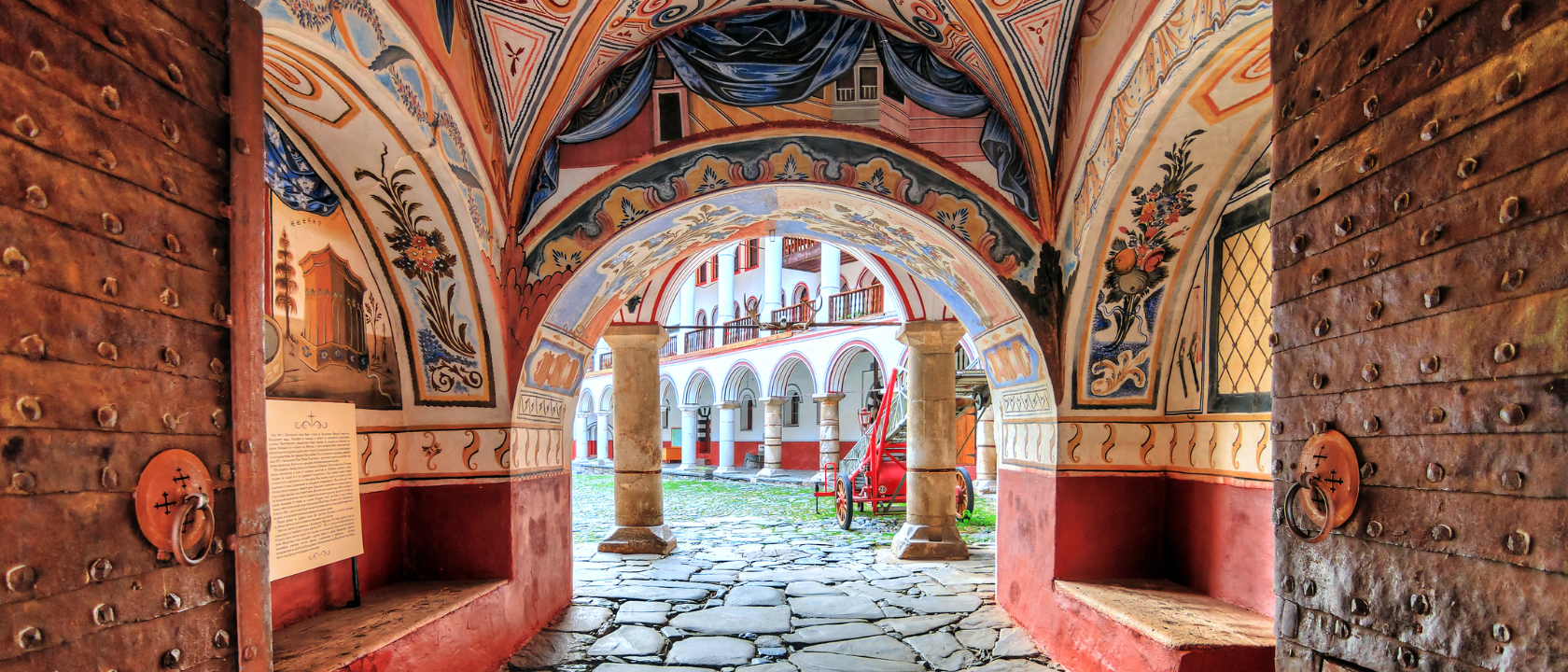
Explore the history and heritage of the Thracians on our tour Bulgaria & the Black Sea: Painted Towns, Byzantine Monasteries & Thracian Treasures travelling from Sofia across to the Black Sea coast with Bulgarian archaeologist Prof. Ivan Vasilev.
View our current selection of programs to Bulgaria
Article images
Tomb in Sveshtari, Bulgaria by Interact-Bulgaria, CC BY-SA 4.0 <https://creativecommons.org/licenses/by-sa/4.0>, via Wikimedia Commons
Thracian state by Kandi, CC BY-SA 4.0 <https://creativecommons.org/licenses/by-sa/4.0>, via Wikimedia CommonsBas-relief of Ramesses II on his chariot during the Battle of On the sea-beat coast, where hardy Thracians tame the Savage Horse by William Frank Calderon, Public domain, via Wikimedia Common
Thracian Tomb of Sveshtari in Bulgaria ID 245734735 © Dudlajzov | Dreamstime.com
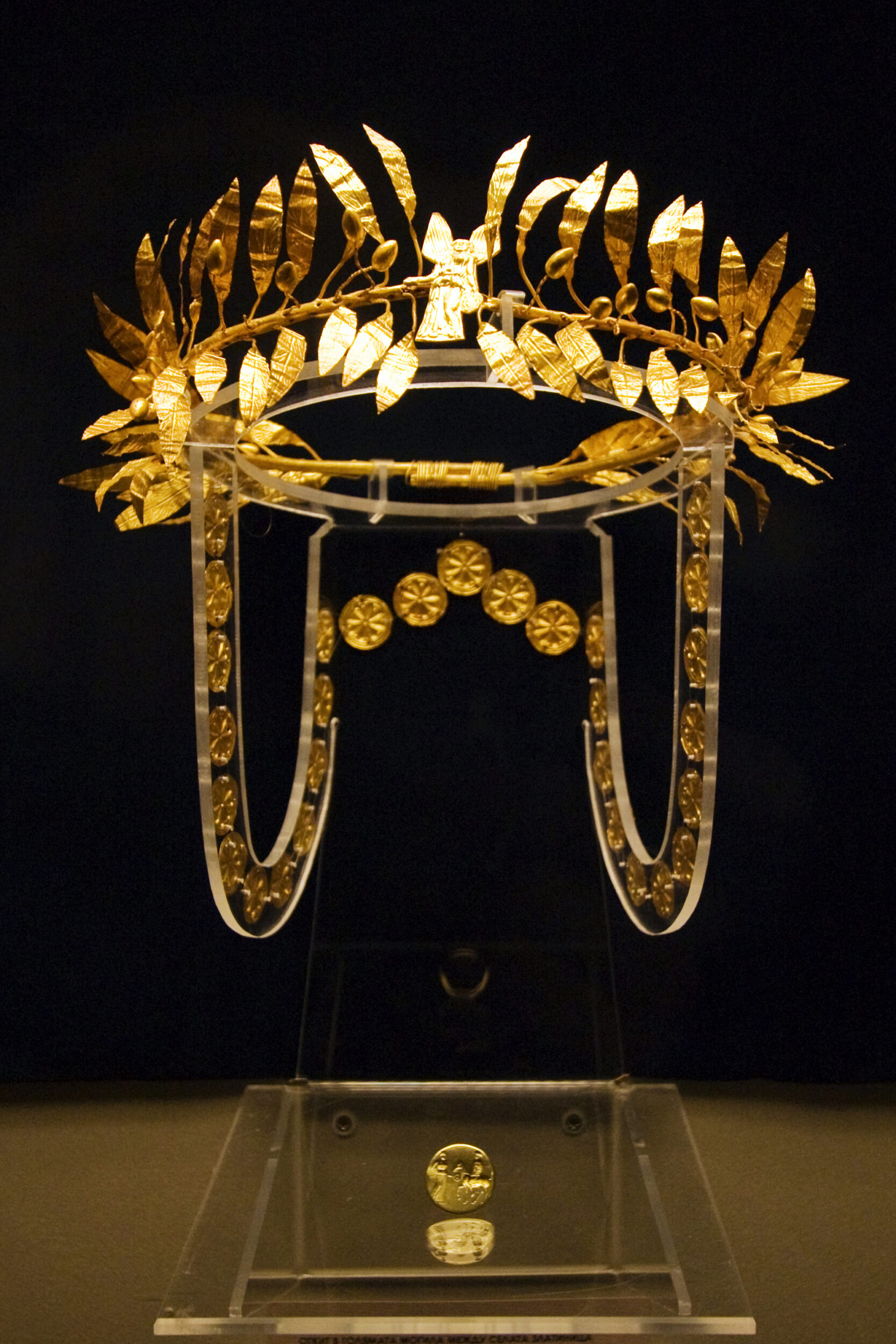
Odrysian Wreath from Golyamata Mogila. Photo by Ann Wuyts. Public Domain
Tomb in Sveshtari by Interact-Bulgaria, CC BY-SA 4.0 <https://creativecommons.org/licenses/by-sa/4.0>, via Wikimedia Commons
Aerial view of a Thracian tomb at Starosel, Bulgaria ID 211023587 © Dudlajzov | Dreamstime.com
National Archaeological Museum Sofia – Bronze Head from the Golyama Kosmatka Tumulus near Shipka by Ann Wuyts, CC BY 2.0 <https://creativecommons.org/licenses/by/2.0>, via Wikimedia Commons
Reproduction of Thracian tomb via WikiCommons Creative Commons Attribution-Share Alike 3.0 Unported
These images have been resized and edited for this website
 Bulgaria & the Black Sea: Painted Towns, Byzantine Monasteries & Thracian Treasures 2027