
A Tale of Three Digs at Edinburgh Castle – Scotland’s Greatest and Least Understood Royal Fortress
by Peter Yeoman
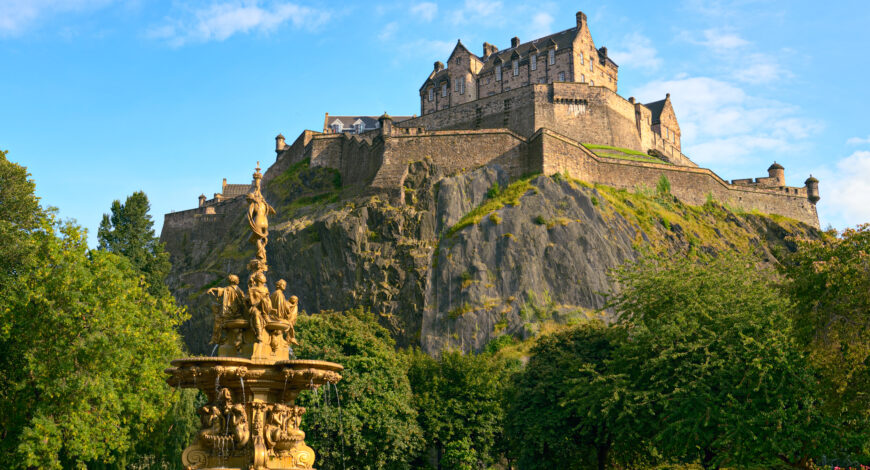
For almost 2 million visitors a year the Castle embodies the ultimate symbol of ‘Caledonia Stern and Wild’, the image that launched a thousand souvenir tea-towels. But surely the castle stands for much more – a prehistoric fort and royal fortress central to the history of Edinburgh and Scotland. Centuries of military use have obscured much of the medieval castle, and this coupled with the fact that there has been little in the way of archaeological excavations has restricted our understanding of the place. The archaeological work which has been done has been extremely successful in revealing tantalising evidence: three of the main investigations are outlined here.
The first major investigation took place in 1912 when W T Oldrieve, Chief Architect His Majesty’s Office of Works Scotland, was exploring the cellars under the Palace then used as the army’s canteen. The Castle today is fronted by the familiar curving bulk of late 1500s Half-Moon Battery, but Oldrieve worked out that parts of the great lost royal residence David’s Tower (commenced 1367 under David II) might still exist below and behind this.
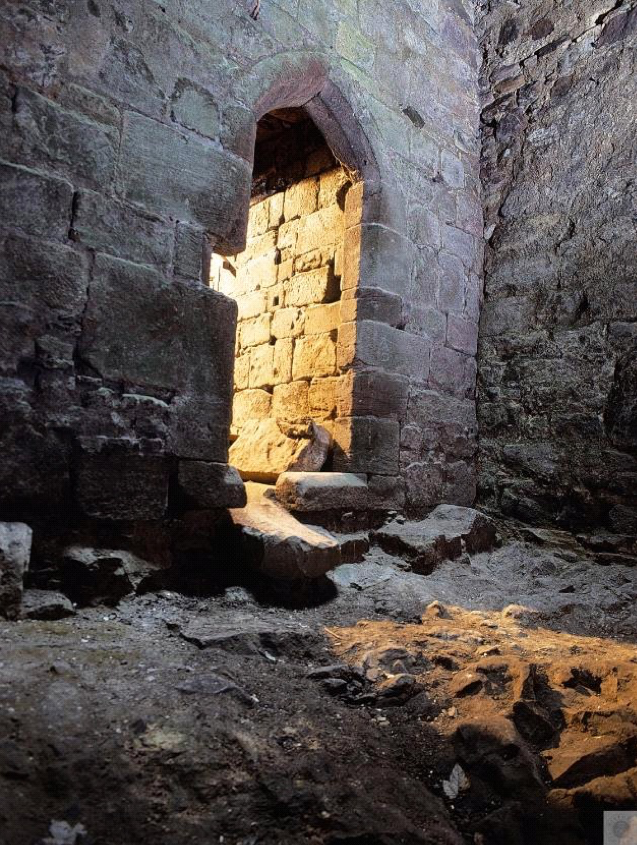
Oldrieve broke through the pavement of the Half-Moon Battery (real Indiana Jones stuff, so out of character for this Edwardian Baptist) into a partly infilled void and was immediately confronted with the outer face of the Tower bearing dramatic visceral scars from its final days under fatal bombardment by Elizabeth of England’s artillery. The English guns had been shipped up and brought to bear on the Castle resulting in the rapid conclusion of the ‘lang siege’ of 1571-73, when the Castle was held by forces loyal to exiled Mary Queen of Scots. David’s Tower, aggressively fronting the Castle, suffered catastrophic damage and collapse. At a depth of five metres he came down onto the vault over a chamber, broke through this, and was amazed to be confronted by the worn steps and doorway of the original front entrance to the tower.
He discovered that its massive broken walls, almost three metres in thickness, still rise 12 metres in height above its rocky base, being barely covered by the paving above, utilised as a foundation to hang the Half-Moon off. Incredible to think that a building of such importance – a principle royal lodging and the prototype tower-house – has been hidden for so long. Oldrieve quickly published his results, and visitors today can experience something of this mighty tower thanks to Oldrieve’s questing mind.
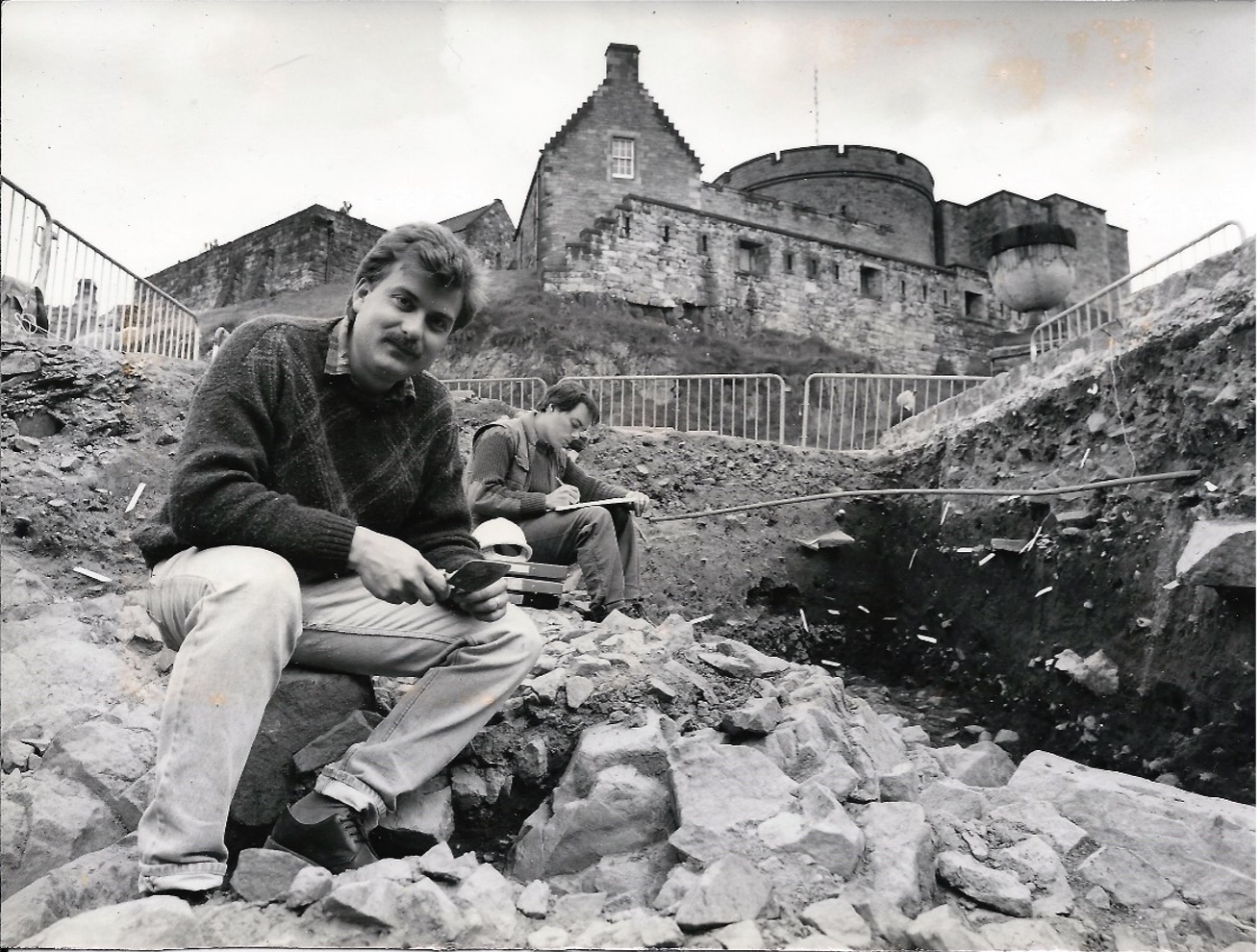
The second dig – from 1987-89 I was fortunate in leading the major campaign of excavations as part of the vehicle tunnel, and multiple other associated works. Not sure how to accommodate me and my team, we were allocated curious accommodations – one in the vault directly under the One O’ Clock gun (remember to put fingers in ears), and another under the stomping tackety boots of the Army School of Piping! Due to the obvious surface outcropping of basalt, the tunnel project leader told me that “we’ll give you two weeks and you won’t find anything”. Well, two years later we’d discovered Roman Iron Age huts, early medieval middens, the road to the back postern where the body of St Margaret had been smuggled out in 1093, the 1335 smithy for the Edward III of England rebuilding after the Bruce destruction, defences of every period, a pit where all the Castle dogs had been killed and buried maybe during an epidemic, a hitherto unknown cemetery where the dead of the garrison were buried in the Glorious Revolution siege of 1693, and moreover doubled the age of the Castle back to the Bronze Age c 900 BCE. Phew!
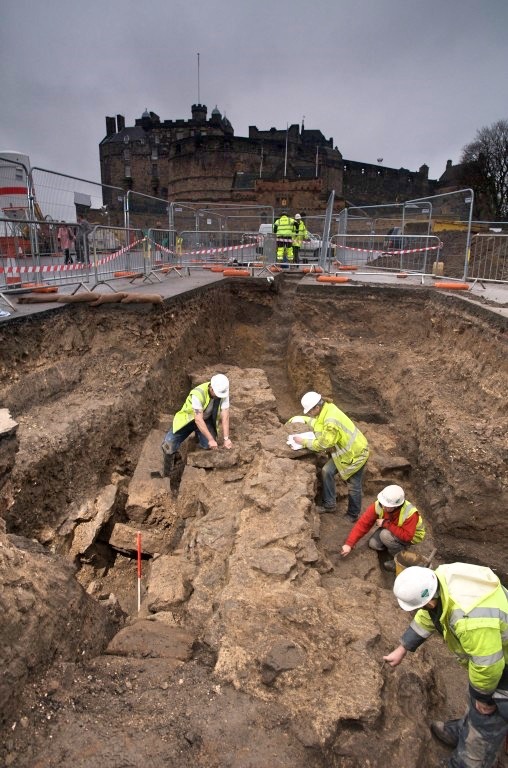 As part of the team responsible for the Castle, I ensured that any works had a suitable archaeological response, and this resulted in 2010 in our third major investigation, when the Royal Edinburgh Military Tattoo Ltd commissioned the construction of a new grandstand. This involved some major works on the Esplanade for the 326 piled foundations, so I advised the contractors in appointing a team of archaeologists to monitor the works. As well as tracing the development of the area, we hoped to locate the artillery bastion built in 1548 with French cash by a leading Italian military engineer. Demolished in 1650, we were amazed when CFA Archaeology located the deeply-buried pointed nose of the Spur towards the town-end of the Esplanade.
The results of all these investigations have been published, and I’ve been able to summarise our generational new understandings in co-authoring the latest guidebook.
Above all, what has been demonstrated is that the archaeological potential is really high, even in unlikely looking parts of the Castle. We are learning more all the time, with Historic Environment Scotland commissioning new research producing wider understandings, challenging mythology – who knows what more secrets will yet be revealed!
Peter recently co-authored the fabulous new edition of the Historic Scotland Edinburgh Castle official guidebook. The research continues and he is currently commissioned by Historic Scotland to write the Statement of Significance for the medieval royal lodgings and Palace. “After 40 years I’m beginning to understand the place!”
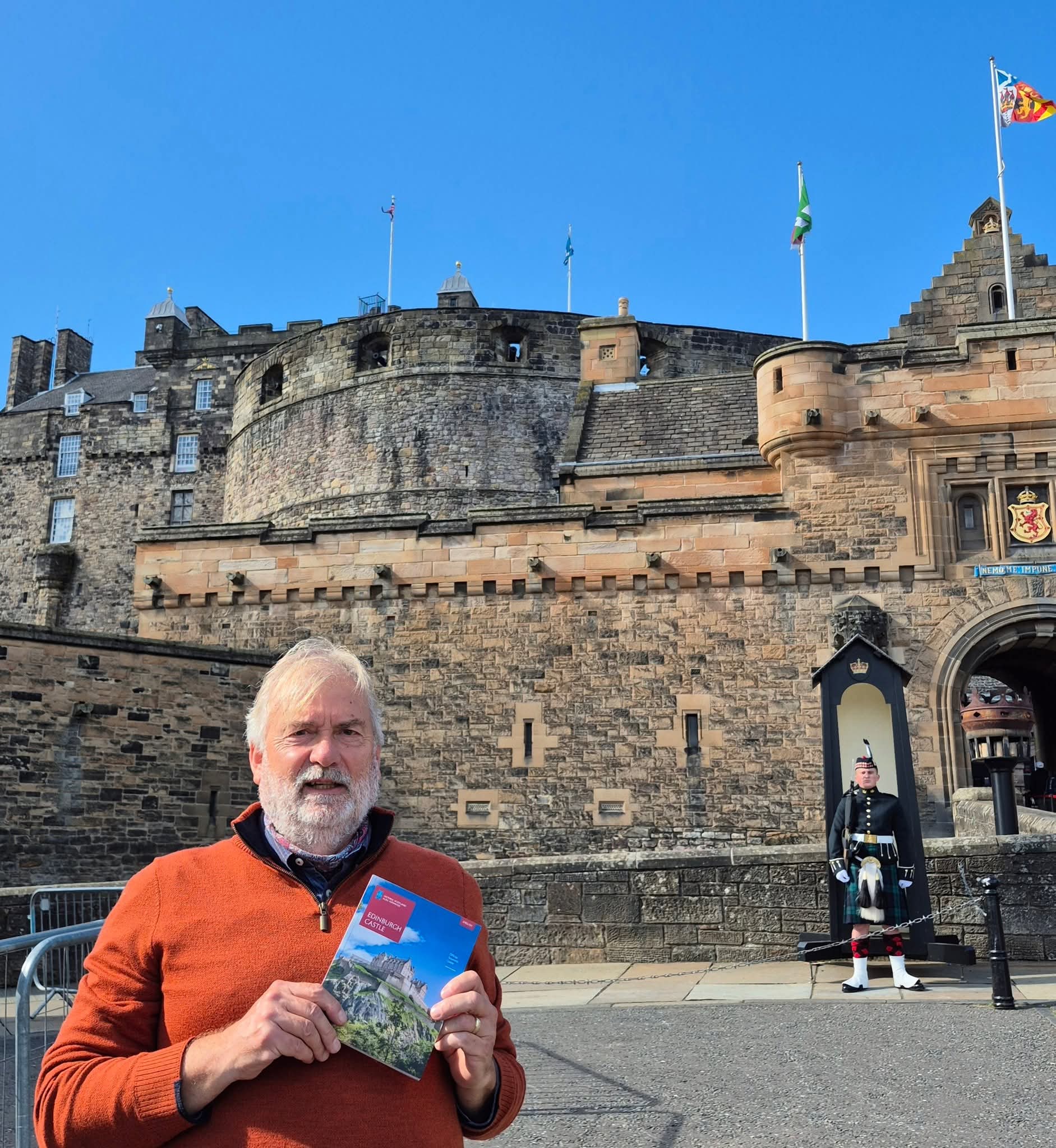
Join Peter Yeoman as he leads ASA’s The Scottish Highlands & Inner Hebrides: Castles, Gardens & Archaeology in May/June 2026. Travel through the beautiful and varied landscapes of his native Scotland, exploring the many layers of its history. Peter was Head of Cultural Heritage and then Principal Heritage Researcher at Historic Scotland, working across their 340 properties, along with the management of World Heritage Sites. He wrote the guidebooks for both Edinburgh and Stirling Castle and is an expert on the fascinating cultural heritage of Iona.
Article Images
Photo 1 : Edinburgh Castle, Scotland from Princes Street Gardens, with the Ross Fountain in the foreground ID 16285905 | Edinburgh Castle © John Pavel | Dreamstime.com
Photo 2 : The front entrance to David’s Tower c1370 as rediscovered by Oldrieve in 1912. © Historic Environment Scotland
Photo 3 : The author sitting on the 11th century road leading down to the postern gate, found in the 1988 tunnel excavations. © Historic Environment Scotland
Photo 4 : Nose of the 1548 artillery Spur discovered during Tattoo stand works in 2010. © Historic Environment Scotland
Photo 5 : Peter in front of Edinburgh Castle
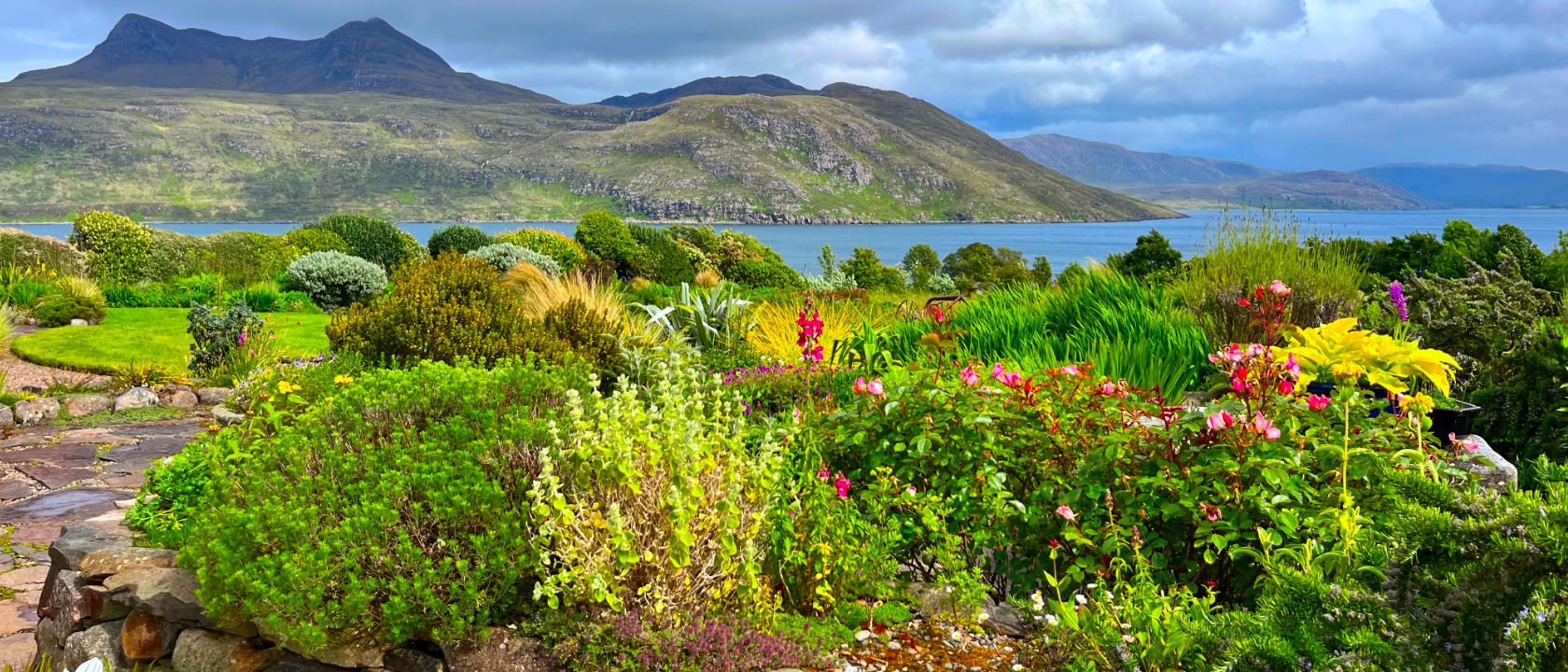 The Scottish Highlands & Inner Hebrides: Castles, Gardens & Archaeology 2027