
Isola Bella & Isola Madre: The Art of Terracing
by Assoc. Prof. David Marshall
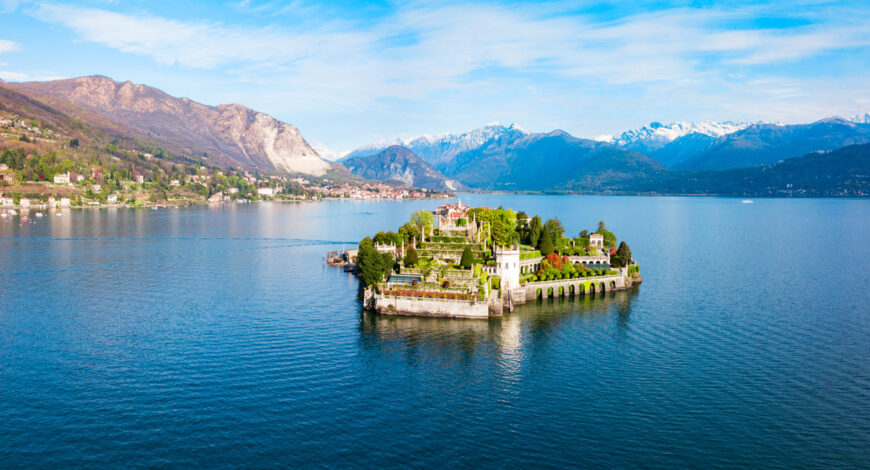
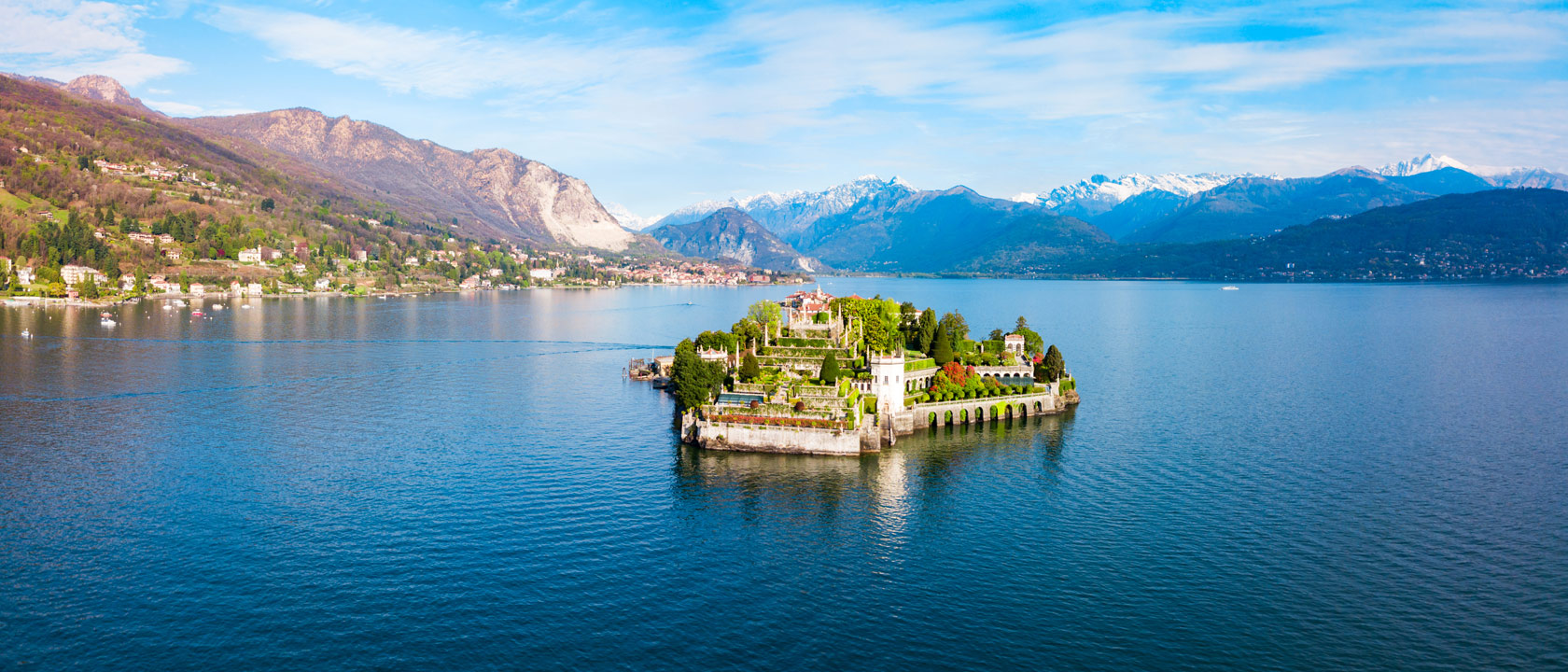
The highlight of any visit to Lake Maggiore is the Borromean islands Isola Bella, Isola dei Pescatori, and Isola Madre. They are found on a westward arm of Lake Maggiore, the first two not far offshore from Stresa, the last in the middle towards Pallanza on the other side of the arm. The lower Alps rise up spectacularly behind them, and the climate is famously mild.
Isola Bella is indeed a beautiful island, even if its name is actually a contraction of Isola Isabella. Italians habitually name their properties after owners, not features. Both names are rather more poetic than the original ‘Isola Inferiore’, and ‘Isola Superiore’ (now usually known as Isola dei Pescatori, or Fishermen’s Island), particularly as the latter is so much smaller. The Italian terms are in fact descriptive of their geographical orientation: ‘lower’ and ‘upper’.
So, is Isola Bella beautiful? In my opinion, it is the most beautiful garden in the world; the perfect balance of formality and informality in the most magnificent of settings, and, being an island, without any messy transitions to the commonplace that most other gardens, however beautiful, inevitably have. It can only be approached by boat, so can be admired from the water.
Yet Isola Bella has received its fair share of criticism that goes back to the defining moment of European gardening, when the formal baroque garden of perfect geometry and plants chosen to look well in pots or shaped, gave way to the informal English garden style of winding paths and specimen trees. ‘It’s too formal’ one still hears today from visitors.
But in spite of this bias toward English garden informality, for these same critics the visit to Isola Madre, invariably the second stop on the itinerary, can come as an anticlimax. Here we find English-style winding paths and mature specimen trees, such as the swamp cypress, with its ‘knees’ sticking up through the lawn. In any other situation Isola Madre would be the highlight of any day, or week, of garden visiting, but the experience of Isola Bella is of a different order altogether.
Isola Bella: Exploring the Influence of Its Unique Lake Setting
Even the most ardent admirer of baroque formality is taken aback by early representations of both Isola Bella and Isola Madre. In these views we see terraces, and only terraces: nature is barely present, and there is little variety. Most gardens can look grim after the bulldozers have done their bit and before the planting has begun, and this is effectively what these views record. The most bizarre are by the Borromeo architect Alessandro Antoniani (1715/17). Some are installed at Isola Madre, and were included in the Mostra del Giardino Italiano in Florence in 1931, the exhibition that promoted an Italian national garden style that focused on hedges and terracing without flowers (Fig. 1). Others have appeared on the art market (Fig. 2).
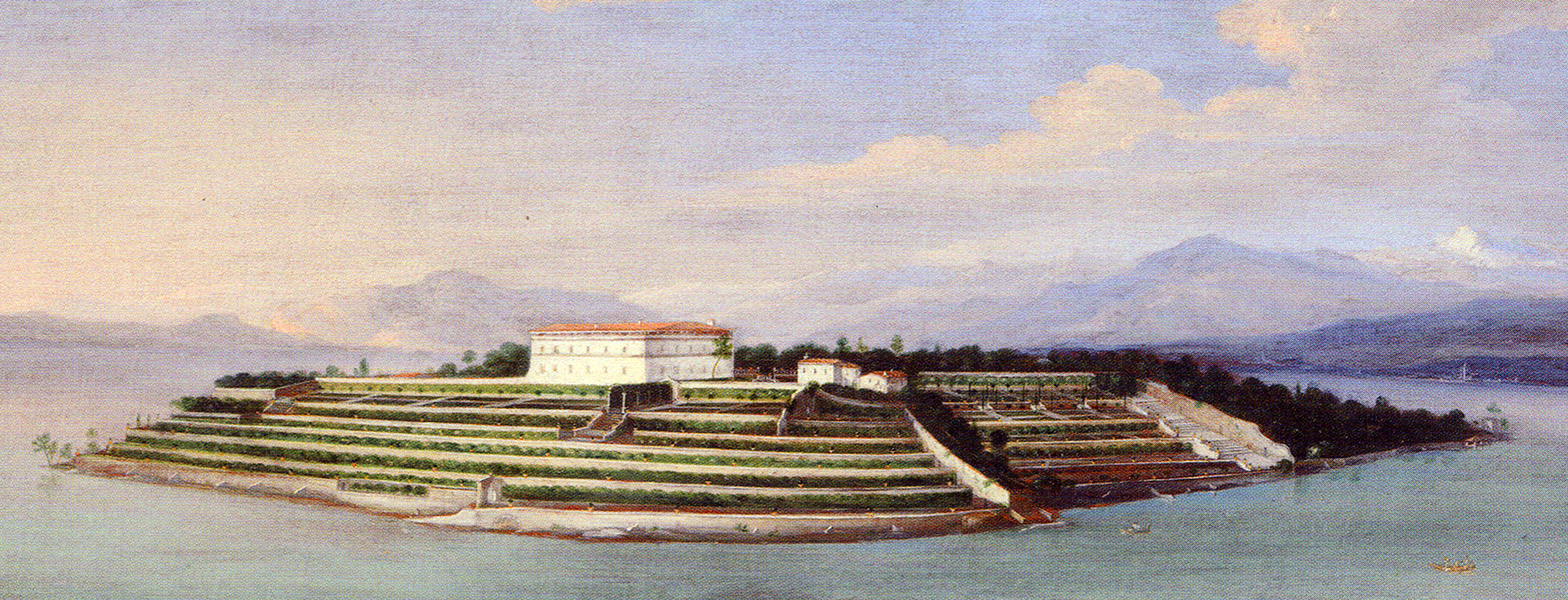
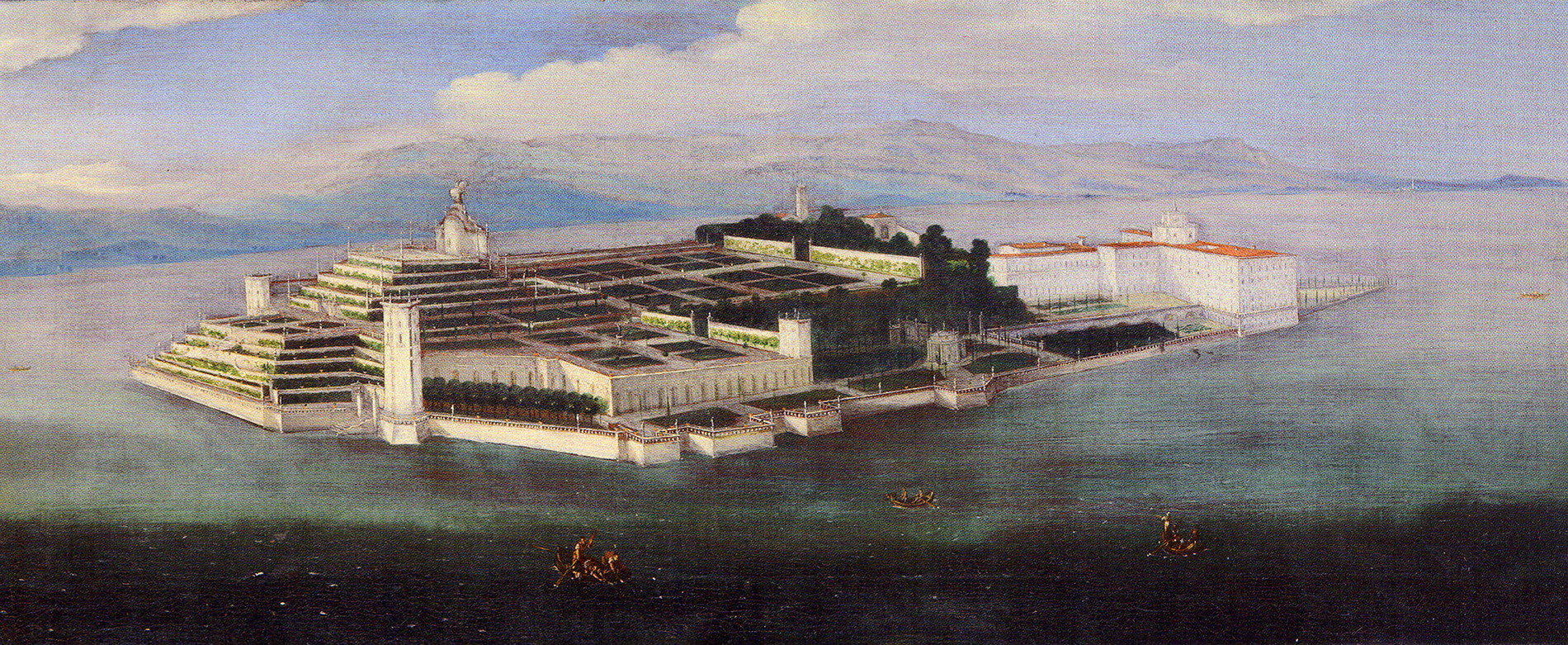
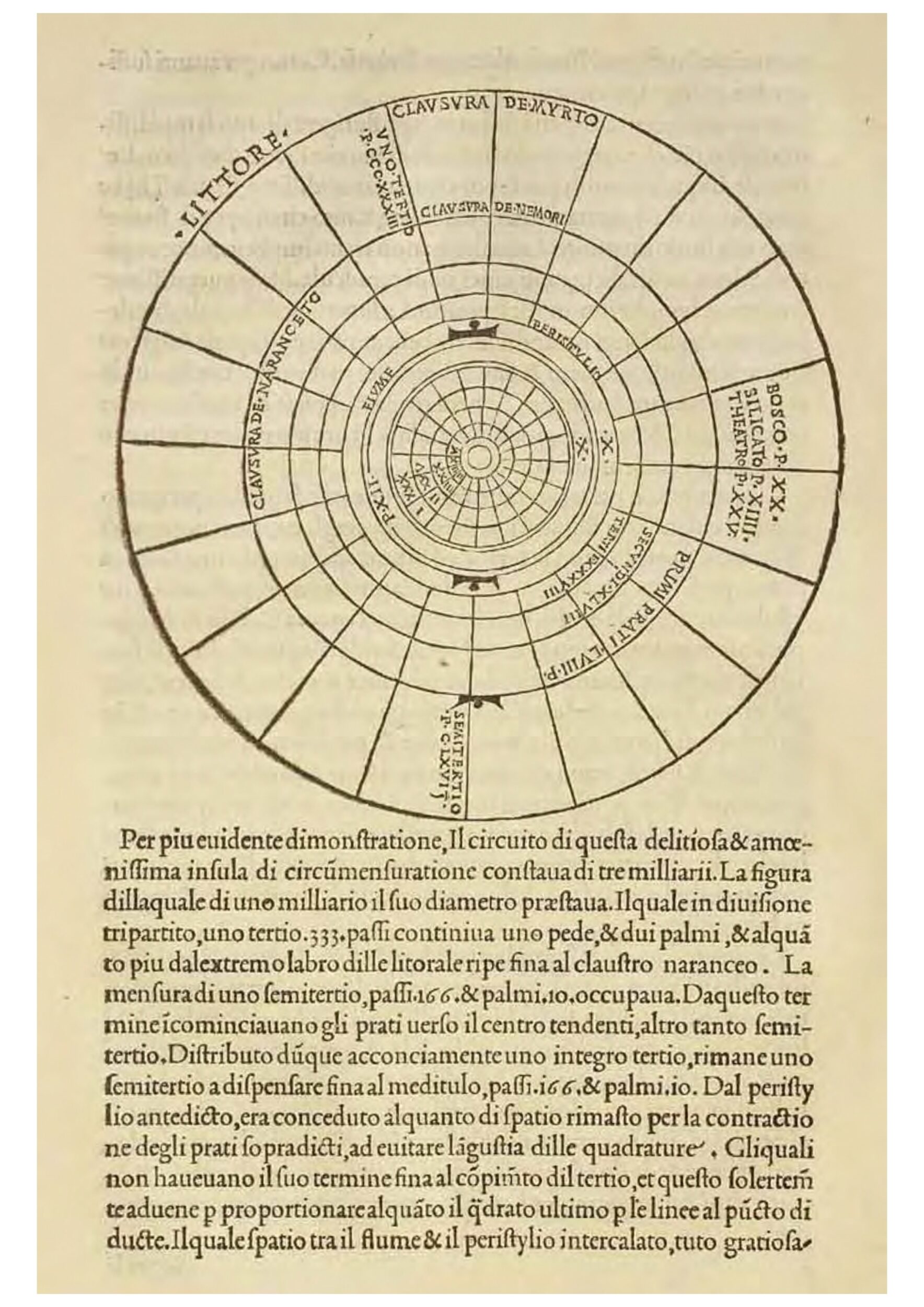
They show both islands as multi-decked cruise ships made of white and green Lego bricks. The view of Isola Madre looks like a series of concentric garden rings and in this respect recalls the most famous fantasy garden-island of the Early Modern imagination, the garden of Cythera in the Hypnerotomachia Poliphili (Fig. 3 Francesco Colonna, Hypnerotomachia Poliphili, Venice, 1499).
This bizarre illustrated erotic romance of 1499 tells the story of the odyssey of Poliphilo (lover of Polia) as he searches through a fantasy landscape for his love Polia, and finds her, dreams enfolded within dreams. This garden-island, centred on the Fountain of Venus, is described in intricate verbal detail that goes on for page after page: regular groves of trees and shrubs, topiary and hedges, controlled by a geometry that is set out in a diagram. In Antoniani’s view of Isola Madre it is as if the concentric rings of the garden of Cythera have been pushed up and given relief, like a collapsible lantern.
But already at this date differences between the two islands are stark. Isola Madre appears as a layer cake of terraces with a rather ordinary block-like palazzo on top, while Isola Bella is a more coherent and varied design, with a balance between towers and terraces dominated by the ship’s superstructure of the Teatro. The garden has, so to speak, erupted out of the water, pushing the palazzo, with its more complex butterfly plan, to one side. Conversely, an engraving by Marc’Antonio del Re of Isola Madre of 1726 plays down the height of the terraces and inflates the size of the palazzo, showing the whole top of the island as a flat surface divided into traditional Renaissance squares.
Isola Bella is in fact shaped like a pointed pear following the line of a partly submerged ridge leading to Isola dei Pescatori with the tiny, vegetated rock of the Scoglio della Malghera between. The Baroque architect Carlo Fontana, Bernini’s successor as Rome’s architectural supremo, presented his 1686–87 design for the gardens as an imagined bird’s-eye (or drone) view from the south-east, conceived in oblique one-point perspective. This is reminiscent of a view of Versailles by Pierre Patel of c. 1668 that shows a bird’s eye view of an early stage in its development with the perspective lines converging far away beyond the confines of the estate, which is usually interpreted as an image of the Baroque ruler’s desire to control the distant countryside from his seat of power.
Fontana’s design, set out as a huge drawing on multiple sheets of paper stuck together, and still at Isola Bella, was intended as the master plan for the island-palace. It was popularised by the Austrian architect Fischer von Erlach (1656–1723) in a simplified variant in an engraving in his Entwurff einer historischen Architektur (Outline of an Historical Architecture) (1721), a kind of architectural wonders-of-the-world illustrated book (Fig. 4). Fischer’s image shows the island as an architectural arrow extended by a terrace that must have reached to the Scoglio della Malghera or beyond, the pointed end of the terrace conflated with the vanishing point. (Fontana’s drawing is more accurate in showing the vanishing point correctly on the horizon.)
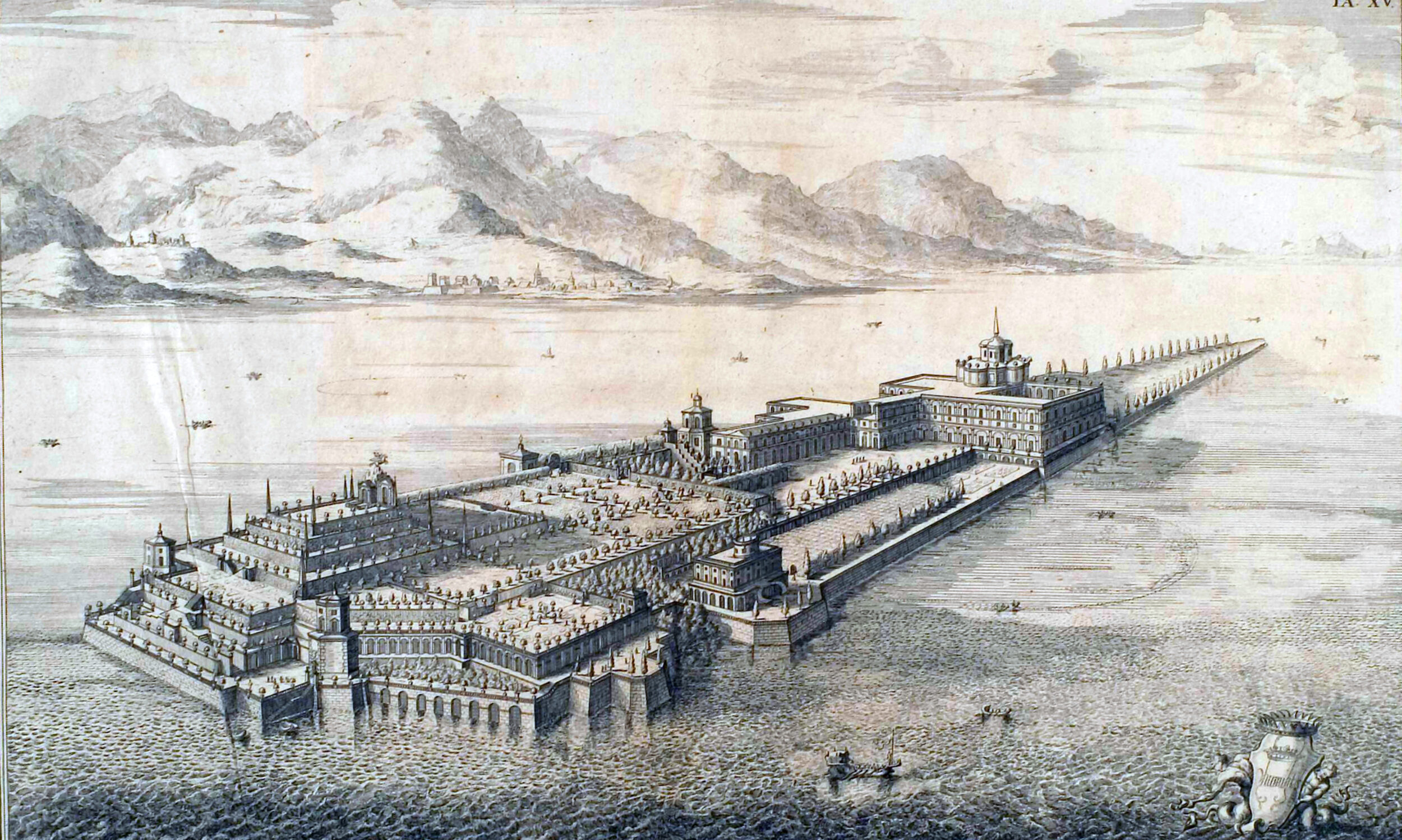
This extended terrace was never executed, and accurate seventeenth-century topographical views show the palace simply ending on some rocks, with a trail of reefs leading in the direction of the Scoglio della Malghera out of sight. A project of the late eighteenth century, recorded in a model of 1812 in the palace, shows instead a harbour enclosed with arm-like moles, a reduced version of which is found there today.
Baroque Visions: The Role of Perspective in Architecture and Garden Design
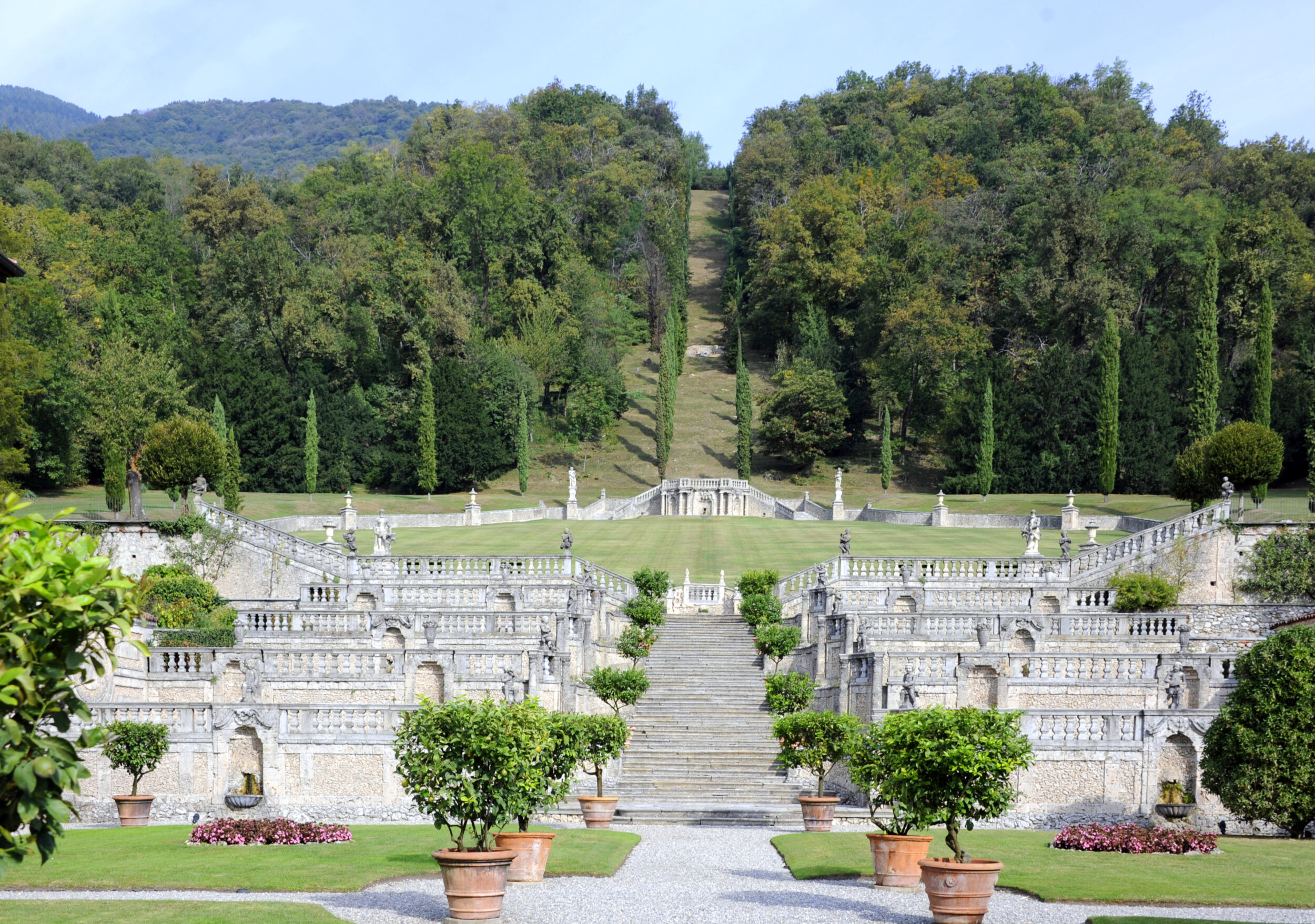
In the Baroque period, perspective could be an important tool of garden designers as well as architects, as is evident today in the Villa della Porta Bozzolo at Casalzuigno, in the hills between Lake Maggiore and Lake Como.
Italian villa gardens were often confronted with difficult, hilly terrain. The usual Renaissance garden concept was a regular grid of squares (this is how Versailles began), and the initial solution was to terrace it as much as possible to create flat, rectangular garden areas, as at the Villa d’Este. In Italy’s mountainous terrain, the Baroque interest in axial perspectives, combined with a desire for economy, often led to a garden with a central avenue climbing a hill, as at Giardino Giusti in Verona and Villa Barbarigo at Valsanzibio in the Euganean Hills near Padua, both of which rise from square compartments on flattish land, and the Villa Chigi at Cetinale near Siena. Even the sixteenth century Villa Cicogna at Bisuchio, not far away from Casalzuigno, has one.
At Casalzuigno, however, the uphill axis is designed to move from wide to narrow in forced perspective when seen from the entrance gate, where the envious passer-by is treated to a spectacular sight that consciously alludes to the perspective sets of Baroque theatre (Fig. 5). This axis is conceived visually: to ascend it is quite strenuous.
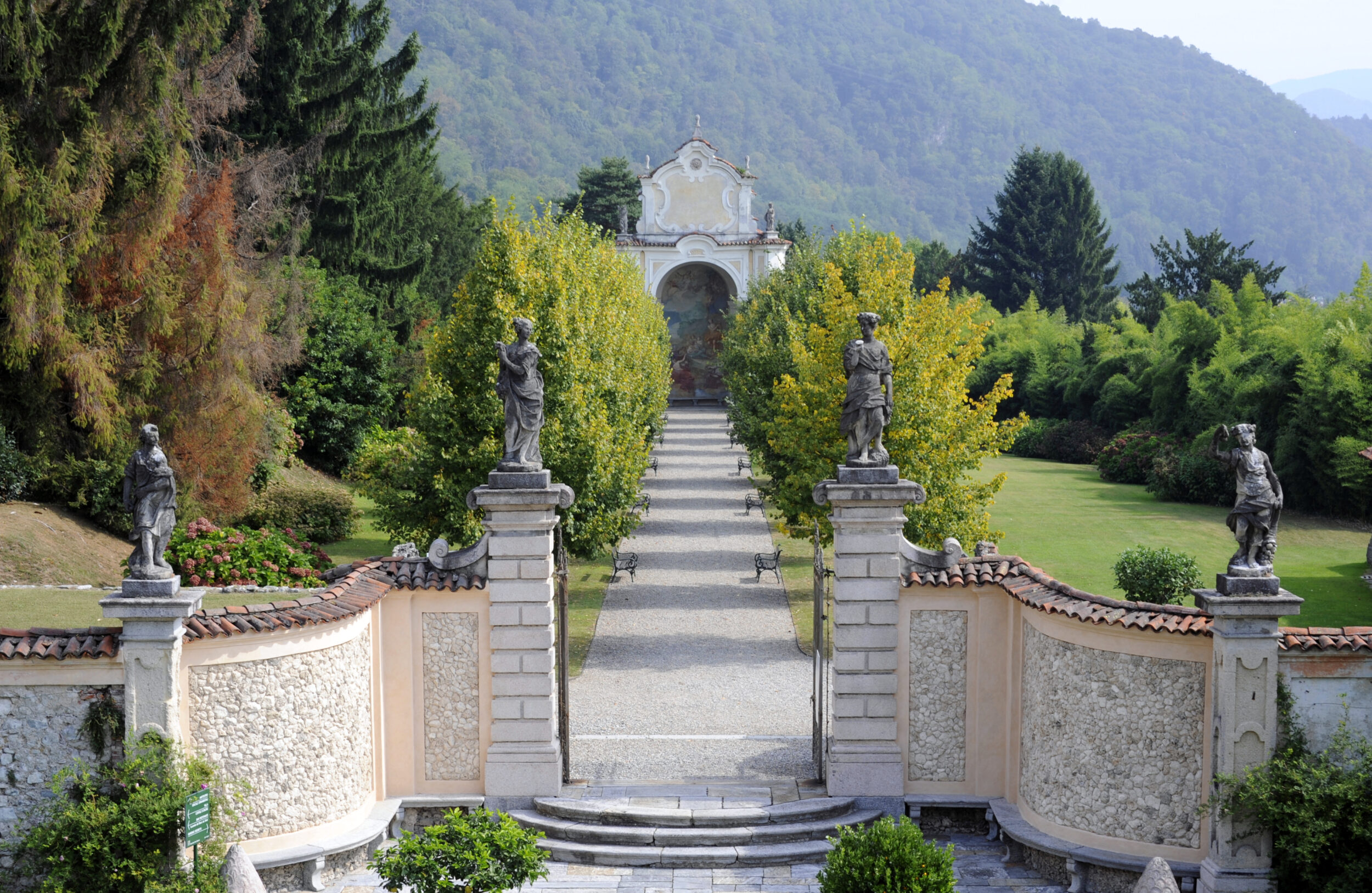
At the bottom of the hill, this axis crosses another at right angles aligned with the entrance to the palazzo, lined with trees and ending in a frescoed pavilion (Fig. 6). This axis would have been attractive to well-dressed Baroque sociability (and to the footsore tourist) as it is an easy stroll there and back and you get to see most of the garden and admire the views to the hills opposite. There is a parallel avenue above, also terminated by a pavilion.
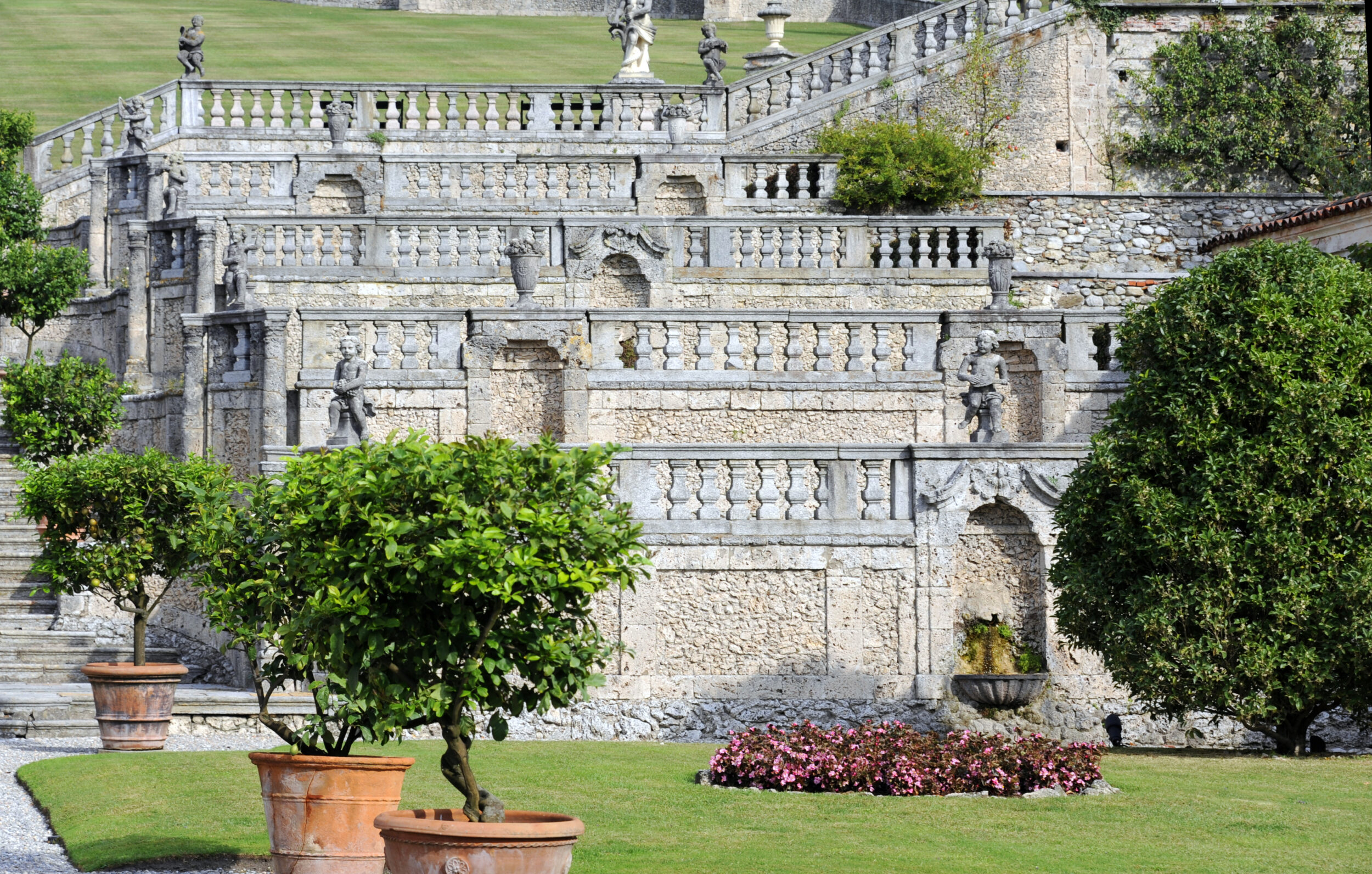
Above the main avenue are five terraces, each with a retaining wall, balustrades and, originally, rows of potted citrus trees (Fig. 7). Seen from below they recall the repetitive terraces at Isola Bella and Isola Madre as seen from the water, but the difference is that that these terraces are primarily markers of the ascent established by the central axis rather than boundaries of garden spaces. The spaces that lie between them are of subsidiary interest, and the visitor has little motivation to go the ends of them.
Above this is a grassed octagonal area or ‘Teatro’ that aspires to breadth and flatness but is in fact on a steep slope. This ‘Teatro’ is like a modern piece of placemaking in that, unlike the Villa d’Este or the Isole, it does not attempt to make level sloping and uneven ground. Instead, it gives meaning to a sloping hillside by defining a finite area with low walls, with emphasis on the central axis provided by a fountain feature. The natural slope of the hill only tweaked a bit. It is not a very practical space — it cannot be planted out as a flower garden or used for activities other than informal ball games — but that is not its primary purpose. It is unique in Italian gardens as an intermediate zone between a steep and narrow stepped ascent and a regular lower area, which in this case can be understood as the reimagining of the garden squares at Giardino Giusti or Villa Barbarigo into an Isola Bella-inspired stack of terraces.
At Isola Bella and Isola Madre, in spite of Fontana and Fischer von Erlach and their impossible viewpoints, axes and perspective play little part in the way it is experienced. At Isola Madre regular plots and the relative flatness of the top of the island showed by Marc’ Antonio del Re cried out to be turned into an English park. The visitor approaching by boat is impressed by the height of the terraces, their clarity obscured by impressive vegetation. On stepping onshore, after passing through a little formal chapel garden, they wander through an English-style botanical garden. The palazzo, in spite of its massive simplicity and impressive loggia, plays only a small part in this experience as it is obscured by trees and not linked by axes or parterres to the landscape.
Isola Bella now has large, established trees, and rich and varied plantings developed during the nineteenth and twentieth centuries. Yet it never became an English park like Isola Madre. The small area of each garden area, the multiplicity of structures, and above all the terracing, which confronts you at every point in the way it does not do so at Isola Madre, forbid it. The way the terracing was done is visible in the lowest terrace on the southeast. Arches have been erected onto the rocks at water level, creating a series of caves. The higher terraces, too, were done in this way, with walls built up from the rocks and backfilled with soil brought from the mainland. It is not like an open-cut mine, where terraces are carved into cliff faces by bulldozers; it is constructed, not cut, although no doubt behind the terrace walls is plenty of rubble chipped off inconvenient high points. The construction of walls that level the landscape led naturally to the construction of the ziggurat that constitutes the Teatro, although no doubt this was originally the highest point. Ornamentation with stone statuary naturally followed.
Too often, attempts to create formal areas in gardens originally conceived informally are unsatisfactory because the geometry of the site is not addressed at the beginning. The beauty of Isola Bella is that, because the hard work of terracing was done, ruthlessly, at the beginning, it could develop in interesting ways that escape the formal-informal opposition. If one looks at a view from the south from the water (which you can see if you catch the right ferry), one is struck by the complexity of what you see. It is like a piece of music, both aurally and visually: the terraces are the regular background beat, as well as being the staves of a sheet of music. The various obelisks, arches, balustrades, pots and tree balls are the notes, while the large, free-growing trees are clefs. Visually it is more complex than any piece of sheet music, analogous to the aural complexity of Bach. The monotony of Antoniani’s moonscape has been replaced by variety challenging to one’s perceptual apparatus.
Because of the circumstances of its creation, both topographical and historical, Isola Bella is an extraordinarily original, if not unique, garden experience. In terms of garden design, its origins lie in the world of the Renaissance, with a regular grid of garden plots, most clearly visible in early views of Isola Madre. Although made in the seventeenth century, it does not embrace the Baroque concern with axiality and perspective found at Casalzuigno, even if Fontana conceived it as a perspectival arrow. And it is special because it is confined to an island in a lake, which it somewhat reluctantly shares with a palace and a small village.
The Enduring Appeal of Lake Islands: Romance, History, and the Power of Place
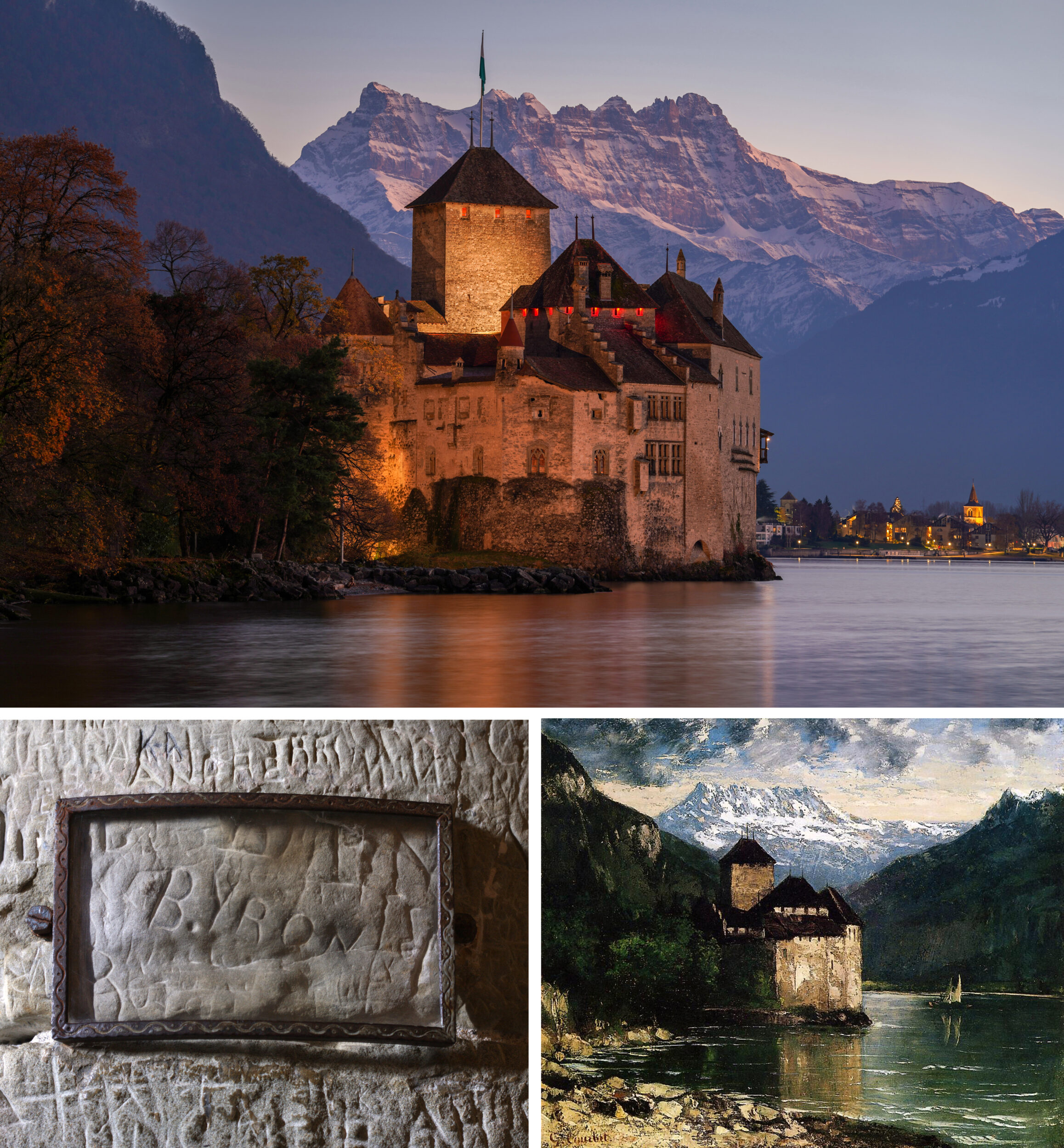
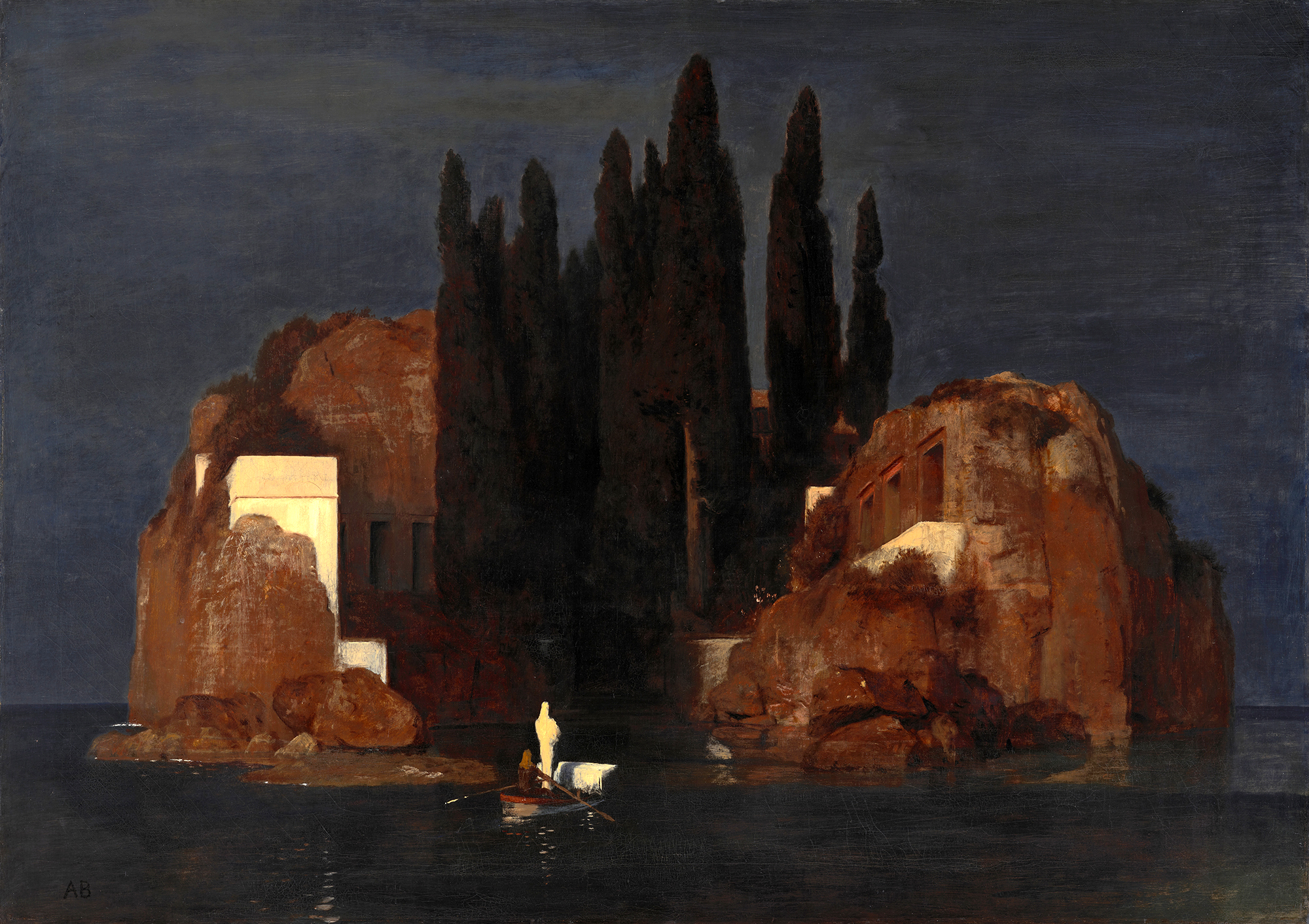
Small, built-up islands set in cosy lakes with a deep past remain irresistible to our still-romantic imaginations. The sight of one inspires in almost everyone the compulsion to find a boat and go there, to discover the amazing things it must contain. For the Romantics it was the Chateau of Crillon in Lake Geneva: if not quite an island, this medieval castle was small, self-contained, in a lake, medieval, and had dungeons where dreadful crimes must have taken place (Fig. 8). It was woven into the literature of Jean-Jacques Rousseau, Victor Hugo, Alexandre Dumas, Gustave Flaubert, Mary Shelley and Lord Byron, who left his signature in the dungeon (Fig. 9). Even Courbet, though hardly a Romantic, was attracted to it (Fig. 10). At the end of the century Arnold Böcklin painted several versions of his Isle of the Dead, infusing an image of a rocky island in a lake (possibly based on Pontikonisi, near Corfu, which has a small chapel amid a cypress grove) with morbid, symbolist messages (Fig. 11).
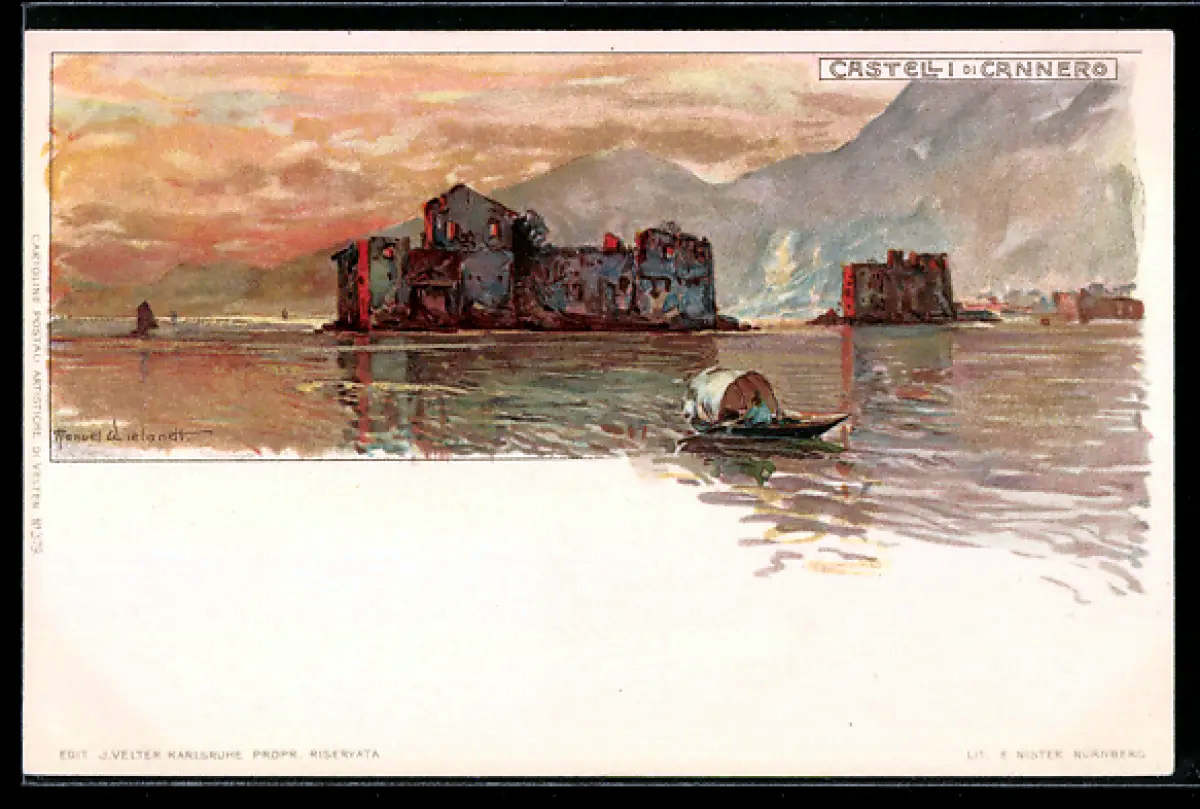
The Borromeo had a medieval island-castle as well, the Castelli di Cannero, further north up Lake Maggiore near Cannobio. Like the Isola Bella chain, these consist of three islets, one little more than a rocky reef, one a turret, the largest a fortress of mainly sixteenth century construction rising directly out of the water. Although not really old enough and lacking the necessary tales of imprisonment to appeal to the Romantics, by 1910 the picturesqueness of its ruined state made it an attractive subject for the postcard designer Manuel Wielandt (Fig. 12).
While dungeons do not have for us the same thrilling horror as they had for Byron, the visitor to Isola di San Giulio in Lake Orta, a half hour’s drive over the hills to the west of Stresa, can imagine some primitive world set deep into an unknowable medieval past, particularly in the church of San Giulio with its Romanesque pulpit populated with bizarre creatures with dinosaur-teeth which only with difficulty can be interpreted as the symbols of the Evangelists.
Isola Bella and Isola Madre trigger different responses from these. They are about love. To enjoy Isola Madre you need to love nature. To enjoy Isola Bella you need to love life and its pleasures. In spirit, as well as geometry, its spiritual home is not a garden but a book: the Hypnerotomachia. Although Poliphilo approached the Island of Cythera in a boat guided by Cupid, rowed by six ‘very capable and masterful’ sailor-nymphs with oars ‘of shining snowy ivory, not like a white radish but naturally glossy’, we have to make do with the ferry, which, alas, is not made of sandalwood, nor is it caulked with ‘a precious liquid composed of almond-benzoin, ladanum, musk, amber, civet and both kinds of storax’.
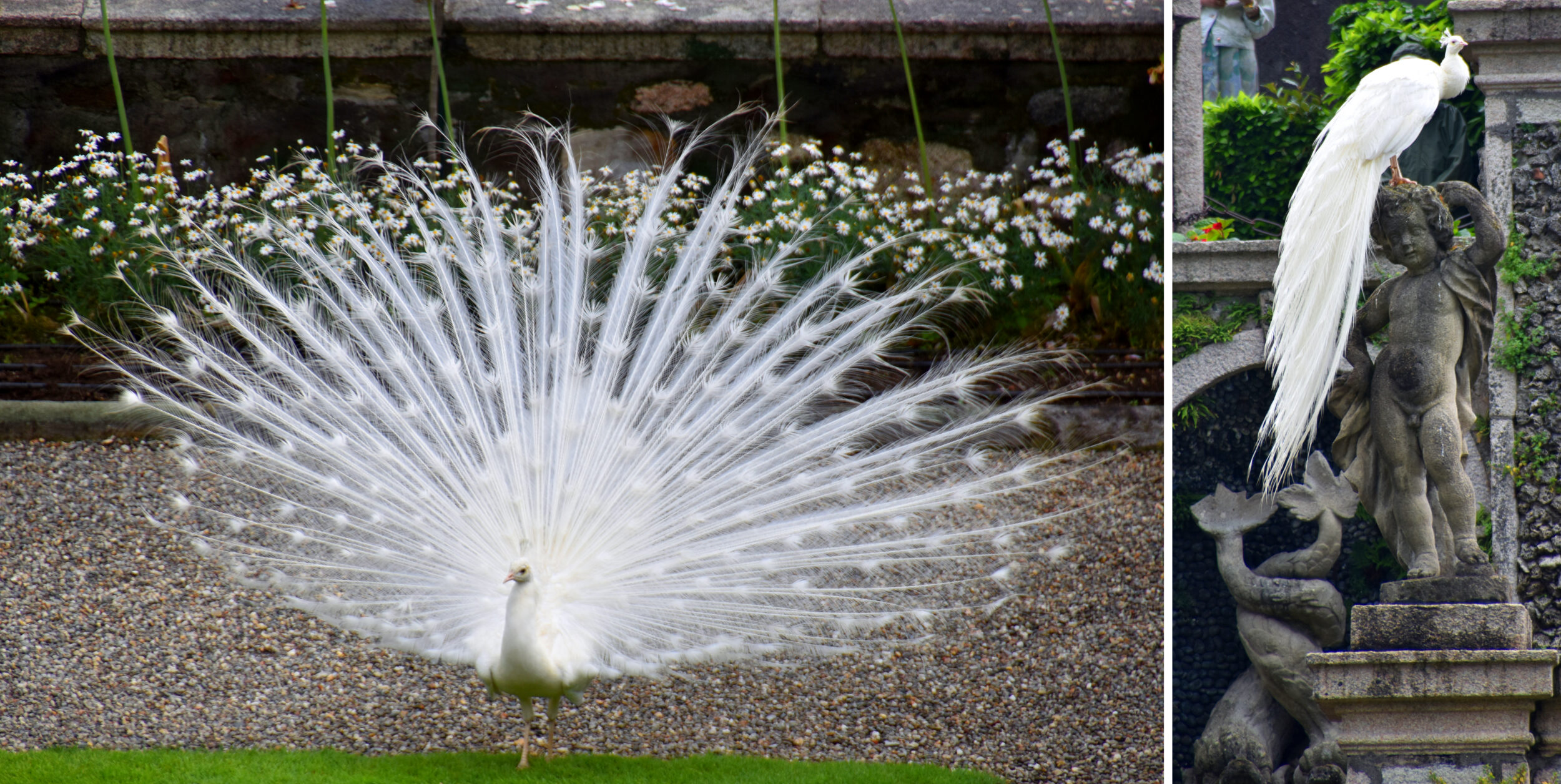
Although Cythera is flat, it is surrounded, at the water’s edge, by an impeccably regular circle of cypresses, with a myrtle hedge between, ‘cut with extreme evenness’ so that ‘no shoot or leaf exceeded any other’, anticipating the perfectly clipped hedges and regular terraces of Isola Bella. On Cythera Poliphilo found ‘innumerable peacocks, white, red and normal-coloured, freely running and perching, some unfurling their tails, while others let their splendid plumage droop.’ At Isola Bella they are only white, but this is a case where purity trumps diversity (Fig. 13).
Travel with art and cultural historians Assoc. Prof. David Marshall and Dr Lisa Beaven on this journey from Udine in Friuli Venezia Giulia, through the majestic Dolomites and Swiss Alps to the beautiful Italian Lakes district, on our tour Art, Gardens and Landscapes of Northern Italy and the Swiss Alps.
 Art, Gardens and Landscapes of Northern Italy and the Swiss Alps 2026