Maintaining the World: Greek Gods – Part I
by Dr Heather Sebo
Whether or not one has a religious faith, we in the modern world are used to the idea of a single, universal, all-powerful, all-knowing God, usually male, who controls every detail of life, every aspect of the universe. The Ancient Greek conception is in direct contrast to this. The Greeks imagined a world full of gods and minor powers. These divinities are not idealized and they are not perfect. They are also not so very interested in human beings. Sometimes minor powers are very local like the nymph Peirene whose inexhaustible tears feed the spring waters at Corinth. But, in general, there are twelve major gods who control the human world and the powers of nature; each of these gods has a specific sphere of influence although, as we shall see, the various domains often overlap and compliment each other. This ancient view is often presented, I will say often misrepresented, as somehow quaint, simple, even childish. Indeed, stories of the Greek gods are most often found in children’s story books.
I would like to demonstrate a little of the complexity and intuitive logic of the Greek theomythic (my word) system. It is not static, it changes in response to the circumstances of a changing world. To my mind, one of its greatest strengths is that there is no orthodoxy, no scripture and no authoritative Holy Book. There is scope for individuals to embrace a more personal relation to some of the gods and not to others. What I hope to show is that the divine system is “good to think with” even if we understand it all as metaphor, as many of the ancient poets may have anyway.
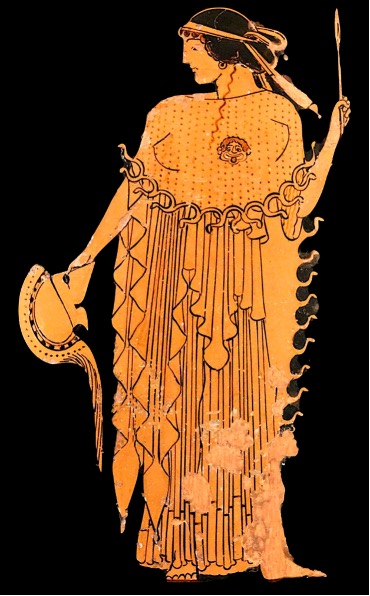 So let’s start with the goddess Athene, the patron divinity of the city of Athens, and who is very often characterised as a goddess of war. Here, immediately, we encounter a complexity because Zeus’ son Ares is also described as a god of war. So, have the Greeks doubled up, are there two gods of war? Well yes! The answer is that the Greeks make a crucial distinction between two very different kinds of war. Ares is the god of manic violence, brutality and aggression; in other words, destructive war for its own sake. Athene’s concern is defensive war, the kind of war that is necessary to protect the community when it is under attack from the savagery of those spurred on by Ares. Her aegis, the snaky garment she wears with the fearsome gorgon head on her chest, is an expression of her capacity to terrify an enemy! The Greeks hated Ares, and in Homer’s Iliad there is a wonderful moment when Athene simply flattens him. But they also recognise, as we surely must, that Ares’ barbarism is a reality.
In fact, Athene is not specifically a war goddess. Her involvement in war is part of a larger, far more sophisticated concern with urban life. Her primary domain is what the Greeks called the polis, by which they mean all the activities of the human community. In this role, Athene is the patron of civilisation and culture, of the crafts, the skills, the arts and especially the kind of intelligence that is essential to these pursuits. Athene’s kind of intelligence is not abstract and speculative, but the creative, active, street smarts that lead to innovation and invention. She is equally responsible for the science of navigation by the stars and for inventing the harness and bit, an important technology for utilising the superior strength of animals.
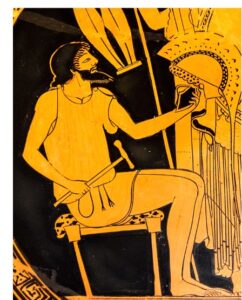
Athena often coordinates with Hephaistos the craftsman god, the blacksmith god of fire and the forge, of metallurgy. He is master of the creative artisan skills necessary to bring Athene’s inventions into being. The Greeks were very alive to the paradoxes in life. It is characteristic of their way of thinking that that the maker of beautiful things should himself be crippled, sometimes Hephaistos is portrayed with one foot backwards. In the vase painting below, the artist has indicated Hephaistos’ disability by drawing him seated.
 .
. 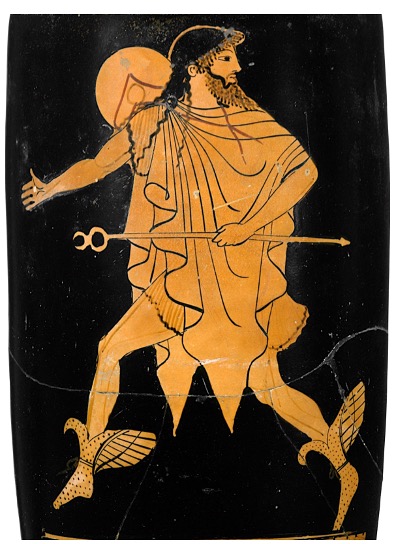
In Greek iconography, we often see Athene in company with Hermes wearing his winged sandals and broad-brimmed hat. Hermes always carries the kerykion; (Latin: caduceus) his messenger’s staff. Hermes is often described as the god of travellers, but this does not adequately convey the significance of his far larger sphere. Hermes is a boundary crosser, a god of entrances and exits, of dreams, of the transition between sleeping and waking and from life to death. We often see Hermes in the role of psychopomp, the conductor of souls leading the dead on their journey to the Underworld. As a boundary crosser, Hermes presides over every kind of transaction, transition and communication; he oversees mediation, diplomacy, the making of contracts, buying and selling. He is an inventor, he is also a thief.
As a god of transitions, we might expect Hermes to have a role in the birth process, but again, the ancient Greeks see things differently. For them, birth is not a boundary crossing but the first in a series of transformations that take us from a state of wild nature to that of an adult, civilized human being. It is not Hermes but Artemis, goddess of the hunt and of wild nature, who attends women in childbirth. It is essential, if unpleasant to our sensibilities, that Artemis ensures the supply of wild animals for the hunt by nurturing their young. Artemis is an implacable figure whose harshness expresses the life and death reality of birth in the ancient world. I think in order to soften her, she is often accompanied in this role by Eileithyia, a far more ancient goddess whose domain is confined to midwifery. Artemis also oversees the various stages or transformations through which girls move, from the coltish wildness of youth, to become adult women and finally to become mothers. It is Artemis’ twin brother, Apollo who oversees what are, from the Greek point of view, the very different transformations through which a young boy passes to become a man. I should stress that Artemis is a virgin goddess and has nothing to do with sex. The passions of sex are exclusively the province of Aphrodite and her acolytes like Eros. (I will talk about Aphrodite and other important gods who look after the world’s fertility in Part 2 of this post.)
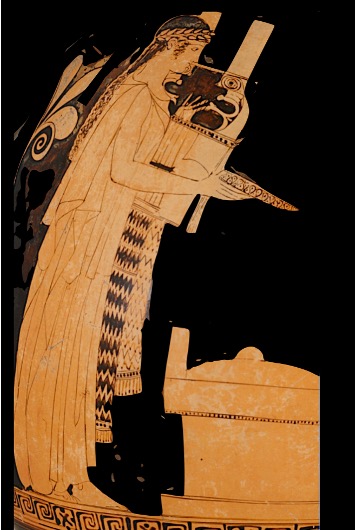
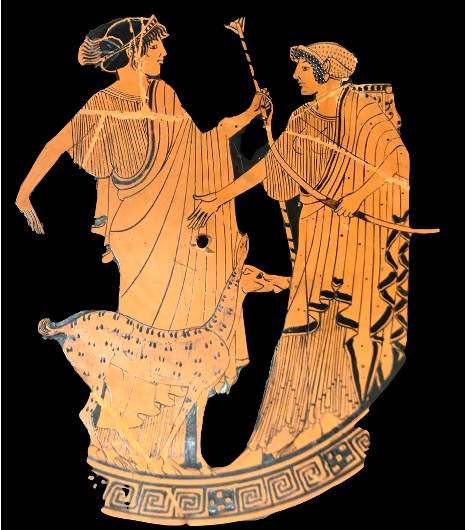
Apollo, is the quintessential Greek god. Apollo brings clarity, harmony, symmetry and order. Apollo maintains all oppositions, all boundaries; all distinctions. Hermes might oversee communications, but without Apollo’s order, there would be no language, no music. Without him the world would devolve into chaos. Apollo is beautiful, youthful and somewhat remote. The Greeks say that he is unsuccessful in love. Apollo has a reciprocal and supportive relation with Hermes. Hermes brings the necessary flexibility; without him the world would ossify and without Apollo’s clear boundaries and distinctions there would be confusion and turbidity.
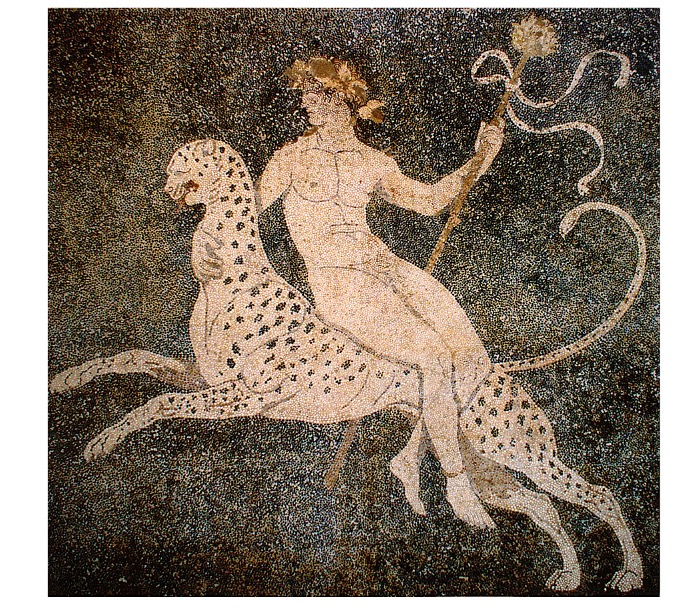
In classical Greek thought, Dionysos is the complementary opposite to Apollo. Dionysos breaks all the rules and blurs all categories and distinctions, especially those between god and mortal, mortal and animal and male and female. In honouring Dionysos, the Greeks celebrate and embrace the non-rational aspects of human nature; intoxication, ecstasy, changed states of consciousness. Dionysos is the god of the vine and of theatre; he gives actors the power to transform into a different personality, an altered mind and being. In art, Dionysos was initially shown as a bearded man in female dress, but especially from the 4th century BCE onwards, he is depicted as a beautiful, endogenous young man. We will meet him again in a moment.
Join Dr Heather Sebo on a journey through Northern Greece, in Macedonia, a landscape dotted with lakes and waterfalls, into the mountains and plains of Thrace and finally cross the northern Aegean Sea to the islands of Samothrace and Lemnos; or travel to the fabled palace kingdoms of Minoan Crete, the citadels of Mycenaean Greece, as well as Corinth, Olympia, Messene, the ancient oracle at Dodona and the Ionian islands of Kefalonia, Ithaca & Corfu on Between Sea and Sky: Homer’s Greek Islands.
Related article
Read Maintaining the World: Greek gods – Part II
- View Tours Heather is currently leading
- Watch her online talk The Labyrinth and the Dancing Floor: Homer’s Mythic Crete
View our current selection of programs to Greece
Article images
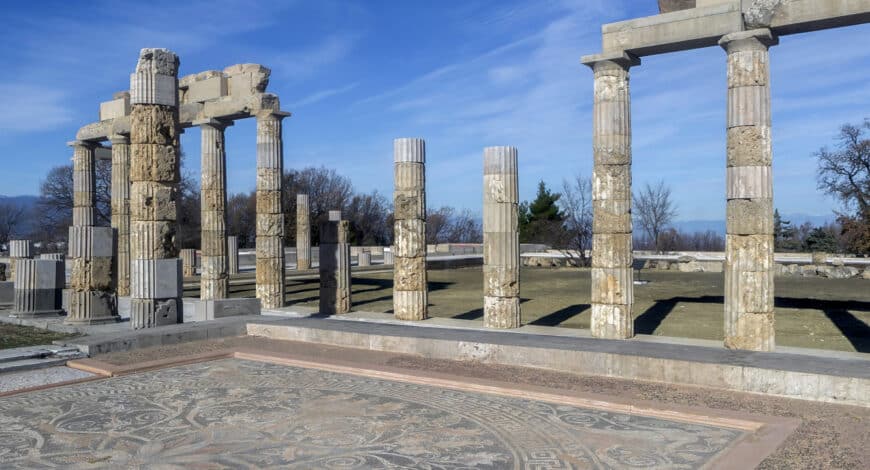
Palace of Aigai, Vergina, Greece. Image ID: 311926176 Copyright Vasilis Ververidis | Dreamstime.com https://www.dreamstime.com/ververidis_info
Athene, circa 490 BCE.Image: MetMuseum OA
Hephaistos with Achilleus’ helmet, circa 490 BCE. Image Public Domain
Hermes with Kerykion, circa 480 BCE. Image: Met museum OA
Apollo with cithara and phiale, circa 450 BCE. Image: MetMuseum OA
Apollo and Artemis with a fawn, circa 470 BCE Image: Public Domain
Pebble mosaic, Pella. Dionysos riding a wild animal, a cheetah or panther, circa 330 BCE. Image: Public Domain.
These images have been resized for this website.
 Between Sea and Sky: Homer’s Greek Islands 2026
  Between Sea and Sky: Homer’s Greek Islands 2027