Kazakhstan: from Steppe to Silk Road Cities 2027
Status: Places Available
11 Sep – 28 Sep 2027


Your leaders


Kazakhstan: from Steppe to Silk Road Cities 2027
Tour Highlights
Journey through time along Kazakhstan’s Silk Roads. How the great rivers of Central Asia shaped oases cities and empires.
This tour, led by geoarchaeologist, Professor Mark G. Mackin, with the assistance of Russell Casey, journeys through the spectacular and diverse mountain, river and steppe landscapes of Kazakhstan that formed the heartland and hub of the ancient Silk Roads of Central Asia.
- Learn from Professor Mark Macklin, internationally recognised as one of the leading global authorities on riverine archaeology, how rivers are both storytellers and shapers of civilisation. They record floods, droughts, and environmental shifts, while also nourishing the fields, cities, and trade routes that depended on their waters. Discover how the great rivers of Central Asia such as the Syr Darya, Ili and their tributaries sustained oasis towns, enabled caravans to cross vast deserts, and underpinned the prosperity of empires from the Persians to the Timurids. Their shifting courses even contributed to the decline of once-great cities.
- Journey through the marine landscapes of Altyn-Emel National Park. Once covered by the great Tethys Ocean, the area is a geological museum of sedimentary and volcanic rock. It features the multi-layered, crimson-red Aktau Mountains. Within the park visit the famous Bes-shatyr Early Iron Age burial mounds that belong to the nomadic Saka people who dominated the Eurasian Steppe more than 2000 years ago.
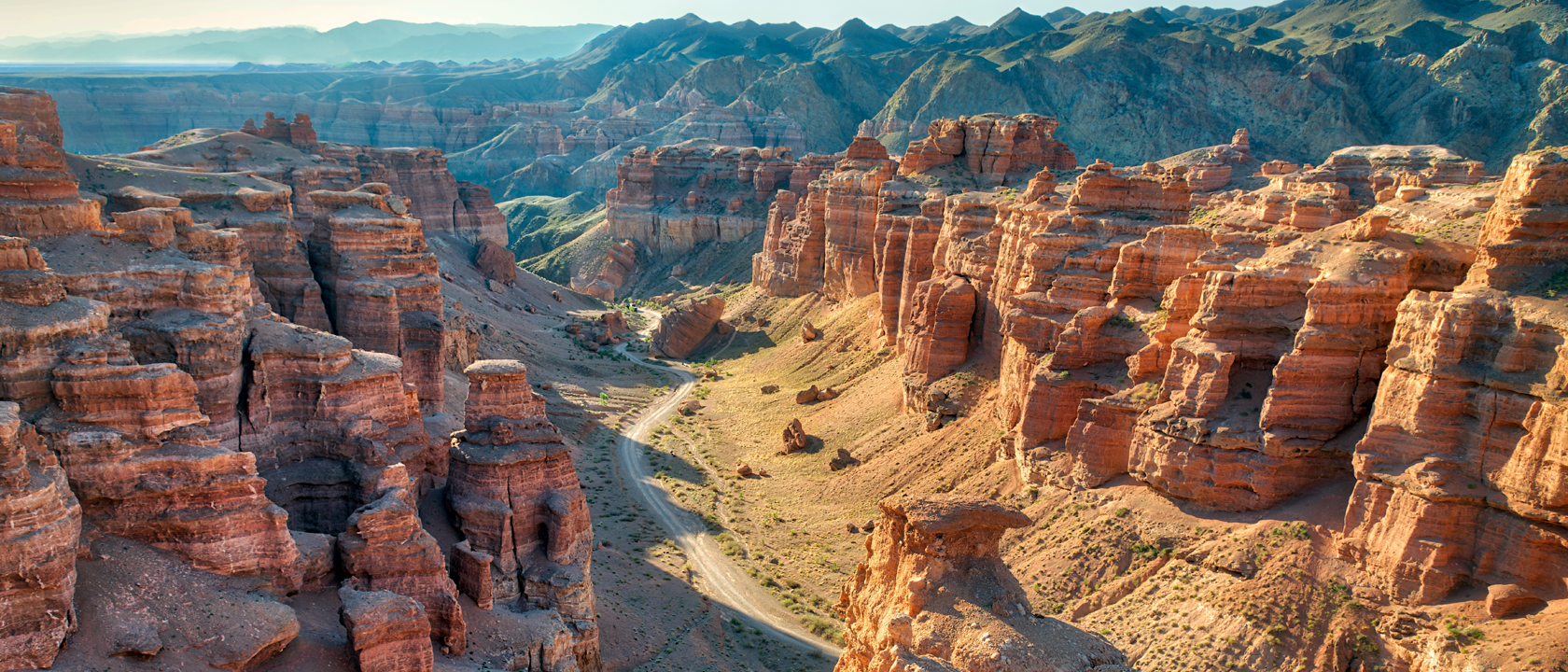
- Unearth in the Charyn Canyon a 5 million year long record of climate change preserved in ancient river sediment and windblown dust, which is helping us to understand global ocean-land interactions and the impacts of anthropogenic global warming.
- Explore two UNESCO listed biosphere reserves of the Tian Shan Mountains. To the east, lies the Kolsay Lakes National Park with its three sublime alpine lakes; and the turquoise blue Kaindy Lake, famous for its sunken forest. To the west, Aksu-Zhabagly Nature Reserve is home to an abundance of fauna including a rich bird population; and extensive forests of the wild apple tree which spread to Europe via the Silk Road.
- View the UNESCO listed Tanbaly petroglyphs – 5000 rock carvings dating from the 2nd millennium BCE to the early 20th century CE, that provide a valuable insight into the social organisation, rituals and daily life of the pastoral peoples of the Central Asian steppes.
- Explore ancient cities which form the nodes of the Serial World Heritage Silk Roads, including Akyrtas, Taraz, Otrar, Turkistan and Sauran. These cities were ruled by various empires and khanates over centuries, including the Turkic Khanate in the 7th century CE, the Karakhanid dynasty in the 11th century CE, and the Mongol Empire in the 13th century CE.
- In Turkistan view the UNESCO World Heritage listed Mausoleum of Khoja Ahmed Yasawi. Dedicated to the 12th-century CE mystic Ahmad Yasawi, it was built between 1389 and 1405 CE during the rule of Timur.
- Visit the National Museum whose Golden Hall includes gold ornaments from the burial mound of the 4th-century BCE young Saka warrior, Altyn Adam (‘Golden Man’).
- Explore the modern capital of Astana. Located on the windswept northern steppe, the city has been transformed into a 21st-century showpiece of futuristic architecture including the Pyramid Building designed by Sir Norman Foster.
Group size: limited to 18 participants
Overnight Almaty (3 nights) • Basshi village, Altyn-Emel National Park (2 nights) • Saty village, Kolsai Lakes National Park (2 nights) • Shymkent (1 night) • Aksu-Zhabagly Nature Reserve (1 night) • Taraz (2 nights) • Shymkent (1 night) • Turkistan (2 nights) • Astana (3 nights)
Itinerary
The detailed itinerary provides an outline of the proposed daily program. The daily activities described in this itinerary may be rotated and/or modified to accommodate changes in museum opening hours and flight schedules. Meals will be taken in hotels, in restaurants with a historical or local flavour, or picnic lunches will be provided. All meals included in the tour price are indicated in the itinerary where: B=breakfast, L=lunch and D=dinner. 2-3 500ml bottles of water (per person) will be provided each day for all site excursions. All meals include bottled water, tea or coffee.
Almaty – 3 nights
Day 1: Saturday 11 September, Arrive Almaty
- Tour commences at 11am in the foyer of the Mercure Almaty City Center
- Welcome Meeting & Introduction
- Panfilov Park, Ascension Cathedral, Ykhlas Museum of Folk Musical Instruments & Green Bazaar
- Welcome Dinner
Meeting Point: The tour commences at 11am in the foyer of Mercure Almaty City Center located in the city centre, 1.6km from the Ascension Cathedral.
Almaty (formerly Alma-Alta), the largest city of Kazakhstan with a population exceeding 2.1 million people, served as the capital from 1929 to 1991. It lies in the northern foothills of the Trans-Ili Alatau Mountains in southern Kazakhstan near the border with Kyrgyzstan. The ancient city dates to the Bronze Age (1000-900 BCE) when farmers and cattle breeders established settlements in the region. From 700 BCE to the beginning of the 1st century CE the area was settled by the semi-nomadic Saka (part of the wider Scythian cultures) and later Wusan tribes. There are numerous burial mounds and ancient settlements in the area from this period including the famous tomb of Altyn Adam (‘Golden Man’), located 50km east of the city. During the 10th to the 14th centuries CE Almaty became one of the trade, craft and agricultural centres on the Silk Road and possessed an official mint. It linked important trade cities such as Almaliq (Xinjiang, China) to the east and the city of Taraz to the west. The city declined in importance during the 15th century CE due to Tamerlane’s attacks and the resultant shift of the trade routes southwards.
We begin with a welcome meeting and introduction, followed by a visit to Panfilov Park which honours 28 soldiers from an Alma-Alta infantry unit of the Red Army who reportedly died during WWII in the Battle of Moscow. Within the park lies the polychrome Ascension Cathedral. Completed in 1907, it is made entirely of wood. Nearby lies the Museum of Folk Musical Instruments named after Ykylas, a great Kazakh musician of the 19th-20th centuries who promoted the purity of folk culture. The museum, which contains the largest selection of Central Asian instruments, includes traditional dutars, two string dombras, kobyz and mouth harps. We also visit the Green Bazaar, Kazakhstan’s most famous market which contains an impressive array of produce.
Tonight, we enjoy a welcome dinner at a local restaurant. (Overnight Almaty) LD
Day 2: Sunday 12 September, Almaty – Tanbaly – Almaty
- UNESCO World-Heritage listed Petroglyphs of the Archaeological Landscape of Tanbaly
Today we visit the world-famous rock art at Tanbaly Gorge which were inscribed on the UNESCO World Heritage List in 2004. Located 170km northwest of Almaty, the reserve consists of approximately 5000 rock carvings dating from the Middle Bronze Age (c 2500-1900 BCE) to the early 20th century. The Bronze Age carvings are known for their intricate, deeply cut images which include solar deities, sun-headed figures, and scenes of hunting and rituals. They provide a valuable insight into the social organisation, rituals and daily life of the pastoral peoples of the Central Asian steppes. (Overnight Almaty) BLD
Day 3: Monday 13 September, Almaty
- Central State Museum
- Coach Tour of Almaty including the Central Asia Art Museum
This morning, we visit the Central State Museum which displays a collection of over 200,000 artefacts related to Kazakhstan’s history and culture. Exhibits of carpets, weapons and jewellery show the historical context of trade and the interaction of cultures along the Silk Road.
This afternoon we take a coach tour of the city to view some of its key monuments including the new Central Asia Art Museum which opened in September 2025. Founded by entrepreneur and collector, Nurlan Smagulov, the 700-strong permanent collection includes Kazakh and Central Asian contemporary art. The museum’s design by British architects Chapman Taylor draws inspiration from Almaty’s mountain landscape. (Overnight Almaty) BL
Basshi village, Altyn-Emel National Park – 2 nights
Day 4: Tuesday 14 September, Almaty – Tamgaly Tas Petroglyphs – Bes-shatyr – Altyn-Emel National Park
- Tamgaly-Tas Buddha Petroglyphs
- The Saka Burial Mounds at Bes-shatyr
From Almaty we journey 4-5 hours northeast to Altyn-Emel National Park which lies at the foothills of the Dzungarian Alatau, a mountain range of the Tian Shan system. Altyn-Emel is vast, covering over 300,000 hectares and hosts a remarkable range of ecosystems from semi-desert saxaul forests to alpine meadows and mountain gorges. It’s home to more than 70 species of mammals and around 300 species of birds including the black stork and steppe eagle.
En route to the park we stop to view the Tamgaly-Tas petroglyphs which consist of three main engraved rocks depicting Buddha and Burhans (Bodhisattvas) that are accompanied by Tibetan inscriptions. They are believed to have been engraved by the Oirat-Djungar people who were Western Mongol tribes that converted to Tibetan Lamaist Tantric Buddhism in the 16th century. The actual site is thought to have been built around 1705-1710 CE. Its location along the cliffs of a gorge on the right bank of the Ili River, was an important river crossing of the Silk Road. The site shows all the characteristics of a temple. Its construction follows the general many-millennia long tradition of rock engravings used to signify places endowed with spiritual powers and ceremonial functions. It also follows the specific Buddhist tradition of open-air ritual sites common among nomadic peoples. Parallel examples can be found in the Himalayas and the High Pamirs.
Late morning we continue to the Saka burial mounds at Bes-shatyr which are located on the right bank of the Ili River within Altyn-Emel National Park. Together with the necropoli at Boraldai and Esik, the site forms part of the prehistoric Silk Road which is currently on the UNESCO World Heritage Tentative List. The site comprises 81 burial mounds which date to the 5th and 4th centuries BCE and range in height from 6 to 18 metres. Archaeological evidence suggests the tombs were used ceremonially for memorial rites and represent complex funerary customs for high status Saka elites. They demonstrate the intercultural exchanges between China and Central Asia in the pre-Silk Road era and serve as exceptional testimony to the Saka nomadic culture and belief systems.
In the late afternoon we continue our journey east to the village of Basshi, the gateway to Altyn-Emel National Park. (Overnight Basshi Village, Altyn-Emel National Park) BLD
Day 5: Wednesday 15 September, Altyn-Emel National Park
- Katutau and Aktau Mountains
Today we continue our exploration of Altyn-Emel National Park. We begin with a visit to the colourful Katutau Mountains. The result of powerful volcanic eruptions and the cooling of lava, these fascinating rock formations are distinctive crimson red in colour.
In contrast, the nearby Aktau Mountains are a geological museum of sedimentary rock from the Cretaceous period dating back to approximately 145 million years. These comprise the sediments of the former Tethys Ocean, that was followed by an ancient inland sea – Paratethys – , which covered much of what is now Kazakhstan until around 5 million years ago when it became progressively shallower. Today’s Black Sea, Caspian Sea and Aral Sea are remnants of the Paratethys Sea. Tectonic shifts then uplifted the region, while weathering and erosion by wind and water carved the land to create the distinctive, colourful, multi-layered peaks and valleys seen today. The mountains are known for their numerous late Cenozoic vertebrate fossils which include fragments of ancient rhinoceroses (giant Paraceratherium), mastodons, deer, turtles and crocodiles. (Overnight Basshi Village, Altyn-Emel National Park) BLD
Saty village, Kolsai Lakes National Park – 2 nights
Day 6: Thursday 16 September, Atyn-Emel National Park – Charyn Canyon – Saty
- Charyn Canyon & the Valley of Castles
This morning, we journey south to the Charyn Canyon, located on a semi-arid plateau near the border with China. The canyon, spanning approximately 154 kilometres, was cut by the fast-flowing Charyn River over the last 1.5 million years or so, ago which carved deep ravines in the landscape as it flowed northward from its headwaters in the Tian Shan Mountains. In various places the canyon attains a depth of 150 to 300 metres. In 2021, a virtually unbroken record of climate change was discovered when scientists were able to calculate moisture content from alternating layers of ancient river sediment and dust, which allowed them to reconstruct a record of rainfall in the region over the last five million years.
The canyon (there are 5 different canyons) consists primarily of ancient, red sedimentary rocks whose colourful, stratified layers create its distinctive appearance. A combination of water and wind erosion has further resulted in rock formations which resemble colourful sculptures; a particular feature of the well-known ‘Valley of Castles’, which we visit this afternoon. (Overnight Saty Village) BLD
Day 7: Friday 17 September, Saty – Kolsai Lakes National Park – Saty
- Kaindy Lake
- Lower Kolsay Lake
This morning, we enjoy a 4km walk around the spectacular Kaindy Lake. Located in the Tian Shan Mountains at an altitude of 2000m. The lake was formed when the Kaindy River was blocked by a large landslide believed to have been caused by a great earthquake in 1911. However, new dating of trees now submerged by the lake show that it was formed following an earlier earthquake (Chilik) in 1889. It is famous for its sunken forest of Picea schrenkiana (Asian Spruce native to the Tian Shan) which never rot because the lake’s water is extremely cold, with temperatures not rising above 6°C even in the summer. This low temperature, combined with the mineral-rich water, preserves the wood and prevents the microorganisms that cause rot from thriving. Additionally, lime deposits and mineral-rich glacial runoff from the surrounding mountains causes the lake’s water to have a vibrant, often turquoise or bluish-green hue.
Following lunch at our guesthouse in Saty, we journey to Kolsay Lakes National Park, listed by UNESCO as a Biosphere Reserve. The Kolsay Lakes were formed by natural landslides blocking the Kolsay River in the Tian Shan Mountains. They consist of a cascade of three alpine lakes, each sitting at a different altitude. The Lower Kolsay Lake, which we visit, sits at an altitude of approximately 1818m. It is about 1km long and 400m wide, and is surrounded by spruce trees, alpine meadows and mountain pastures. A short walk from the parking area takes us to the lower lake from where we can take an optional 2-hour walk around the lake’s edge to enjoy the crystal-clear waters known for their mirror-smooth reflections. (Overnight Saty Village) BLD
Shymkent - 1 night
Day 8: Saturday 18 September, Saty – Charyn Canyon Viewpoints – Almaty – Shymkent
- The Black Canyon (Stone Shelf) Viewpoint
- Moon Canyon, Napoleon & Austrian Viewpoints
- Early evening flight from Almaty to Shymkent
This morning, we return to Charyn Canyon via several viewpoints, including Moon Canyon known for its striking moon-like, yellow-hued geological formations. The Napoleon and Austrian Viewpoints provide sweeping panoramic views of the main canyon. We also view the contrasting Black Canyon which is famous for its dark, dramatic cliffs and rugged terrain. It is home to alpine grasses, dry steppe flowers and cliff-nesting birds such as falcons, vultures and larks.
In the late afternoon we fly east from Almaty to Shymkent, an important regional and cultural centre which historically was part of the Silk Road and played a crucial role in regional trade and cultural exchange. It was founded in the 12th century CE as a caravanserai to protect the nearby silk road trade town of Sayram and grew as a market centre for trade between Turkic nomads and the settled Sogdians. (Overnight Shymkent) BL
Zhabagly village, Aksu-Zhabagly Nature Reserve – 1 night
Day 9: Sunday 19 September, Shymkent – Sharafkent – Aksu-Zhabagly Nature Reserve
- Ortalyq Qyrgy Bazaar and Kyluet Ethno Museum, Shymkent
- Sharafkent Village
This morning, we explore the Qyrgy Bazaar, a large traditional market selling a variety of food including dried fruits, nuts and spices, as well as clothing and carpets. We also make a short visit to the Kyluet Ethno Museum. Established by famous potter Kendebay Karabdalov, the museum includes a pottery workshop, a collection of musical instruments and an underground hilvet (ancient underground structure with a prayer room).
From Shymkent we travel to Sharafkent, a small village well-known for its grandmothers who wear traditional attire. They make local Kazakh handicrafts and prepare traditional feasts including baursak (Kazakh fried dough). We will enjoy lunch with a local family before continuing our journey south to our campsite in the village of Zhabagly. The campsite, which provides accommodation in a mixture of guesthouse rooms and yurts, is set in green pastures that overlook the spectacular Tian Shan Mountains. (Overnight Aksu-Zhabagly Ruslan Guesthouse) BLD
Taraz – 2 nights
Day 10: Monday 20 September, Aksu Zhabagly Nature Reserve – Taraz
- Aksu-Zhabagly Nature Reserve incl. the Aksu River Canyon
The Aksu-Zhabagly Nature Reserve, which opened in 1926, is the oldest and most famous reserve in Central Asia. Included in the UNESCO World Biosphere Reserves List in 2016, it covers the north-western part of the Tian Shan Mountains. It is home to an abundance of fauna including rare species like the snow leopard, argali (wild sheep native to the highlands of Central East Asia), mountain goat and Bukhara deer. It also hosts a rich bird population; over 267 nesting and migratory birds have been recorded. Many colourful birds inhabit the gardens of local villages. In the open grassland, bee-eaters, warblers, tilts and blue rollers can easily be viewed, while the higher reaches are ruled by falcons, vultures and eagles. Endemic florae include the red tulip that became the symbol of Holland; and the wild apple tree, Malus sieversii, which grows in vast forest that stretch for more than a thousand kilometres. Genetic analysis shows that the domestic apple originated from this wild variety and spread to Europe during the time of Alexander the Great via the Silk Road. Our morning visit to the reserve includes a view of the mighty Aksu River Canyon which fluctuates from 200m to 500m in depth and is 30km in length.
Following a picnic lunch in the reserve, we travel to the ancient city of Taraz which is located near the border with Kyrgyzstan. An urban centre located in an alluvial oasis of the Talas River, Taraz was an important Silk Road city and is considered one of the most significant historic settlements of Kazakhstan. Unlike the major medieval settlements of Otrar and Sauran, Taraz was reoccupied in the post-medieval period and today is a thriving modern city. (Overnight Taraz) BLD
Day 11: Tuesday 21 September, Taraz – Akyrtas – Taraz
- Akyrtas Palace Complex: UNESCO Silk Road Project
- Ancient Taraz Archaeological Park and Museum
- Monuments of ancient Taraz: Tekturmas Mausoleum, Karakhan Mausoleum and Torkul Caravanserai
This morning, we visit the ruins of the palatial complex of Akyrtas which forms part of the Serial World Heritage Silk Roads. Located 35km east of Taraz at the foot of the lower mountains of the Tian Shan, Akyrtas was the second stage on the medieval road east from the city. The old road, which passed in front of the palace building, formed part of a northern branch of the Silk Road which led from the central regions of Samarkand and Bukhara through the open gap in the chain of the Tian Shan as far as Taraz, before turning east along the fertile strip between the steppe and the mountain range towards the site of Almaty and further to Turfan. The open character of the road made it easier for an army to follow than the passes leading to Kashgar, and was exploited by the Mongol army of Genghis Khan around 1218. This unique walled settlement with extensive use of stone as building material was probably the location of the palace of Karluk Khans in the 8th to 10th centuries CE. It features many architectural parallels in the Middle East and serves as a witness to the introduction of Islam in Kazakhstan. The Karluks fought with the Abbasids against the Tang dynasty at the geopolitically pivotal Battle of Talas in 751 CE.
In the afternoon we begin with a visit to old Taraz which is believed to have been founded in the 1st century CE with the earliest historical references dating to 568 CE. Known as the city of merchants, it was an important junction on the Silk Road skirting the northern edge of the Chatkal and Kyrghz mountain ranges, and connecting with Burana in the east, and Samarkand and Otrar in the west. Taraz experienced repeated occupations by invading powers; between the 8th and 13th century CE the Karluks, Samanids, Karakhanids, Seljuks, Karakitai, Khorezmians and finally the Mongols had all held the city. However, despite periods of political turmoil, it saw significant economic growth, particularly under the Karakhanids. The former medieval city consisted of three districts: the citadel which was the military-political core; the shahristan or inner town; and the rabad, the outermost suburb which lay beyond the city’s walls. The Taraz Archaeological Park and Museum preserves remains from the ancient city. Excavations around the modern marketplace have identified several buildings associated with the former citadel which range in date from the 9th to the 12th centuries CE. These buildings include an ‘eastern’ domed bathhouse with evidence of wall paintings; a ‘western’ bathhouse, and another building which clearly had a variety of functions. The later contained a domestic shrine representing a Turkic cult of fire-veneration, and a bakery.
We end the day visiting some of Taraz’s ancient monuments including the reconstructed Tortkul caravanserai. As a vital node along the silk road, ancient Taraz once had approximately 20 caravanserai, essential waypoints that provided safe lodging and storage before continuing the arduous journey across Central Asia. Archaeological excavations here have uncovered evidence of lodgings, bathhouses and other essential facilities typical of these ancient roadside inns. Coins found at this site date the complex to the 6th-7th centuries CE. (Overnight Taraz) BLD
Shymkent – 1 night
Day 12: Wednesday 22 September, Taraz – Shymkent
- Aysha-Bibi & Babazha-Katun Mausoleums
- Regional Museum of Southern Kazakhstan
- Orientation tour of Shymkent incl. Independence Park
We begin with a visit to the Aysha-Bibi and Babazha-Katun mausoleums, unique examples of Islamic architecture which testify to the influence of Sufi traditions and Islam on regional culture. The Aysha-Bibi mausoleum is believed to be the tomb of an 11th-12th-century CE noblewoman. It features terracotta tiles decorated with floral and geometric patterns and relief bands with Arabic inscriptions, following the architectural traditions of the Karakhanid era.
Mid-morning we continue our return journey to Shymkent. On arrival we visit the Regional Museum of Southern Kazakhstan which includes displays on local geology, Iron Age burial mounds and archaeological finds from Otrar and Sayran. We also make a short tour of Shymkent visiting Independence Park which opened in 2011 to honour the 20th anniversary of Independence Day. (Overnight Shymkent) BLD
Turkistan – 2 nights
Day 13: Thursday 23 September, Shymkent – Otrar – Turkistan
- Otrar State Archaeological Preserve-Museum, Shaulder village
- Otrar: UNESCO Silk Road Project
- Aristan Bab Mausoleum
- Caravanserai Complex, Turkistan
Today we journey north to Otrar. Historically known as Farab, this was one of the great cities of the Northern Branch of the Silk Road. It lies in an important transitional zone between the nomadic pastoralists of the north and sedentary farmers of the south. It is attested as a local capital in the 6th−8th centuries CE, before becoming the major town of the region during the 9th−12th centuries CE, serving as a political, trade and cultural centre. By the early 13th century CE, it was on the extreme north-eastern edge of the Khwarazmian Empire and thus became the first city to be sacked by the Mongols who arrived in 1219 and progressively swept through Central Asia. Tamerlane visited Otrar en route to conquer China, however he fell ill and died here in 1405. Recent research suggests that climate change, specifically long-term drought, is believed to be the ultimate cause for the decline of the city. Scientific analysis and dating of sediment samples from Otrar’s abandoned irrigation canals indicate that water sources dried up, and irrigation systems failed due to a century of decreasing rainfall before the Mongol invasions, making the city’s agricultural base unsustainable. We will spend several hours exploring this ancient city whose extensive ruins include the foundations of the citadel, residential areas, mosque, bathhouse and the 14th-century CE Palace of Berdibek.
The museum in nearby Shaulder village houses artefacts including pottery, tools and coins found at the archaeological site of Otrar. The earliest exhibits date to the Bronze Age.
Before continuing to Turkistan, we also visit the mausoleum of Aristan Bab who is known among Islamic preachers as an important figure and a companion of the Prophet Muhammad, as well as the first teacher of the religious mystic, Khoja Ahmed Yasawi. The mausoleum was constructed over four main stages between the 12th and 20th centuries CE.
In the late afternoon we continue to the ancient capital of Kazakhstan – Turkistan, the abode of Turkic Sufism and a sacred place with a long history. This evening, we dine at a local restaurant and visit the Caravanserai Complex, one of the city’s modern attractions which aims to recreate Silk Road-era artisan streets and trade quarters. It also includes a “flying theatre”, hotels and numerous restaurants. (Overnight Turkistan) BLD
Day 14: Friday 24 September, Turkistan
- Mausoleum of Khoja Ahmed Yasawi: UNESCO World Heritage Site
- Azret Sultan Reserve-Museum incl. Hilvet Semi-Underground Mosque, medieval bathhouse, Mausoleum of Rabia Sultan Begum, Mausoleum of Yesim Khan
- Kultobe Settlement: UNESCO World Heritage Site
- Juma Mosque
The city of Turkistan is an ancient archaeological gem perched on the Eurasian Steppe. Literally meaning “land of the Turks’, it was first settled as early as the 6th century CE by former Turkic nomads who used it as a caravan stop along the Silk Road. Following the final demise of Otrar in the 16th and 17th centuries CE, the city, which was known as Shavgar and Yasi, rose to prominence and claimed its modern title when it became the capital of the Kazakh Khanate until its Russian conquest in 1864. Today, Turkistan has various groups of Turkic descents, from Kazakhs to Uzbeks.
We spend the morning visiting the Azret Sultan Reserve-Museum. Spread over 557 hectares, this complex comprises not only a gallery containing thousands of valuable artworks, but also numerous historical monuments including the Mausoleum of Khoja Ahmed Yasawi, Hilvet Semi-Underground Mosque, a medieval bathhouse, and the mausoleums of Rabia Sultan Begum and of Yesim Khan.
The Mausoleum of Sheikh Khoja Ahmed Yasawi was commissioned by Tamerlane to cover the 12th-century CE grave of renowned, poet, philosopher and mystic, Khoja Ahmed Yasawi, who helped spread the Sufi Yasawiyya branch of Islam throughout the Turkic-speaking world. Built between 1389 and 1404 CE, the mausoleum towers 38.7m high and is capped with a turquoise dome, the largest in Central Asia. Considered one of the best-preserved architectural feats from the Timurid Empire that ruled the region in the 14th century CE, it was designated as a UNESCO World Heritage site in 2003. The 35-room mausoleum contains ancient Persian paintings, a carpeted mosque and intricate stonework mirroring that of the monument’s exterior.
Beneath the mausoleum of Khoja Ahmed Yasawi lies the hilvet, Yasawi’s hand-dug, semi-underground mosque which was meticulously crafted to sustain secluded prayer. UNESCO has dubbed the mosque, a “second Mecca’, as it remains an important destination for Sufi pilgrims and is an outstanding example of Kazakh architecture.
Eighty metres from the mausoleum and mosque lies the Vostochnaya Banya an ancient, semi-underground bathhouse that was built between 1580-1590 CE to serve pilgrims to the Mausoleum of Khoja Ahmed Yasawi. Nearby, also lies the mausoleum dedicated to Rabia Sultan Begum, the daughter of Ulugh Beg, a descendant of Tamerlane and wife of Abu’l Khayr Khan, the ruler of the Uzbek Khanate. The original 15th-century CE mausoleum was reconstructed in the 1980s and features a distinctive pointed arch façade with intricate tile work.
The partially restored, mausoleum of Yesim Khan, a significant political figure in the Kazakh Khanate, was built in the 17th century CE. This modest square structure, built of baked brick, features a preserved façade portal decorated with geometric patterns and glazed tiles.
This afternoon we explore the archaeological site of Kultobe, considered the earliest urban settlement in the region. This ancient Silk Road city served as a regional cultural, religious, and trade hub during the Sarmat-Kangly era, between the 1st century BCE and the 4th century CE. It played a vital role on the Silk Road, providing well-developed infrastructure and advanced techniques for defence and metalworking. It later became a spiritual centre for the Kazakh Khanate, particularly associated with the Sufi preacher Khoja Ahmed Yasawi. During our walk through this ancient settlement, we can view remnants of streets, gates, market quarters and civic infrastructure. The citadel features hexagonal-shaped fortress wall with towers, advanced fortification techniques and a cruciform temple. (Overnight Turkistan) BLD
Astana – 3 nights
Day 15: Saturday 25 September, Turkistan – Sauran – Syganak– Kyzylorda – Astana
- Archaeological site of Medieval Sauran: tentative UNESCO World Heritage Site
- Syganak
- Evening flight from Kyzlorda to Astana
Today we visit the ancient cities of Sauran and Syganak, both part of the Fergana-Syr Darya Corridor which is included on the UNESCO World Heritage Tentative List.
The ancient city of Karatobe which was established in the 1st century CE, later relocated 3kms north to a more defensible location sometime between the 13th and 14th centuries CE, forming the larger medieval city of Sauran. Situated on the Silk Road near the Syr Darya River, Sauran was one of the most famous and important cities of medieval Kazakhstan and played a central role in regional politics, trade and religious life up until the 18th century CE. This morning, we explore this city whose original layout reflects careful urban planning and strong fortifications. The oval shaped settlement, spanning approximately 50 hectares, is encircled by a well-preserved adobe fortress wall and a deep moat. In addition to the main gate, which was guarded by two two-story towers, the 2360-metre-long wall contained a further seven towers. Passing through the walls, we explore the ruins of the residential and civic spaces which include the remains of a mosque and medrese. One of Sauran’s most impressive features is its large number of lines of water collection wells, known as karaz (in Persian meaning ‘water uplift’). Aerial surveys indicate there are over 100km of such lines in the area that supported Sauran and its surrounding agricultural fields and small villages. Initially these were assumed to be qanat, a water collection and distribution system that is widespread in the Middle East, North Africa and Central Asia. However, recent studies suggest the karaz of this region represent a combination of traditional qanat construction with a new model for water transport and delivery that takes advantage of the local hydrogeology. Rediscovery of this forgotten technique is not only of great significance for the historical reconstruction of water and land use in the Turkistan oasis but could have economic significance for future modern land reclamation in desert zones.
From Sauran we follow the course of the Syr Darya River, which flows north-west to the Aral Sea, for approximately 180km to reach Syganak, another forgotten Silk Road city located in the Kyzylorda Region. Founded in the 4th century CE, it became a capital of the Kipchak Khanate during the 11-13th centuries CE. In 1220 the city was destroyed by the Mongols but was rebuilt in the mid-13th century CE. During the 14-15th centuries CE it became a major political and economic centre, in which the coins were minted for the eastern wings of the Golden Horde. Throughout the 15-16th centuries CE it was an important centre of the Kazakh Khanate before eventually falling into decline in the 17th century CE. The settlement spans nearly 20 hectares and features the remains of fortifications, a citadel, residential and civic structure. Archaeological evidence confirms that the city had also developed systems of water management connected to the Syr Darya and mountain streams from the Karatau Range.
From Syganak we journey a further 2 hours north to the city of Kyzylorda, also located on the Syr Darya, from where we take an early evening flight to the capital of Kazakhstan, Astana. (Overnight Astana) BL
Day 16: Sunday 26 September, Astana
- National Museum of the Republic of Kazakhstan
- Kazakh Master Zerger (jewellery maker)
This morning is devoted to exploring the National Museum which covers the history and culture of Kazakhstan from ancient to modern times. A highlight of the collection is the Golden Hall which displays Bronze Age ornaments from the famed Altyn Adam (Golden Man) burial mound. This 4th-century BCE young Saka warrior was buried with assorted funerary goods including 4000 gold ornaments.
Jewellery traditions of the Kazakh people date back to the artistic metalworking of early nomads developed in the Middle Ages. Masters of Kazakh jewellery are referred to as zergers (from the Persian word “zer-zar’, meaning gold). Their techniques of making artisan jewellery, zergerlyk, are considered sacred by Kazakhs and are traditionally passed down by inheritance. We shall visit the home of a master zerger who works with traditional metals and stones to create jewellery including rings, earrings, bracelets and chest ornaments. His home serves as a small museum of Kazakh culture. (Overnight Astana) BL
Day 17: Monday 27 September, Astana
- Modern Astana: Hazrat Sultan Mosque, Independence Square, Palace of Peace and Reconciliation & Atyrau Bridge, Baiterek, Nur-Alem, Grand Mosque, Aka Orda Presidential Palace
- Time at leisure
- Farewell dinner
Astana (meaning ‘capital city’ in Kazakh), is the second-largest city in the country after Almaty. For the period 2019-2022 the city briefly adopted the name Nur-Sultan in honour of its former president, Nursultan Nazarbayev, who made the historic decision to transfer the capital to the centre of the country. Astana officially became the capital of Kazakhstan in 1997. Its transformation into a modern and planned city was guided by a master plan designed by Japanese architect Kish Kurokawa.
Today we tour the city which is renowned for its modern landmarks. These include the Hazrat Sultan Mosque and the adjacent Palace of Peace and Reconciliation – a 62-metre-high pyramid designed by Foster and Partners. We also view the Atyrau Bridge designed by New Moon Architects in 2018, the Baiterek tower, Kazakhstan Pavilion, Grand Mosque and the Aka Orda Presidential Palace. The Kazakhstan Pavilion and Science Museum, locally known as Nur Alem, was designed as the iconic sphere at the centre of EXPO-2017. Designed by American architect duo Adrian Smith and Gordon Gill, it remains the largest spherical building in the world. The Astana Grand Mosque, which opened in 2022, is the largest mosque in Central Asia.
This evening we enjoy a farewell dinner at a local restaurant. (Overnight Astana) BLD
Day 18: Tuesday 28 September, Depart Astana
- Departure transfer for participants travelling on the ASA ‘designated’ flight
Participants travelling on the ASA ‘designated’ flight will transfer by private coach to Astana’s airport in the early morning. B
Accommodation
Accommodation ranges from 3- or 4-star hotels to basic guesthouses. The standard is very much based on availability in the areas where we will be travelling.
- Almaty (3 nights): 4-star Mercure Almaty City Center – 1.6km from the Ascension Cathedral.
- Basshi village (2 nights): Comfort Altyn Emel Hotel – a small guesthouse offering basic accommodation. Ideally located for visiting Altyn-Emel National Park, it has 16 twin rooms each with an en suite bathroom.
- Saty village (2 nights): Saty Prestige Hotel – a small hotel ideally located for visiting Kolsai Lakes National Park, offering 17 rooms with en suite bathroom.
- Shymkent (1 night): 4-star DoubleTree by Hilton Shymkent – located in the city centre.
- Zhabagly village (1 night): Guesthouse of Lyuda – ideally located for visiting the Aksu-Zhabagly Nature Reserve, the guesthouse offers 15 rooms with an en suite bathroom.
- Taraz (2 nights): 4-star Hotel Shahristan – located in the heart of the city centre.
- Shymkent (1 night): 4-star DoubleTree by Hilton Shymkent
- Turkistan (2 nights): 3-star Hampton by Hilton Turkistan – within walking distance of the UNESCO-listed Mausoleum of Khoja Ahmed Yaswi.
- Astana (3 nights): 4-star Hilton Garden Inn – chosen for its central location.
Single Supplement
Payment of this supplement will ensure accommodation in a double room for single occupancy throughout the tour. The number of rooms available for single use is extremely limited. People wishing to take this supplement are therefore advised to book well in advance.
How to Book
ASA RESERVATION APPLICATION FORM
Please complete the ASA RESERVATION APPLICATION and send it to Australians Studying Abroad together with your non-refundable deposit of AUD $1000.00 per person payable to Australians Studying Abroad.
Practical Information
Fitness Criteria
Level 3 CHALLENGING
Among our most physically demandingYou must be able to:
- withstand exposure of altitudes up to 2000m and varying climatic conditions. This tour does NOT include travel at high altitude which is generally considered to be at least 2400m. The highest points visited on this tour are Lake Kaindy (2000m) and Kolsay Lower Lake (1818m).
- manage at least five to seven hours of physical activity per day with ease.
- walk at a regular pace, some days for at least 5-7km, and negotiate challenging historic and archaeological sites many of which are large and unsheltered and include several flights of steps.
- cope with a demanding tour schedule which includes some longer days, several early-morning starts and several one-night stays.
- cope with extensive travel, using both coach and 4×4 vehicles, over a range of different terrain including mountainous winding roads. Duration of travel ranges from 2-12hrs per day.
- cope with accommodation ranging from 3-4-star hotels to very basic guesthouses.
- handle a shower over a bath; walk-in showers are NOT available at the smaller hotels and guesthouses.
- manage your own luggage – porterage is not available for the majority of hotels & guesthouses.
- tolerate cuisine which may be significantly different from your usual diet, and where catering for special dietary requirements is extremely limited. This particularly applies outside the main cities, at the smaller guesthouses located in the countryside.
- manage your health. There is a high risk of gastric ailments (you should consult your doctor about medication before departure). Refer to the Travel Doctor’s web site www.travellingwell.com.au. The section in the book regarding traveller’s diarrhoea treatment is very good and aligns with the advice from the Centre for Disease Control.
- travel with realistic expectations. Kazakhstan’s tourism infrastructure is still developing. You may encounter:
- rudimentary toilets during many road journeys.
- absence of WiFi & irregular plumbing at hotels and guesthouses.
- variable road conditions and unavoidable delays.
- limited options for changing money. Cash machines are not widely available, and often don’t work.
Fitness Levels
Please also view the fitness criteria required for our tours, graded from Level 1 to Level 3, at www.asatours.com.au/fitness-level/
All ASA tours are active programs suitable for people with a good level of mental and physical fitness and good mobility. They are not suitable for people who lack stamina, have difficulty walking at the group’s pace or who have mobility issues. An unavoidable aspect of every tour is the need to manage walking, stair-climbing and standing for long periods of time.
It is a condition of travel that all participants agree to accept ASA’s directions in relation to their suitability to participate in activities undertaken on the tour, and that ASA retains the sole discretion to direct a tour participant to refrain from a particular activity on part of the tour. Before enrolling on an ASA tour please read the fitness requirements carefully.
Passport & Visa Requirements
All tour members should ensure that they have sent ASA a copy of the front page of their current passport no later than 3 months prior to departure.
- Please check that your passport will be valid for 6 months after your date of return to Australia. This is important because many countries will refuse entry to anyone whose passport is about to expire.
- Please make sure your passport has at least 2 empty pages.
Visa requirements:
- Kazakhstan Nationals of Australia, New Zealand and the United Kingdom do not require a visa for thirty days.
Tour Price & Inclusions
AUD $13,490.00 Land Content Only – Early-Bird Special: Book before 30 Sep 2026
AUD $13,890.00 Land Content Only
AUD $1790.00 Single Supplement **
** Payment of this supplement will ensure accommodation in a double room for single occupancy throughout the tour. The number of rooms available for single use is extremely limited. People wishing to take this supplement are therefore advised to book well in advance.
Tour Price (Land Content Only) includes:
- Accommodation ranging from twin-share rooms with private facilities in 3 to 4-star hotels to basic guesthouses.
- All meals, indicated in the itinerary, where: B=breakfast, L=lunch & D=dinner
- Transportation as outlined to compete the tour itinerary. This is mainly by air-conditioned coach, however there are some days where road conditions require the use of smaller vehicles including travel by 4×4 SUVs.
- Domestic flights: Almaty to Shymkent (Day 8) and from Kyzlorda to Astana (Day 15)
- Porterage of one piece of luggage per person where available at hotels (this is not available in the smaller guesthouses)
- Lecture and site-visit program
- Entrance fees
- 2-3 x 500ml bottled water per person each day for all site excursions
- Bottled water and tea or coffee at all meals; wine with ‘Welcome’ and ‘Farewell’ meals
- Tips to the coach driver, National Guides and restaurants for included meals
Tour Price (Land Content Only) does not include:
- Airfare: Australia-Almaty, Astana-Australia
- Beverages with meals
- Personal spending money
- Airport-hotel transfers
- Luggage in excess of 20kg (44lbs)
- Travel insurance
- Visa for Kazakhstan (note: Australians do not need a visa for short term stays of up to 30 days)
Tour Map
Gallery
Deposits
A non-refundable deposit of $1000.00 AUD per person is required to reserve a place on this ASA tour.
Cancellation Fees
If you decide to cancel your booking the following charges apply:
- More than 75 days before departure: your initial deposit of $1000.00 is non-refundable.**
- 75-31 days prior 50% of total amount due
- 30-0 days prior 100% of total amount due
**$500.00 of this amount (ie 50% of your deposit) may be credited to another ASA tour departing within 12 months of the original tour you booked. We regret, in this case early-bird discounts will not apply.
We take the day on which you cancel as being that on which we receive written confirmation of cancellation.
Unused Portions of the Tour
We regret that refunds will not be given for any unused portions of the tour, such as meals, entry fees, accommodation, flights or transfers.
Will the Tour Price or Itinerary Change?
If the number of participants on a tour is significantly less than budgeted, or if there is a significant change in exchange rates ASA reserves the right to amend the advertised price. We shall, however, do all in our power to maintain the published price. If an ASA tour is forced to cancel you will get a full refund of all tour monies paid. Occasionally circumstances beyond the control of ASA make it necessary to change airline, hotel or to make amendments to daily itineraries. We will inform you of any changes in due course.
Travel Insurance
ASA requires all participants to obtain comprehensive travel insurance. A copy of your travel insurance certificate and the reverse charge emergency contact phone number must be received by ASA no later than 75 days prior to the commencement of the tour.
Final Payment
The balance of the tour price will be due 75 days prior to the tour commencement date.
Limitation of Liability
ASA is not a carrier, event or tourist attraction host, accommodation or dining service provider. All bookings made and tickets or coupons issued by ASA for transport, event, accommodation, dining and the like are issued as an agent for various service providers and are subject to the terms and conditions and limitations of liability imposed by each service provider. ASA is not responsible for their products or services. If a service provider does not deliver the product or service for which you have contracted, your remedy lies with the service provider, not ASA. ASA will not be liable for any claim (eg. sickness, injury, death, damage or loss) arising from any change, delay, detention, breakdown, cancellation, failure, accident, act, omission or negligence of any such service provider however caused (contingencies). You must take out adequate travel insurance against such contingencies. ASA’s liability in respect of any tour will be limited to the refund of amounts received from you less all non-refundable costs and charges and the costs of any substituted event or alternate services provided. The terms and conditions of the relevant service provider from time to time comprise the sole agreement between you and that service provider. ASA reserves the sole discretion to cancel any tour or to modify itineraries in any way it considers appropriate. Tour costs may be revised, subject to unexpected price increases or exchange rate fluctuations.
Interested in this tour?
Take the next step
or alternatively Download PDF Reservation Application