
Ionian Cities of the Eastern Aegean
by Dr Sophy Downes
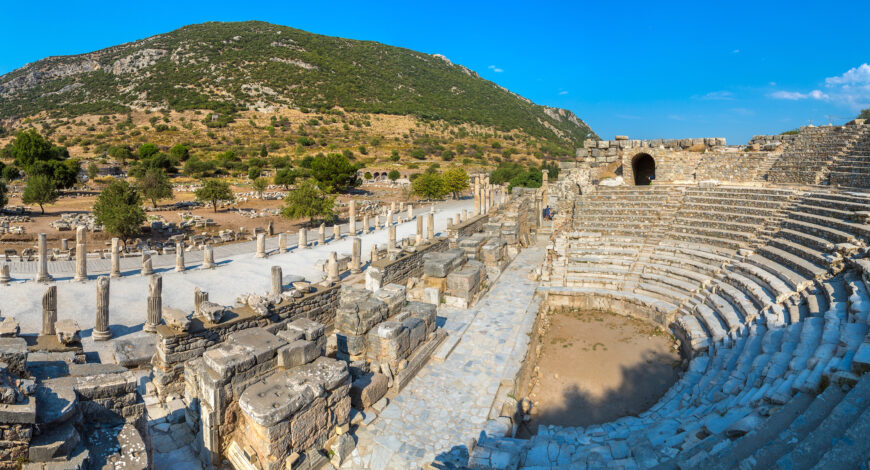
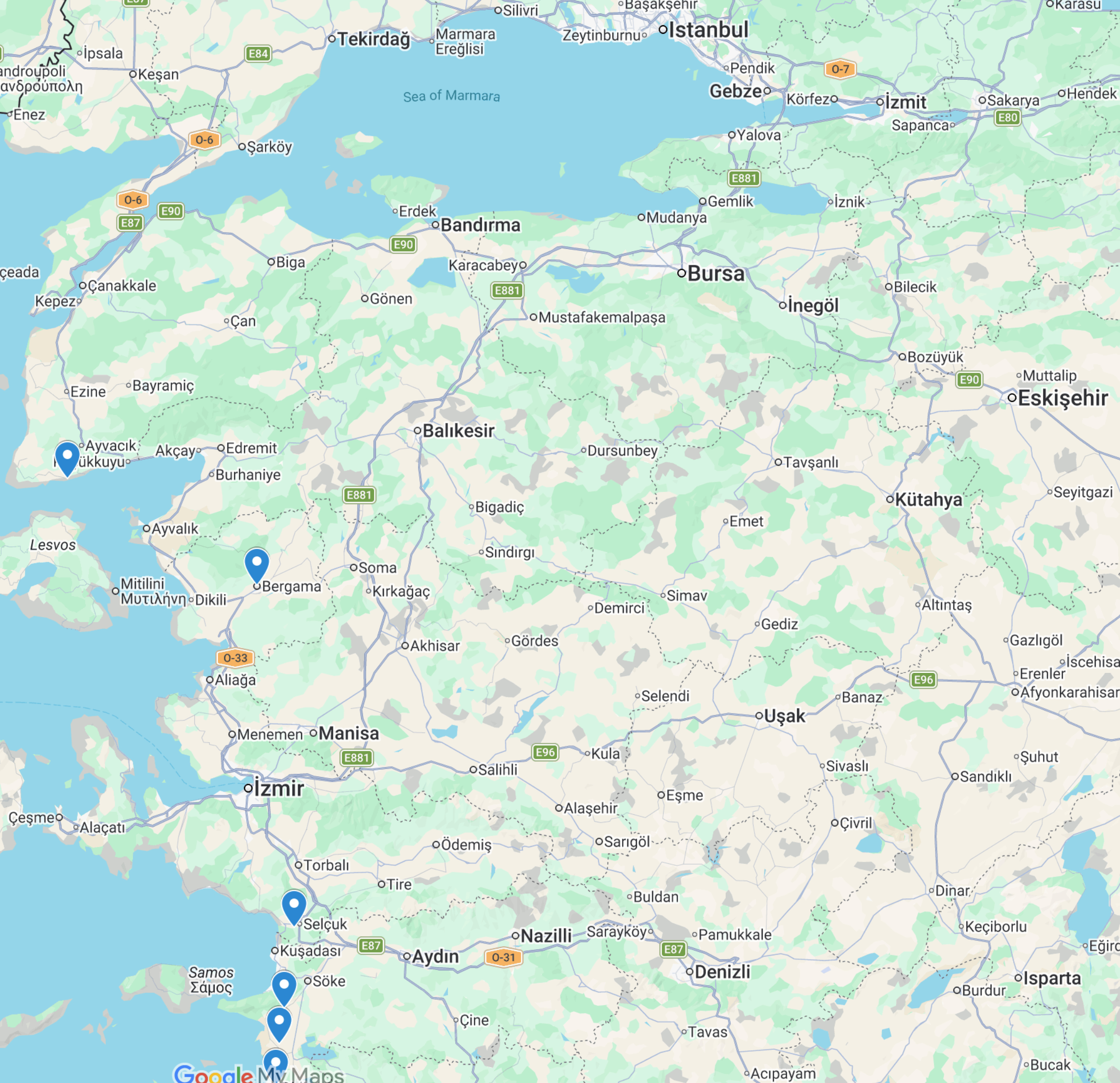
Scattered along the Western coast of modern Türkiye, stand a series of ruined cities. All Greek in origin, these settlements occupied a peculiarly fortunate location. The wide strip of land beside the Eastern Aegean is fertile from the four river valleys that run through it, lower, and therefore warmer, than the Anatolian plateau to the east, while the seacoast to the west gives access to cross-Mediterranean trade. In the sixth century BCE the cities of Ionia, the ancient Greek name for this region (specifically the area in the centre of this coast), were richer than those of mainland Greece and the intellectual centre of the Hellenic world. Architecture, philosophy, and maritime trade all flourished here, in a cross-cultural, cosmopolitan world. The temple of Artemis at Ephesos was one of the largest in the ancient world, Didyma one of its most important oracles, while Miletos was the home of Greece’s earliest philosophers. These Ionian cities, each with its own history of flourishing and decline—one of the peculiarities of Greek history is that the many city-states which make up the Greek world rarely follow the same trajectory, even when they are close neighbours—survive today in a series of beautifully preserved temples, theatres, marketplaces, and streets, some on high cliffs, some down by the shore, chiselled blocks of marble and limestone left to bleach in the sun between the olive groves and the waves.
Seafaring and early migration
Why were there Greek cities here to begin with? The simple answer is the sea. In the ancient world by far the easiest, fastest and cheapest way to travel is by water. This is especially true of the Mediterranean, which is a gentle sea with very little tide. As a result, places that are connected by sea are ‘closer’ than those connected by land, even if strictly numerical distances are much further. In the ancient world, the important geographical unit is often the sea and the connected settlements around it rather than a block of land, and it is common to find peoples moving from one shore to another.
Greek migration east across the Aegean begins early. Many of the classical sites of the Eastern Aegean have prior Minoan and Mycenaean settlements known from the Late Bronze Age. The famous Trojan War may well reflect, in poetic form, the tensions between these Greeks incursions and the local inhabitants. Indeed, letters preserved in the archives of the Hittites, the main power in Eastern Türkiye at the time, suggest the story may have some slight basis in historical events. Then, from the eleventh century, further population movements took place from mainland Greece, in a process referred to as the Ionian Migration. The classical sources describe this as a heroic endeavour led by Athenians, but in reality it is probably best understood as a series of numerous small enterprises undertaken by various groups over a long period of time. By the sixth century these Greek settlers had solidified into Ionians, with a clear sense of self-identity marked by the creation of The Ionian League, a confederation of coastal cities, whose official meeting place was recently discovered on Mount Mykale, near Priene. The Ionians also developed cultural traits distinct from the mainland, of which perhaps the mostly easily recognisable is the Ionic order of architecture.
Conflict and connections with the interior – Lydia and Persia
But this enviable sea-board location has made Ionia always disputed territory. Interactions between the sea-faring Greeks and the land-dwelling populations led to rich cultural exchange, but also frequent conflict. From the eighth century BCE, the main land power in Western Anatolia was Lydia, a proverbially wealthy state—from its last king we get the phrase ‘rich as Croesus’—famous for its perfumes, textiles, furniture and prosperity. The poet Anacreon used ‘Lydian-living’ as a synonym for the easy life. Lydia maintained on the whole friendly relations with the Ionian cities, importing Greek goods and dedicating at Greek sanctuaries, but this did not preclude attacking them on occasion. From the mid-seventh century, under the Mermnad dynasty, as Lydia grew ever richer on the gold that washes down in the Pactolus river through the Lydian capital of Sardis—the first known coinage was minted in seventh-century Lydia, whence the concept spread swiftly to Greece—these attacks increased, until by the mid-sixth century Croesus had brought all the Ionian cities under his control, leaving only the islands free.
Lydia’s expansionism extended to the east, where it brought the kingdom into contact with the newly formed Achaemenid Persian empire, rapidly transforming into the pre-eminent power in the ancient world. In the version related by Herodotos, an Eastern Greek himself, born in Halicarnassos a century later, Croesus sent to the oracle at Delphi—that the king consulted a Greek sanctuary for advice is sign of the close integration between the Greek and Lydian worlds—to ask if he should attack. The oracle replied, ‘If you do, a great empire will fall,’ so Croesus attacked, not realising that the empire that fell would be his own. Though the details, as often with Herodotos, may not be reliable, this story does seem to reflect a reality that the conflict was triggered not by the Achaemenids, but by Croesus, who perhaps sought to exploit the geopolitical instability created throughout the Ancient Near East by the Achaemenid king Cyrus’ unexpected rise to power, in which case he seriously underestimated Cyrus’ military talents.
Ionia in the Achaemenid satrapy of Sparda
After the fall of Sardis in c.546, the Ionian cities soon came under Persian control. The Persians, who referred to the Greeks as the Yauna, a corruption of Ionian, as the East Greeks were those they most frequently encountered, established the cities in the satrapy (administrative area) of Sparda, a Persianization of the Lydian Sfar/d, or Greek Sardis, the city which remained the capital of the region. Achaemenid rule was not universally popular among the Ionian cities. But despite the widespread rebellion which broke out in 499 BCE—this insurrection, known as the Ionian Revolt, was joined by most of the coastal cities, and also notoriously by the Athenians, who sent 20 ships in support, a decision that would eventually led to the Battle of Marathon and all its far-reaching consequences—Persia continued to hold the region for the next two hundred years.
Achaemenid presence is remarkably sparse in the archaeological record. Traces can be found in borrowed pottery forms and metal vessels, in the clothing depicted in some reliefs and wall paintings, and often in seals, a key component of Achaemenid administrative hierarchy, but these vestiges are minimal. There is little to no monumental Achaemenid building, and the indications are that the Achaemenids adapted to the local religious practice, rather than imposing their own—this is particularly clear at Ephesos where, in addition to multiple Persian votives, one of the temple officials seems to have taken the Persian title Megabyxos. The idea that this scarcity of evidence reflects ‘light-footprint’ Persian occupation has been challenged in recent years; instead, it is suggested that Achaemenids may have imposed their rule in ways that do not show up easily in the archaeology—agricultural estates, garrisons, and deportations, as well as the well-attested tribute, are all possibilities. But the absence remains interesting, and it is in striking contrast both to contemporary Greek literature, in which the Persians are a continual, looming presence until the rise of Alexander, and to the Roman occupation of the area centuries later, which left massive remains in temples, amphitheatres, forums, and roads.
East Greece into the modern age
‘Wealth never stays long in one place,’ says Herodotos. After Achaemenid rule, the Ionian coast remained prosperous, continuing to be coveted and fought over, destroyed and rebuilt, through Alexander, the Seleucids, the Romans, the Byzantines, and into the Ottoman empire. But the wealth has moved from one location to another following shifting shorelines and political exigencies, and gradually the ancient Greek cities of Ionia have been deserted, leaving spectacular ruins behind.
The Greek presence, however, remained a constant until 1923. In the early twentieth century, the greatest Greek city was, once again, not in mainland Greece, but in Ionia, in this case the port of Smyrna, famous for its liberal cosmopolitan culture, its banking, and its industry. With the collapse of the Ottoman empire after World War I, the Greeks under Venizelos decided to invade inland, an enterprise which quickly collapsed when it encountered the brilliant general and soon-to-be Turkish President, Atatürk, leading to what the Greeks call ‘The Catastrophe,’ i.e., the burning of Smyrna. A population exchange was subsequently negotiated between the two countries, an event still widely lamented in Greece, especially in the Rebetiko folk music tradition, and gradually the Greek placenames also were replaced with Turkish alternatives. Today there is almost no Greek population in Türkiye, except for a community of a few thousand in Istanbul, and after three and a half millennia of inhabitation, the world of East Greece has finally vanished.
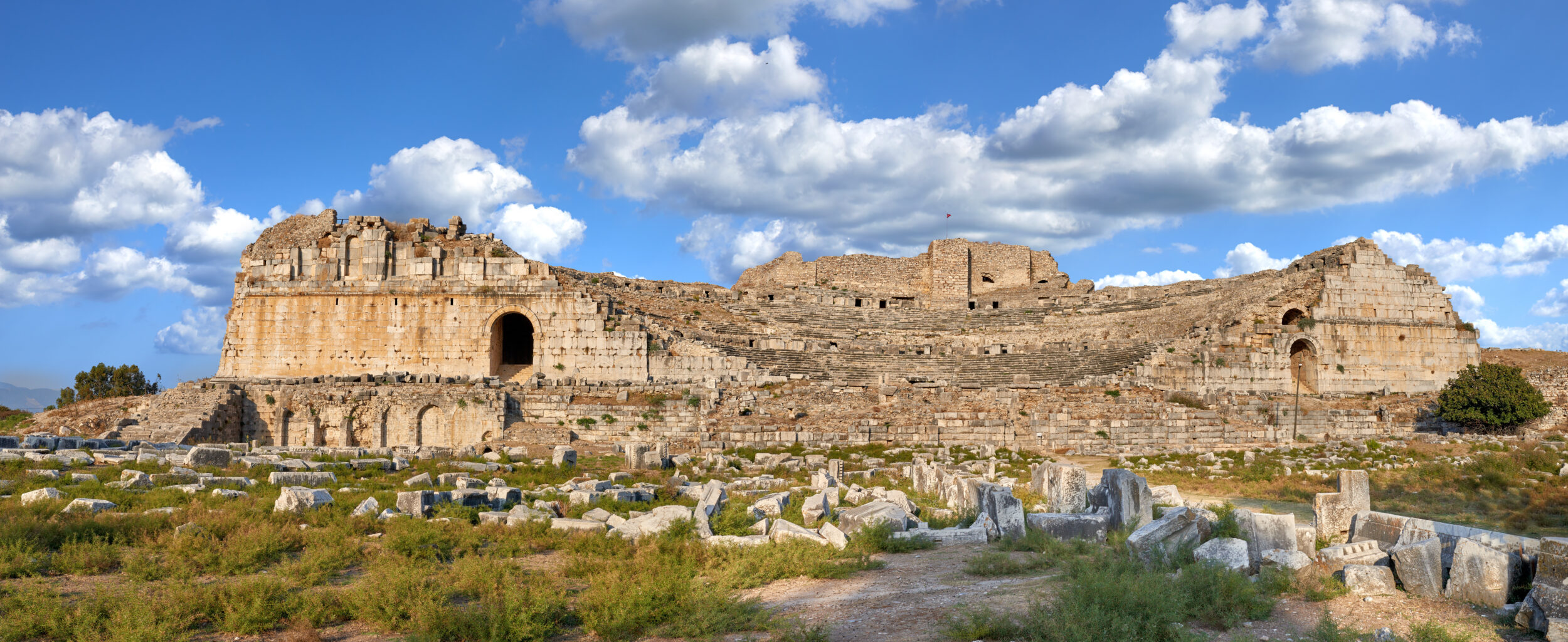
Miletos
In the sixth century, Miletos was the richest and most powerful of the Ionian cities. Its four harbours, now lost to silt, processed trade from Egypt to the Black Sea. Its fertile chora—the land that surrounds the urban area of an ancient polis—produced wool, whose quality was famous in the ancient world, as well as grain and olive oil for export. But Miletos was most famous for its intellectual milieu, as the home of the earliest Greek philosophers and astronomers. In the early sixth century Thales of Miletos, influenced by Babylon and Egypt, was the first Greek to propose replacing the gods with energies and to explain causality by natural laws not divine intervention. He argued for a first cause, which according to Aristotle he maintained was water. Together with fellow Milesians and pre-Socratic philosophers, Anaximandros and Anaximenes, Thales established the observation and experimentation of the Western scientific tradition. But Miletos’ pre-eminence became its downfall. It led the Ionian revolt, and the city’s sack in 494 after the battle of Lade was notoriously brutal, including the destruction of its temples. Miletos was soon rebuilt, but it did not regain its status as a major city until the Roman conquest of Asia Minor.
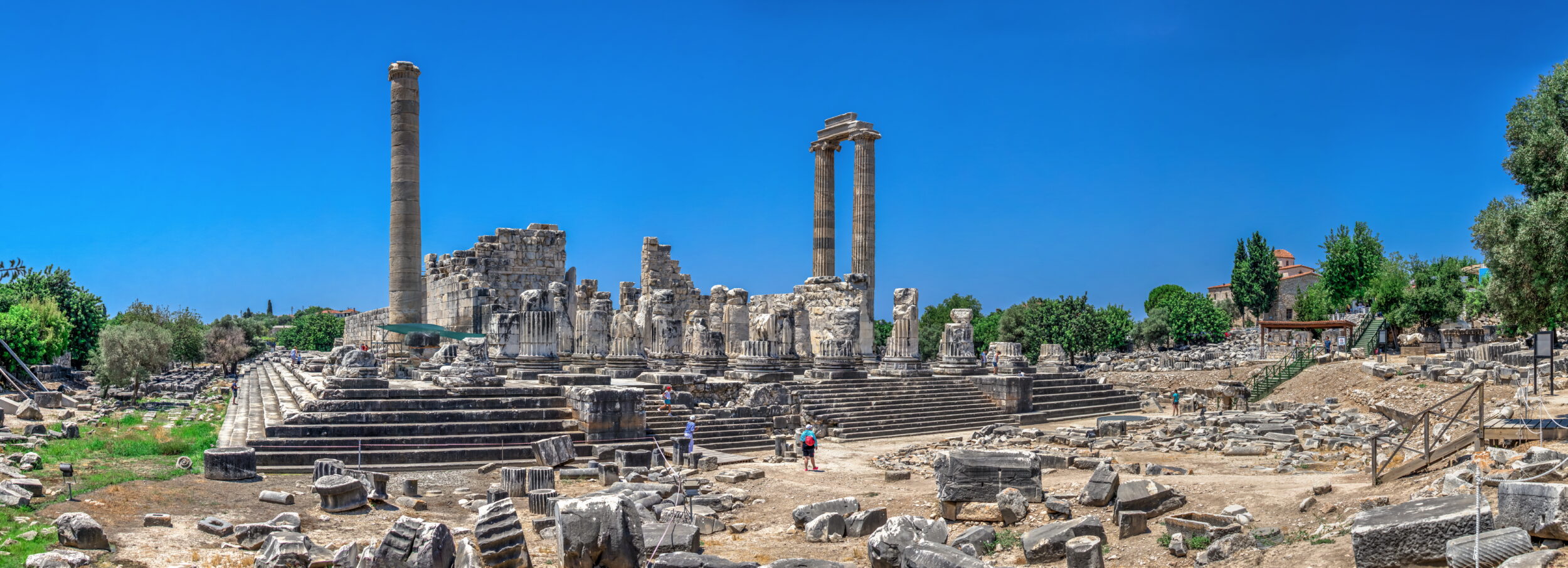
Didyma
Not strictly a city, Didyma was rather an important sanctuary within the sphere of Miletos, to which it is connected by the 20 km Sacred Way. Dedicated to Apollo and his sister Artemis, the site was one of the most important oracles of the Greek world. The archaic sanctuary, uniquely in the Greek world, was administered by a single family, the Branchidai. The name does not seem to be Greek in form, suggesting that family were local in origin, an interesting example of early fusion between the Greek and Anatolian worlds. Little remains of the archaic temple, which was sacked after the Ionian Revolt and its cult statue carried off to the Persian city of Susa; the main ruins today are the impressive monumental temple built to replace it, after Alexander of Macedon liberated the sanctuary in 334. Vast in scale, built to rival the Artemision at Ephesos, the Hellenistic temple also has extremely unusual architecture, with two tunnels leading down to an internal courtyard, where the main shrine was housed. In this later period the oracle received messages from the god through a mantic trance, as at Delphi, but there is evidence that the archaic oracle may have consulted astragyaloi instead—knucklebones, which the Greeks used like dice.
Assos
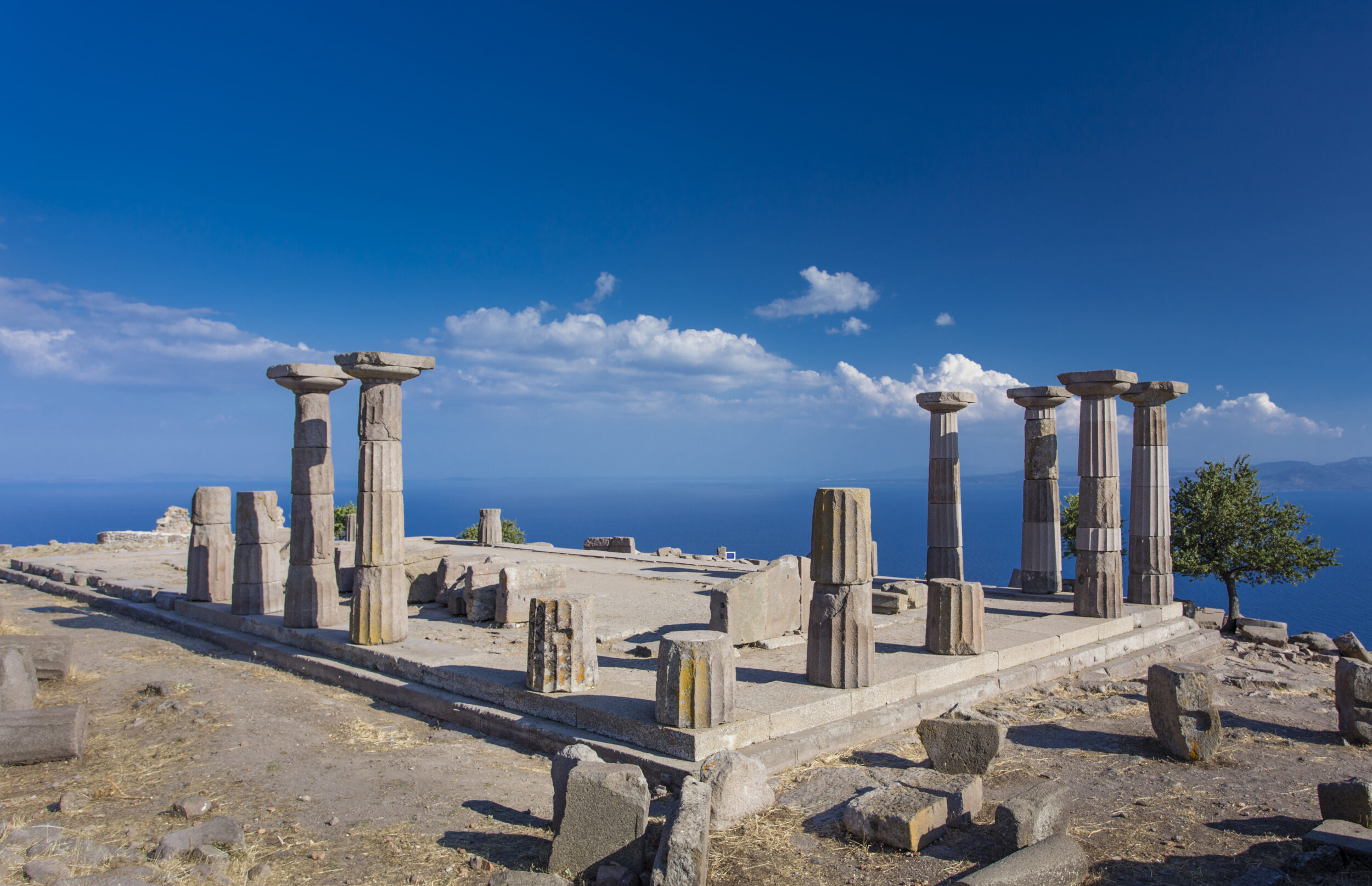
Steep and austere, with spectacular views over the sea, Assos is one of the most atmospheric sites of the Eastern Aegean coast. Technically in Aeolia, the area north of true Ionia, Assos was at its height in the fourth century, when Aristotle spent four years there. But the site is best known for its late sixth-century temple, the only example of Doric architecture in archaic Anatolia. Why the Assians chose the simple, sturdy style typical of mainland Greece and Sicily rather than the delicate volutes of the Eastern Ionic order remains unclear—some consider it a political reach towards the mainland, some an example of the artistic experimentation typical of the late Archaic period—but the stark lines integrate well with the rocky Akropolis, from whose volcanic andesite stone the temple is built. The rest of the city is immaculately preserved, and the site was chosen for the very first excavations of the American Archaeological Institute in 1881 for this reason.
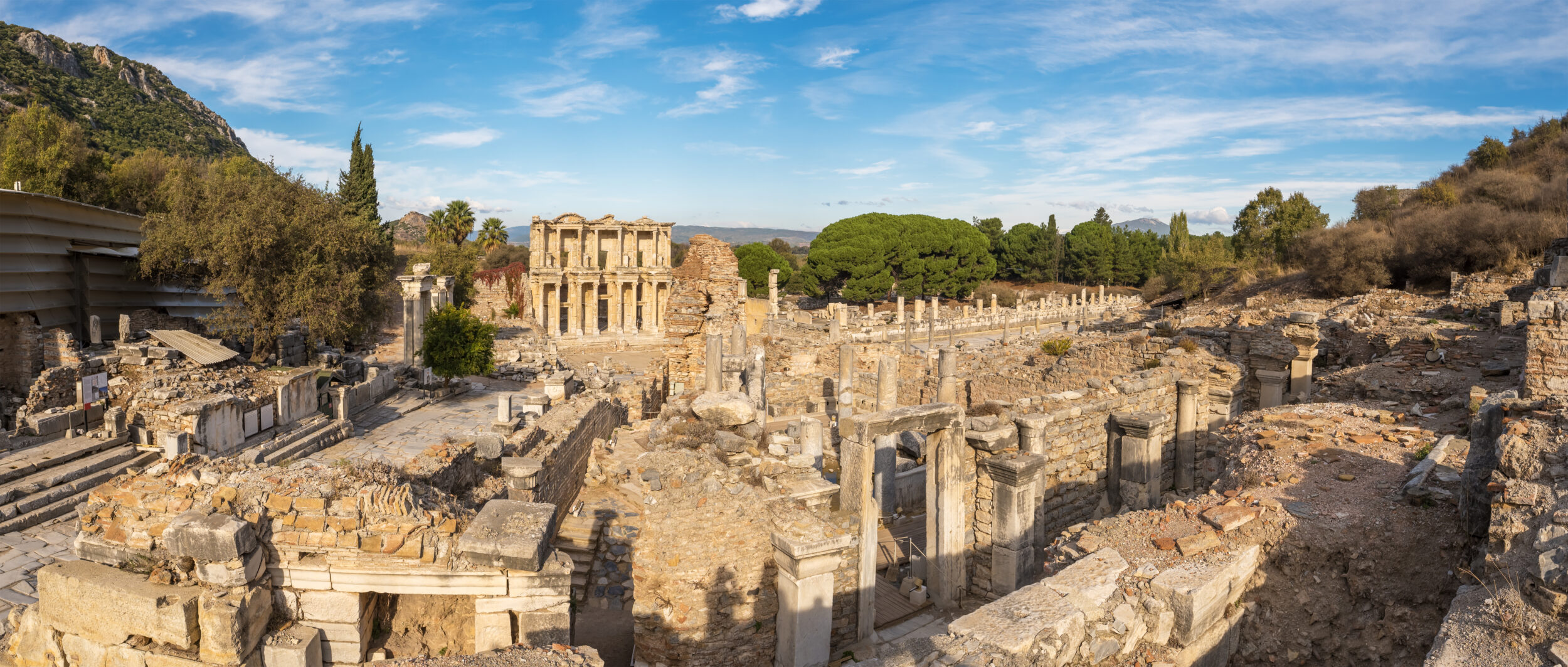
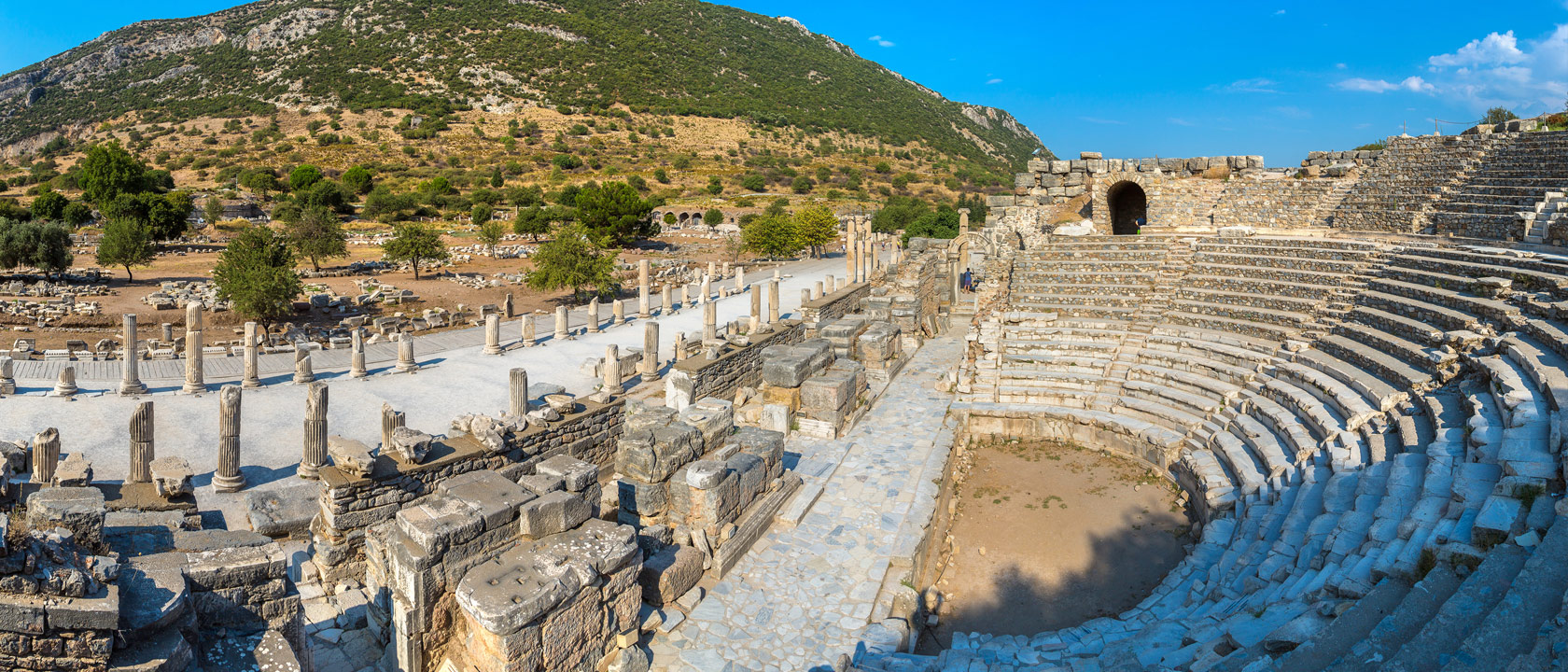
Ephesos
Ephesos is today perhaps most famous for its Christian history and its spectacular Roman ruins—the library of Celsus, the theatre, the terraced houses—dating to the city’s time as the capital of the Roman province of Asia. For centuries before this, however, the city was already the home of one of the most important sanctuaries of the ancient world, the shrine of Artemis of Ephesos, which also had the closest connections to the non-Greek world of all the Ionian sanctuaries. The cult, which dates back to at least the eighth century BCE, was probably an assimilation of Artemis to the indigenous goddess Kybele. Its cult statue, widely copied in the Roman world—the original does not survive—is highly unusual. Its static pose and dark face and hands suggest that it may have been very early, and like many early Greek cult statutes, carved from (oiled) wood; its decoration with lions, leopards, goats, griffins, and bulls, suggests an association with Potnia Theron, the mistress of the animals, an aspect of Artemis, which, however, had much earlier antecedents; meanwhile the multiple ‘breasts,’ which horrified the early Christians, have been variously interpreted as gourds, bees’ nests, bulls’ testicles, and ostrich eggs, but remained unexplained.
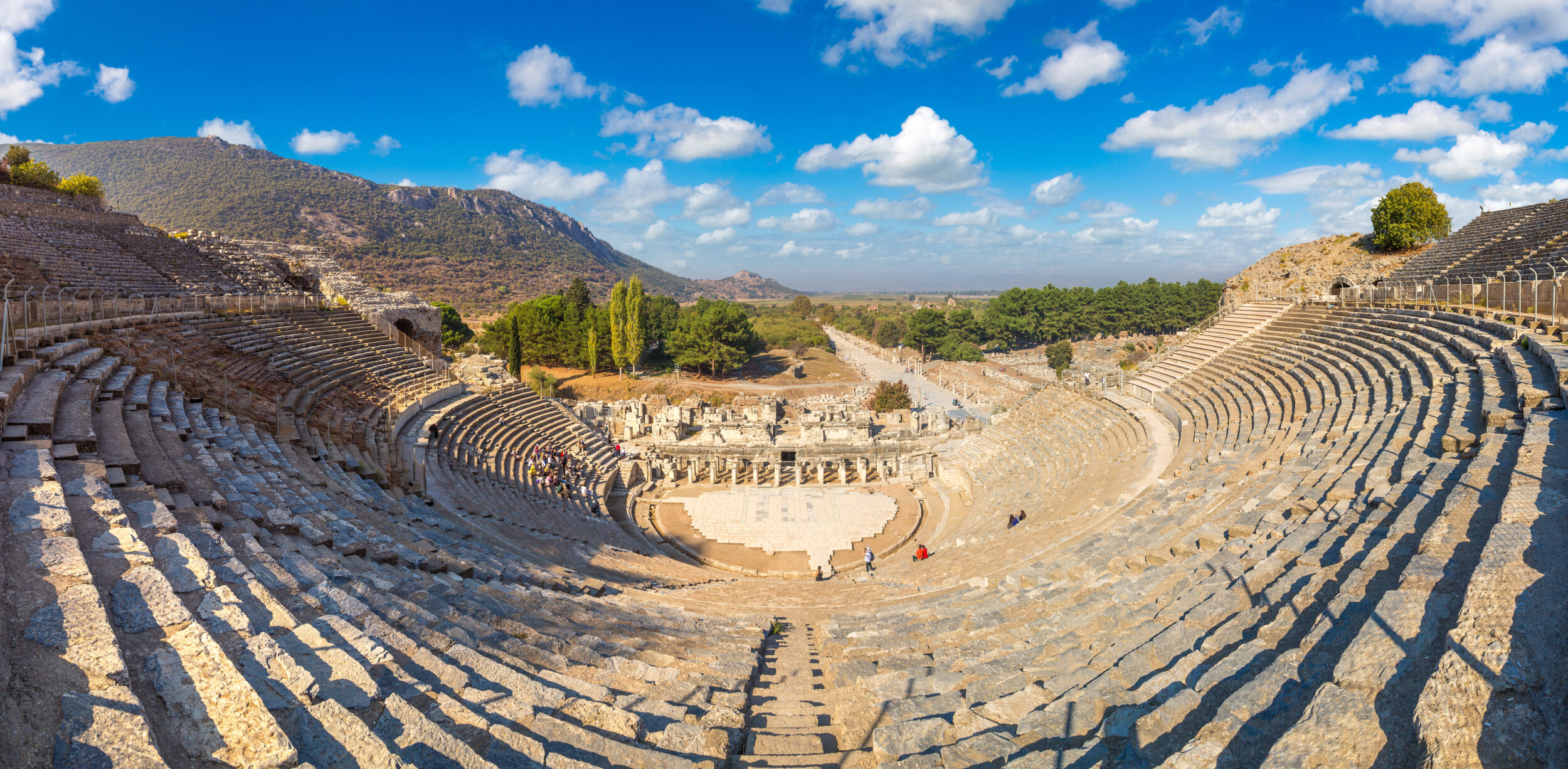
The sixth-century Artemision, which housed the statue, was the largest temple in the Greek world, until it was eclipsed by the Heraion on Samos, the island across the strait, which, non-coincidentally, was fractionally larger—6,038 sq. m versus 6,017 sq.m—an example of the competition between Greek poleis, which along with the cross-cultural interaction drove cultural development in the Greek world. Of all the Ionian cities, Ephesos had the closest relationship with Lydia. The sixth-century Artemision was partially financed by Croesus himself, as is confirmed by inscriptions found on its column drums. Under the rule of the Achaemenids, who may have associated the cult with their goddess Anahita, this patronage continued: Persian objects were left as votives, reliefs show figures in Persian clothing participating in the site’s rituals, and one of the temple officials seems to have taken the Persian title Megabyxos. Unlike neighbouring Miletos, Ephesos did not participate in the Ionian Revolt, and as a result the archaic temple was not damaged; nevertheless, it burnt down in the fourth century. Its replacement, said by Antipater of Sidon to be the greatest of all the Seven Wonders of the World, does not survive either: it was pillaged for stone in the fourth century CE and the remains sank in the silt of the Kaystros river. A single column, assembled from scattered drums in 1972, is all that survives on site—fortunately, however, the Roman ruins more than make up for this.
Priene
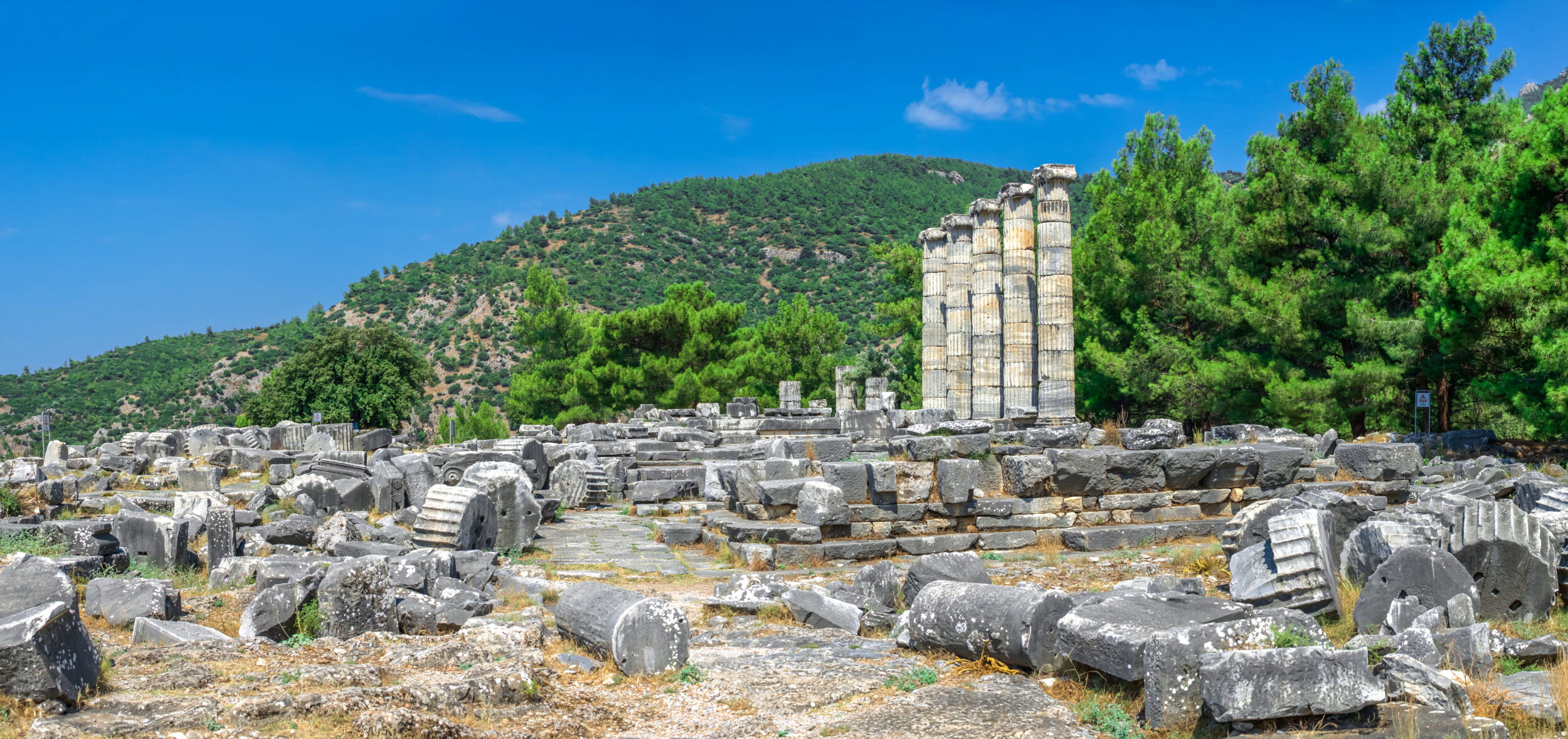
Peaceful, cool, mountainside Priene is a perfect example of a Hellenistic model city. Relocated to its current site in the mid-fourth century BCE—the earlier city, though known from textual sources, has never been found—the new city was laid out in a grid, according to the principles popularized by Hippodamos, another denizen of Miletos, back in the fifth century. The site includes, as well as the public structures—theatre, temples, bouleuterion, agora—extensive residential buildings, water pipes, and sewage systems, all immaculately preserved. The first patron of these works was Mausolus, the Achaemenid satrap of Caria; after the Greek conquest, Alexander smoothly took over the project and personally dedicated the main Temple of Athena Polias, a beautiful example of Ionic architecture. Although a small settlement, never more than 5000 people, Priene was always an important city as the guardian of The Ionian League’s cult centre, whose site, the Panionian, was discovered in the nearby hills in 2015. Priene was abandoned in the second century CE, when the Maeander silted up the nearby harbour, and the population moved to Miletos. This and its isolated hilltop location meant the stone was relatively untouched, hence its excellent condition today.
Pergamon
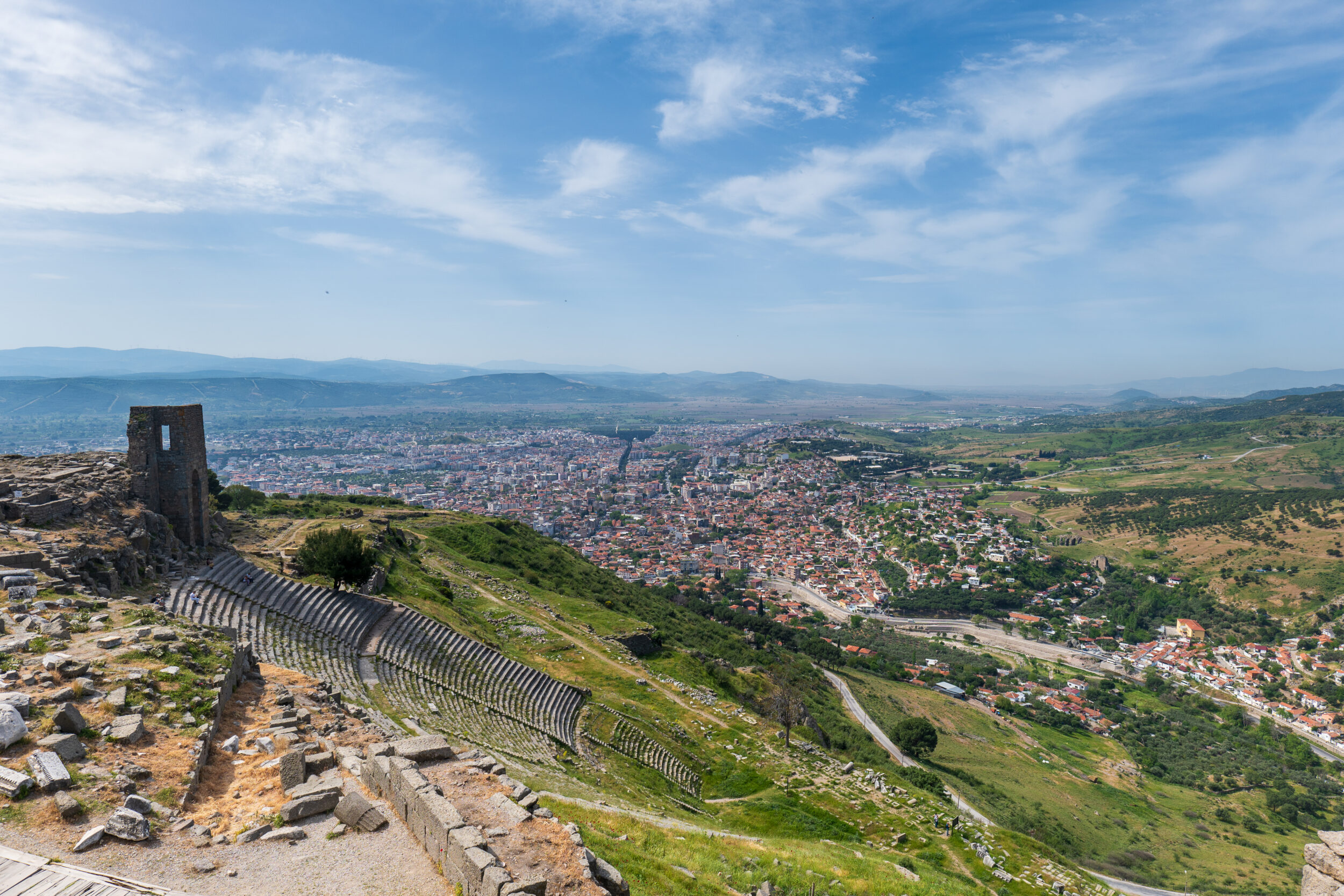
Another spectacular hilltop site, with cliffs falling away on three sides, Pergamon was also remodelled in the Hellenistic period, but on a far greater scale than Priene. As the capital of the newly-formed Attalid kingdom, emerging from the wars of Alexander’s successors, Pergamon’s terraced city-scape, again organised on Hippodamian principles and structured around a hairpin route up the south slope, was intended to rival Athens (a city where the Attalid kings also made significant donations), while its library of 200,000 scrolls was second only to that at Alexandria. The visual references to Athens were many: a copy of Pheidias’ gold and ivory statue of Athena, the high asymmetrical skyline echoing the Athenian Akropolis, and in Pergamon’s most famous monument, the Altar of Zeus, a relief of the Gigantomachy: not only was this theme borrowed from the Parthenon, where it had come to represent the victory of the Greeks over the Persians, but the Altar deliberately ‘quoted’ from the Parthenon reliefs in the composition of its figures. In other respects, the altar was a Hellenistic masterpiece, its deep, emotional carving miles away from the Parthenon’s Classical calm. Architecturally, the Altar combined Greek with non-Greek elements: the stepped design is an East Greek form originating in Egypt; the colonnaded podium is best paralleled in Carian and Lycian monuments, notably the Mausoleum of Halicarnassos and Nereid monument; while its ground-level reliefs, here spilling out onto the steps in high Hellenistic excess, are best paralleled in Achaemenid, or before that Assyro-Babylonian, art. These various influences are a reminder of Ionia’s long and varied connections with the non-Greek world, including, but not limited to, continuing Achaemenid influence long after the Persians’ withdrawal from the area. Unfortunately, the Altar was removed to Berlin in the nineteenth century, but it is still possible to see the spectacular location of what Revelations refers to as the Seat of Satan (or Saint John may have meant the whole city), as well as the streets, and stoas (a favourite Attalid building form), and vertiginously steep theatre of Pergamon, and to admire the condensed layout of perhaps the most completely designed and architecturally satisfying city of the Greek world.
Dr Sophy Downes, is a classical archaeologist, whose research interests have led her continuously further east, to Türkiye and eventually Iran. She initially studied Classics at Oxford; she then did a MPhil at Cambridge, focusing on the funerary monuments of Western Anatolia in the Classical period. After living for a couple of years in Rome, she returned to the Institute of Archaeology in London, where she wrote her PhD thesis, a comparative study of the architecture and politics of Persepolis and the Athenian Acropolis.
Sophy leads ASA’s tour entitled ‘Türkiye: The Ages of Anatolia’, which includes Istanbul, Bursa, Gallipoli Peninsula, the Ionian Cities of the Eastern Aegean (as described above), Konya, the rock-cut monasteries of Cappadocia, Ankara and the ancient capital of the Hittites at Hattusha.
 Türkiye: The Ages of Anatolia 2027