
Phoenicia, Carthage and the Mediterranean. Part I: A Synoptic History of the Phoenicians
By Christopher Wood
From around 1,000 BCE until their defeat by the Romans during the Punic wars (264 – 146 BCE), the Phoenicians, a Semitic people originating in the Levant, created a Thalassocracy, a seaborn trade empire that dominated much of the Mediterranean. Their great rivals before the Romans were the Greeks, who formed colonies in Cyrenaica on the North coast of Africa, in Southern Italy and Eastern Sicily, in Corsica and on the Mediterranean coast of France. This essay begins by discussing the origins and development of the Phoenicians (Part I) and then explores the geographical setting of the Phoenician expansion (Part II). It discusses the topography of the Mediterranean basin, its seas, islands, coastal plains, mountains and deserts (Part III). The essay ranges far beyond the Phoenician experience in an attempt to show how the peculiar nature of this unique sea has also shaped the fortunes of many powers and peoples throughout history. In so doing it attempts to demonstrate how travellers may move beyond narrow, specialised histories of particular peoples and periods to gain broader perspectives such as how the natural environment and human culture interact, and how the past relates to the present.
In the early history of what we call civilisation, the Mediterranean was dominated by great empires that emerged along the Fertile Crescent which runs from Anatolia down the Euphrates and Tigris Valley and across to the Nile. It was here that a hybrid form of wheat was domesticated and the surpluses produced by its cultivation enabled the rise of a priestly class and royal houses. From this transformation rose a number of great empires in Egypt, Mesopotamia and Anatolia. At this time the eastern Mediterranean could be considered a mere frontier of civilisation. In the second millennium BCE, however, a number of peoples formed small states in the Levant. The Minoans created their kingdom on Crete, and the Mycenaeans a trade empire centred upon the Peloponnese.
Birth and Expansion of the Phoenicians: From Lebanon to the Western Mediterranean
The coast of present-day Israel, Palestine, Syria and Lebanon came to be dominated by a group of Phoenician cities that never developed a unified political organisation. Phoenician civilisation was created through the achievements of a number of small city-states, each functioning as an independent political entity. Occupying only a narrow strip of land along the coast, the major Phoenician cities of Tyre, Sarepta, Sidon, Beirut, Byblos, and Arwad were forced to turn to trade and commerce in order to support themselves. Thus developed Phoenician commercial interests: overland, with Aram-Damascus, the kingdoms of Israel and Judah, Assyria; overseas, across the entire Mediterranean and down the Atlantic coast of North Africa.
The Phoenicians were descendants of the Canaanites. The name Canaan is derived from the word kinahhu designating the purple-red dye for which the area was famous throughout antiquity. Tyrian or Phoenician purple, as the colour was known to the Greeks and Romans, was made from the crushed shell of the sea snail Murex trunculus, and heaps of crushed Murex shells are a common feature at most Phoenician archaeological sites. An estimated 10,000 shells were required to produce 1 gram of pure purple dye. The Greek names of Phoenicia and Phoenician are translations of the local terminology, derived from phoinix, the Greek designation for the same purple dye.

Most of the important Phoenician cities of the Early Iron Age had already been major sites in the Bronze Age and have remained as major centres of habitation to the present day. Since the remains of the Iron and Bronze Age lie buried beneath the buildings of the modern cities, the Phoenicians have for long been a people best known from excavations outside their homeland. Excavation of many Phoenician colonies throughout the Mediterranean world has taught us to identify a characteristic type of site which had a double harbour separated by a headland, a small island or point of land. Phoenician architecture typically used ribs or pillars of well-dressed stone separated by sections of wall made of uncut field-stones set in clay. Phoenician pottery was characterised by red burnished piriform jugs and two-spouted lamps.
Phoenician Iron Age material culture shows a strong affinity with earlier Bronze Age forms, a continuity not seen in the cultures of other peoples of the area. For example, the ribbed architecture so characteristic of all Phoenician sites first appears at Late Bronze Age Ugarit, and many of the artistic elements in Phoenician metalwork and ivory carving can be traced to objects in use in Ugarit at that period.
This evidence is absolutely crucial, for it points to the Phoenicians’ role in the Iron Age revival. At the end of the Bronze Age, around 1300 BCE, the civilisations of the Middle East, and that of Mycenae, collapsed. This collapse has been associated with widespread famine and revolt, and the invasion of the Hittite kingdom of Anatolia by the so-called ‘Sea Peoples’, mentioned in Egyptian sources, of which little is known. There followed a ‘dark age’ until around 1000 – 800 BCE when a general economic and cultural revival occurred. This revival, associated in Greek history with the Dorian Invasion and the emergence of the Greek City State, led ultimately to the flowering of classical culture to which the West owes so much. The Phoenicians seem to have played a vital role in the revival of trade at this time. They traded with the Greeks, exporting wood (especially cedar), slaves, excellent glass and powdered Tyrian Purple, used by the Greek elite to colour clothes and other garments and not available anywhere else. The Phoenicians, it must be remembered, created the alphabet system that was used in modified form by the Greeks, and thereby transmitted to Western civilisation.

They also exported wine to Egypt. The Phoenician expansion westward was probably motivated, above all, by the search for minerals. They imported silver from Spain, and tin from England, which was then smelted with Cypriot copper to make bronze; Cyprus was one of the first places where the Phoenicians established colonies.
The Phoenicians revealed by the Archaeology
Despite Greek evidence that the Phoenicians had a thriving literary culture, no substantial Phoenician texts survive. Their culture must therefore be reconstructed from descriptions by Greeks like Herodotus and later from Roman sources describing the Carthaginians. The culture of the Levantine Phoenicians can only be reconstructed from archaeological sites, many of them neo-Phoenician. Although it has not been possible to obtain much information from the early Phoenician cities of Syria and Lebanon, the site of Amrit (Classical Marathos) has revealed evidence of a neo-Phoenician religious centre that was heavily influenced in its architectural style by the Egyptians, Mesopotamians and the Achaemenid Persians. It is the only extant site in Syria whose remains, though fragmentary, convey to us a sense of this mixing of civilisations, reflecting the ability of the Phoenicians to absorb and syncretise outside influences. People from the nearby Arwad Island founded the site as a religious centre. Many of its buildings date from the period of Persian dominance and the main monument of interest, the temple compound, was built at the end of the 6th century BCE with elements freely borrowed from Mesopotamian and Egyptian architecture.


Syria – Tartus, Phoenician site of Amrit (Marathus). Left: Ancient tombs. Right: Syria – Temple of the god Melkart
The compound, the Semitic sacred ‘open space’, was dedicated to the god Melqart, associated in the Greek period with Hercules and the Egyptian god of healing, Echinoun. A rock-cut enclosure (c. 50 x 40 m) was constructed that could be flooded by a nearby sacred spring, whose healing properties were the reason for the complex. In the centre of the artificial lake was a small cella raised on a high rock-cut cube, topped by an Egyptian-style cornice and originally by a frieze of stepped Mesopotamian-style triangular merlons. The pond was surrounded on three sides by a colonnaded arcade whose façade was formed from plain rectangular pillars in Egyptian style originally topped by a continuous row of merlons. Two towers flanked the North edges of the East and West colonnades, again reflecting Mesopotamian inspiration. On the open platform between the towers was a high altar facing south towards the opening in the cella.
South of the temple are many funerary monuments and hypogea (underground tombs). Most striking are two towers consisting of square pedestals with lions at each corner, surmounted by huge monolithic cylinders, 13 and 23 feet high respectively. The smaller of these is topped by a pyramid and the larger one by a half-sphere. Another consists of a great black mausoleum in the shape of a cube; a large fallen obelisk lies nearby. Beneath the monuments are a large number of burial chambers. These tower tomb monuments are characteristic Phoenician forms and are found in many parts of the Mediterranean. For example, the tower tomb of the local prince Ateban near Dougga in Tunisia was crowned with a pyramid like the one at Amrit. The cube form, pyramids and obelisks have obvious affinities with Egypt. More important however, they recall ancient Semitic worship of abstract forms seen also in the Dagan temple at Ugarit.


Left: The Mausoleum of Ateban, Dougga, Tunisia. Right: Sarcophagus of Eshmunazar II, Le Louvre, Paris
A large number of anthropoid sarcophagi have been found throughout Phoenicia and on the Palestinian coast, reflecting an Egyptian influence on burial customs in this region. An outstanding example is the black granite coffin of King Eshmunazar of Sidon, its lid carved in the likeness of the king in a distinctly Egyptian style. From the Amrit burial ground a large number of similar coffins have also been found, generally made from ceramic, and several are now in Tartous museum. Two of the best examples of such coffins are displayed far away in the Museum of Cadiz in Spain.
At the site of Tabbat al-Hammam, located just north of Amrit, are the remains of the earliest artificial harbour, or cothon, in the eastern Mediterranean. Its breakwater was built of ashlar blocks extending into the sea and seems to be a construction of the late 9th century BCE. As such it probably marks the beginning of Phoenician expansion into the Mediterranean, an expansion that took them first to Cyprus, then to the northern and southern coasts of the western Mediterranean. In 814 BCE the Phoenicians founded the city of Carthage on the North African coast. Here they also built a sophisticated harbour that can still be seen today.

The Rise and Fall of Carthage: Rome and The Punic Wars
In 539 BCE Cyrus the Great of Persia conquered the Phoenicians’ homelands, turning Tyre, Sidon, Arwad and Byblos into four vassal kingdoms. Although these kingdoms prospered, in part by providing ships for further Persian expansion in the eastern Mediterranean, many of their peoples fled to Carthage, which began to supersede the Levant as the epicentre of Phoenician power. In 332 BCE Alexander the Great besieged and sacked Tyre. Although the other Phoenician cities of the Levant submitted to Alexander peacefully and were allowed to maintain some of their independence, the Hellenistic states of Alexander’s successors effectively destroyed Phoenician power in the eastern Mediterranean.
By the 6th century the Phoenicians had established trading colonies across much of the Mediterranean, in Cyprus, Malta, Libya, Tunisia, Sicily, Sardinia, the Ligurian coast of Italy, Algeria, Spain, Portugal, Morocco and Mauretania. Modern imprints of this grand commercial venture, which led Fernand Braudel to exclaim that the Phoenicians created one of the first world economies, can be found in the language and genetic profiles of certain modern Mediterranean peoples. The Maltese language, for example, includes elements of Punic. Spencer Wells, geneticist, anthropologist, and leader of the Genographic Project, has demonstrated that male populations of Lebanon, Malta, Spain, and other areas settled by Phoenicians share a common m89 chromosome Y type.
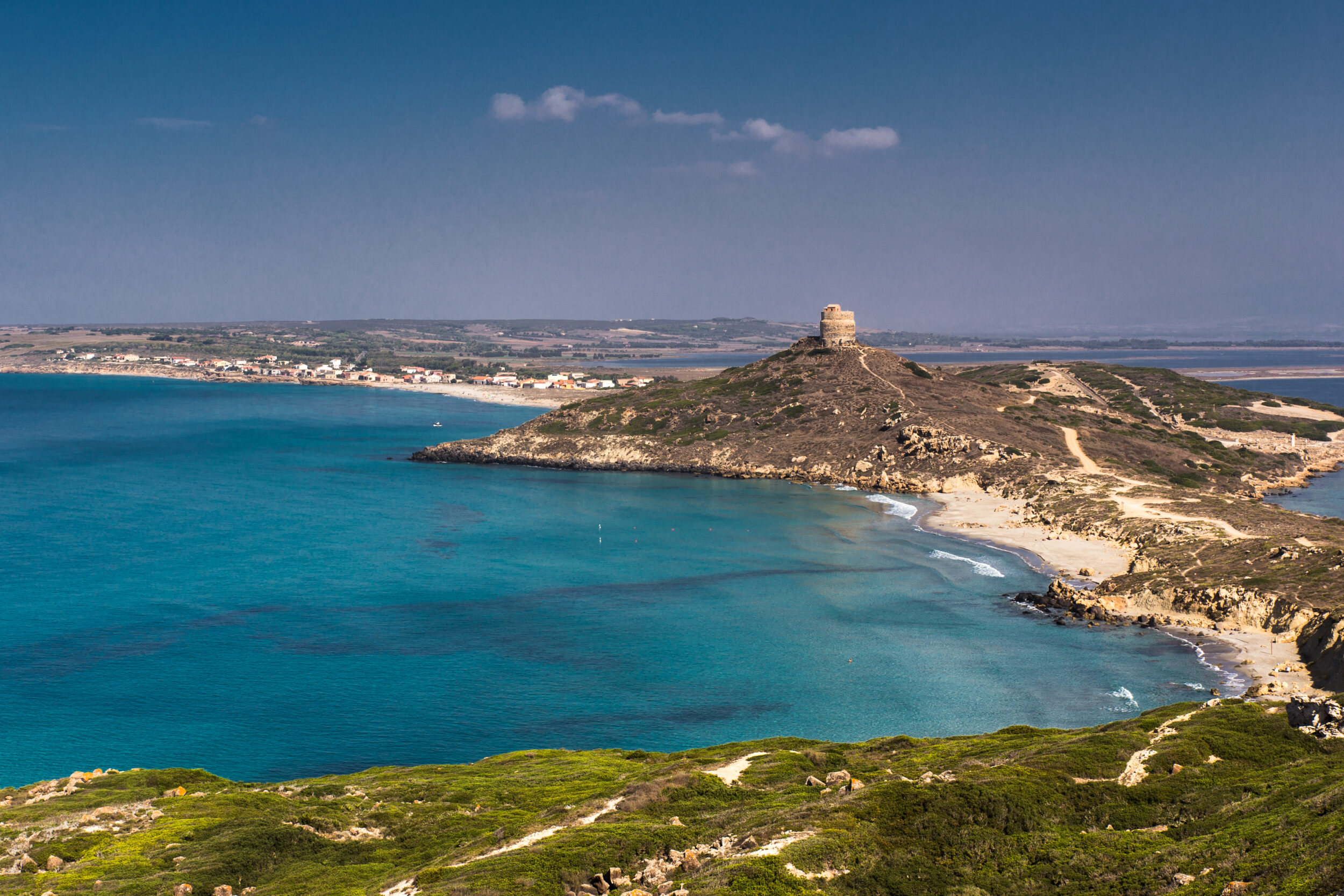

Ancient cities of Tharros (left) and Nora (right) in Sardinia
Carthage, in Tunisia, had been founded in 814 BCE under Pygmalion of Tyre (820-774 BCE). With the loss of autonomy on the Levantine coast it now became the capital of Phoenicia in the West. Carthage competed with the Phoenicians’ earlier trade partners, the Greeks, for trade supremacy, often in alliance with Etruria. Carthage also established strong trade relations with the indigenes of North Africa. On the whole, Carthaginian relations with these peoples were peaceful and involved locals adopting Phoenician Gods, although her entanglement with the Kingdom of Numidia was to contribute to her downfall.
From the 8th to the 3rd century BCE the navies of Carthage dominated the western Mediterranean. In 264 BCE, however, she became embroiled in a conflict between Hiero II of Syracuse and the Mamertines of Messina. The machinations of the Mamertines, initially allies of Carthage, brought the other major power of the region into the theatre of war. By 264 BCE Rome had the Italic peninsula under her sway. Her powerful armies were composed of Roman citizens, whereas those of Carthage were made up of mercenaries. Rome, on the other hand, had no navy. The First Punic War lasted over 20 years, during which Rome built up a navy. The war resulted in a Roman victory, Rome’s annexation of Sicily, and huge reparations to be paid to the victor by Carthage. The Carthaginians, moreover, were unable to pay their mercenaries, which led to a revolt (238 BCE) and civil war, the War of the Mercenaries. Rome took advantage of this war to annex Phoenician Sardinia and Corsica.

Two powerful families emerged from the final Carthaginian defeat of the mercenaries. One of these, the Barca, profited from Rome’s preoccupation fighting the Illyrians (Western Balkans) to develop a powerful empire in Iberia, built upon the mining of silver. Tensions in Iberia, in part sparked by conflicts between Rome’s and Carthage’s client Iberian tribes, eventually led to the Second Punic War (218-201 BCE), and the invasion of Italy by the Barca family’s most famous scion, Hannibal (248-c.182 BCE). Hannibal took the Romans by surprise, entering Italy by crossing the Alps. Although in the next 16 years he repeatedly defeated the Romans, his campaign eventually collapsed for a number of reasons. Hannibal had lost most of his siege machinery and many of his elephants in the Alpine crossing. His repeated calls for reinforcements and supplies from Carthage were not heeded, and his attempts to persuade the client cities of the Romans in Italy to revolt and join him failed. Despite his many victories, Hannibal was unable to deal the knockout blow by taking Rome, and the war ended with a Roman invasion of Africa.


Left: Bust of Hannibal Barca, Naples National Archaeological Museum. Right: Second Punic War (208-201 BCE)
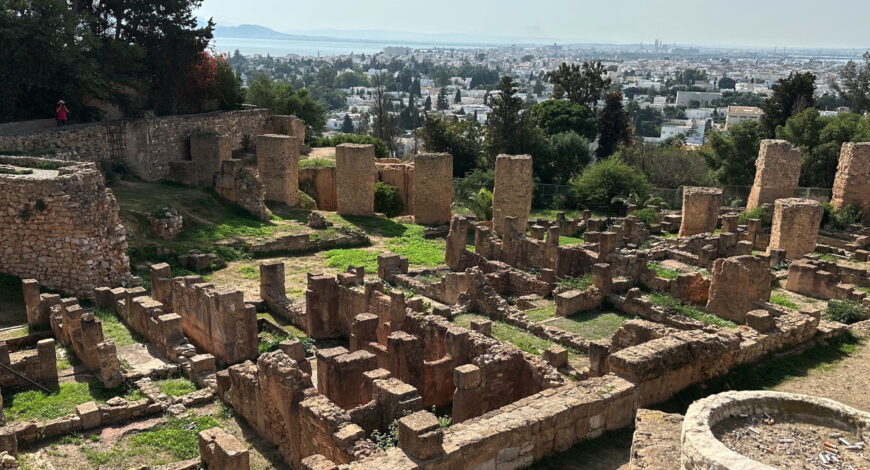
The Carthaginian Empire was now reduced to Carthage itself and its immediate hinterland. Its war against the Numidian Kingdom not only ended in defeat and reparations to be paid, but also raised fears in Rome that Carthage may pose a renewed military threat. Cato the Elder at the time ended all his speeches with “Ceterum censeo Carthaginem esse delendum” (“Furthermore, I think that Carthage must be destroyed”). Rome initiated the war by demanding even more reparation and, after a three-year siege, defeated Carthage and utterly destroyed the city (146 BCE). A new Roman city was constructed; much of its Punic predecessor cannot even be excavated because it lies beneath one of Tunis’ wealthy suburbs. Rome’s greatest criticism of the Carthaginians was that they sacrificed their children in bloody rituals. Tunisian tour guides sympathetic to the Punic cause still contest this slur.

Follow the routes of the Phoenicians and explore their heritage on tours in Tunisia, Algeria, Morocco, Cyprus, Sicily, Sardinia & Corsica and Spain.
On the same subject
Phoenicia, Carthage and the Mediterranean. Part II: The Mediterranean Setting
Phoenicia, Carthage and the Mediterranean. Part III: The nature of Mediterranean shipping (coming soon)
Article images
Public quarter of Byrsa, Carthage. Photo by Dr Christopher A. Tuttle
Peter Paul Rubens – Hercules’s Dog Discovers Purple Dye. Public domain, via Wikimedia Commons
Punic harbour of Carthage. Public domain via Wikimedia Commons
Phoenician alphabet by anarres
Syria – Tartus, Phoenician site of Amrit (Marathus). Photo ID 11918644 © Dbajurin | Dreamstime.com
Temple of the god Melkart, Amrit, Syria. ID 11918450 © Dbajurin | Dreamstime.com
The Mausoleum of Ateban, Dougga, Tunisia. Photo by Monaam Ben Fredj, CC BY-SA 4.0 via Wikimedia Commons
Sarcophagus of Eshmunazar II, Le Louvre, Paris. Unknown Auhor CC BY-SA 4.0 via Wikimedia Commons
Model of the Punic Harbour of Carthage, Carthage National Museum. Photo by Kristen Hellstrom
Ancient City of Nora Image ID: 154448441 by Zabrodsky | Dreamstime.com https://www.dreamstime.com/zabrodsky_info
Tharros by Berlinrider, CC BY 2.0 https://creativecommons.org/licenses/by/2.0/ via Flickr.com
First Punic War 264BCE by Jon Platek CC BY-SA 3.0 via WikiCommons
Bust of Hannibal Barca from Capua. Photo by Fratelli Alinari, Public domain, via Wikimedia Commons
Second Punic War. Photo by Javierfv1212 CC BY-SA 3.0 via WikiCommons
Tophet, Carthage. Photo by Kristen Hellstrom
These images have been resized for this website.
 Tunisia: From Carthage to the Sahara 2026
  Sardinia and Corsica: Islands of Forgotten Riches 2027
  Tunisia: From Carthage to the Sahara 2027