
Access to your government’s embassy while travelling
Australia www.dfat.gov.au
New Zealand www.mfat.govt.nz
Canada www.travel.gc.ca
United Kingdom www.gov.uk
America www.usembassy.gov
Time Zones
Rabat, Morocco is GMT +1
To obtain the current local time and date in the cities and countries you are travelling to, please visit: www.timeanddate.com
Electricity and Plugs
Morocco uses 220/230 volts. Plugs are of the two-round-pronged European type (type F) – www.korjo.com/adaptor-guide
Currency
To obtain the most up-to-date exchange rate you may wish to visit: www.xe.com/currencyconverter
The official currency of Morocco is the Moroccan Dirham (DH or MAD). There are banknotes to the value of 20, 50, 100 and 200 MAD. In addition, you will find 1, 2, 5 and 10 MAD coins. Centimes (or cents) are in the following denominations: 10, 20 and 50. 100 Centimes = 1 Dirham.
Cash
Dirham is a closed currency, and you can only buy it at the airport or after you have entered the country, and you can only change it back before customs on departure.
Euro, USD, GBP cash can be exchanged at the airport on arrival, which is the easiest and best way. It can also be done at banks, larger hotels and official bureaux de change (identified by a golden sign) only; changing money in the streets is illegal. Visitors must keep the exchange receipt provided to exchange Moroccan currency back into the original national currency at departure.
Do not take large notes as vendors may find they are difficult to change. Try to bring foreign currency notes in small denominations in Euro or USD (eg. US $20, US $10, US $5 and even US $1 notes). Avoid purchasing old notes (request crisp, new notes!)
Cash is the simplest and most common way to pay for small purchases, payment by credit card is also widespread, especially for larger purchases and in hotels and restaurants.
ATMs (guichets automatiques) are the easiest way to access your money in Morocco and are common in even in small towns. ATMs sometimes run dry on weekends.
Mastercard and Visa are the most accepted credit cards. They often attract a surcharge of around 5% from Moroccan businesses. If you have questions about using your credit card in a foreign country, please contact your bank prior to departure from your home country.
Visa
Regular passport holders from more than 70 countries (including Australia, New Zealand, Canada & United Kingdom) visiting Morocco for tourism purposes DO NOT require a visa and will be granted permission for short-term stay (90 days) on arrival. Ensure your passport is valid for a minimum of six months after your departure date and has at least 2 clear pages in your passport. You may be asked to provide documentation outlining the reason for your visit and confirming your departure date. If you are unsure, please check with your local authority, consulate or embassy for requirements.
Telephone & Communication
Mobile Telephones
Most mobile telephones work in Morocco and coverage is good in most areas. Check with your local provider regarding ‘Global Roaming’ and coverage in the places you are visiting. If you are planning to purchase a local sim card, please check with your local provider prior to departure to make sure your phone is unlocked and will accept another sim card.
Another way to access data for your phone overseas is by purchasing an e-sim. Please ensure that your phone is suitable, it usually requires a phone not older than a few years old. Look for companies like Airalo or Holafly.
WhatsApp Messenger is an economical way to stay in touch with friends and family. WhatsApp is free and offers simple, secure, reliable messaging and calling service.
ASA tour leaders use WhatsApp to communicate with tour participants while travelling, so the app should be downloaded to your mobile device prior to joining the program.
Internet
Internet access is widespread and available throughout Morocco. Many hotels and cafes offer access; some charge while others have free Wi-fi zones.
Personal Safety
Morocco is overall safe to travel to but bear in mind that opportunistic petty crime can still be an issue, anywhere you go.
- Petty theft and pickpocketing, although rare, can occur. Keep expensive jewellery at home and have an awareness of where your bags and possessions are at all times.
- Do not leave any personal items unattended.
- Take extra care in crowded places and avoid keeping your wallet or phone in your hip pocket.
- We strongly recommend the use of a money belt to keep your cash, cards and travel documents safe. This should be kept under your clothes at all times. This is a precaution that should be taken anywhere due to the difficulties that can be experienced when trying to replace stolen items.
- Take photocopies or photos of all important documents (passport, credit cards, E-tickets, insurance).
- It is generally helpful to take a business card from the hotel you are staying at. This can assist hugely if you get lost or if there is a language barrier. If you have a key card for your hotel, make sure you keep these two cards separate.
Eating & Drinking Precautions
- It is not appropriate to drink the tap water in Morocco. It is however a necessity that you stay hydrated, and bottled water is provided while on an ASA tour. Make sure the bottle’s seal is not broken before drinking.
- Under no circumstances eat raw vegetables or salads. This also applies to the parsley and mint garnishes often served with grilled meat.
- Only eat well-cooked meat and fish, and fruit you peel yourself.
- Avoid dairy products as milk is unpasteurised in some parts of Morocco and should be avoided. Don’t drink anything containing ice.
Australians Studying Abroad takes the health and safety of its travellers seriously and every measure is taken to ensure that trips are safe, fun and enjoyable. We recommend that all travellers check with their government or national travel advisory organisation for the latest essential travel information before departure:
Australia Smart Traveller
New Zealand Safe Travel
Canada Canada Travel Information
United Kingdon UK Foreign Travel Advice
USA US Department of State
The World Health Organisation also provides useful health information.
Health
It is advisable to consult with your doctor or local travel clinic in the weeks leading up to your departure, allowing enough time to obtain any relevant vaccinations or travel medication that may be required.
Travelling with Medication
Not all medications available in your home country, over the counter or by prescription, are available in other countries. Some may be considered illegal or a controlled substance, even if prescribed by a doctor. If unsure, travellers should check the regulations on importing or transporting medicines to their chosen destination by contacting the relevant embassy or high commission for clarification.
All medication should be carried in their original packaging and in your hand luggage. If you are taking medication whilst travelling, please make sure you have enough for the duration of your trip.
Carry a letter from your doctor stating:
- what the medication is and what it is for
- your required dosage
- that it is for personal use
For more information, contact the Consulate-General in your country.
Australia www.dfat.gov.au
New Zealand www.mfat.govt.nz
Canada www.travel.gc.ca
United Kingdom www.gov.uk
USA US Department of State
What to Pack
Clothing (general)
The time of the year will dictate the type of clothing it is appropriate to bring. For daytime activities, we suggest a wardrobe that is lightweight, versatile, casual and comfortable. It is recommended that “layered” clothing might offer the best comfort in a variety of conditions. Always expect the weather to be changeable.
Beyond the normal wardrobe, we suggest the following:
- Day pack or a cross-body handbag. Site visits often involve walking on uneven ground, up numerous steps and may be of a reasonable duration. You will want to have your hands free to hold rails or steady yourself as applicable. A day pack/ cross body bag will allow you to easily carry your ancillary items: camera, waterproof, sunhat, sunscreen, bottled water, sunglasses etc.
- A hiking pole (fold-up) should be considered as many sites have steps and uneven ground, often without handrails.
- Comfortable walking shoes are very important as there is a lot of uneven ground (hiking boots are not required); sandals or open shoes are only suitable for the evening.
- Sunglasses, sunscreen, swim wear and a hat.
- Travel torch.
- Folding umbrella.
- Toilet paper, wet wipes and hand sanitiser. (see note below – Toilets)
- Camera: Please take all necessary equipment/spares as will be difficult to purchase additional supplies while on tour.
- Extra prescription eyeglasses (if required).
- Eyeshades may be helpful if you have trouble sleeping with the light of the midnight sun during the summertime.
- Evenings can be cool in desert and mountain regions – warm jumper/ jacket or wrap recommended.
- Spare batteries, power bank and charging cables for all devices and additional memory cards.
Toilets: In Morocco it is very common to find squat toilets, which are flushed with a bucket of water. Moroccan toilets almost always do not contain toilet paper and it is a necessity to carry toilet paper and/or hygiene wipes if you will be away from the hotel for an extended period of time.
Etiquette
- No attempt should be made to photograph anything remotely connected with the armed forces, police or in the vicinity of defence installations or Government buildings.
- Many people do not like being photographed, while others may try to obtain money from you. Always ask permission before photographing someone.
Clothing:
- Although ‘foreigners’ do not have to adhere to strict Muslim dress rules, women should not display too much of your body. Shoulders should be covered at all times, and sleeves covering the elbow are advisable. Skirts should be over knee-length. Do not wear clothes that are figure hugging or clothes with a low-cut neckline. A scarf can be used to cover up where needed. Men, as for women, it is culturally insensitive to wear shorts, and we request that you do not do so. Rural areas are more conservative.
A note on Mosques:
- Tourists may not enter mosques in Morocco unless they are Muslim (with the exception of the Grand Mosque in Casablanca).
Bargaining:
- Unless you are shopping at a fixed-price shop, you should bargain. Please remember if you are bargaining, it should be a bit of fun and undertaken with a generous dose of humour and patience, resulting in both parties reaching a mutually beneficial outcome. Generally, if someone quotes you a price, halve it. The seller will come down about halfway to your price, and the last price will be a little higher than half the original price. Chances are you’re arguing over a couple of dollars.
Climate
Spring, which comes late by European standards (between March and May), is perhaps the best overall time to visit, with a summer climate in the south and in the mountains, as well as on the Mediterranean and Atlantic coasts.
While you are travelling in Spring you can expect the weather to be mainly warm to hot during the day, but it can be cold at night, particularly in the desert and mountain areas. Rainfalls can be expected in coastal areas. These travel notes are a guide only
We suggest checking the weather forecast for the most up-to-date information, prior to your departure.
www.worldweatheronline.com or www.weather-finder.com
Average minimum/maximum Temperatures (˚C)
| City | Jan | Feb | Mar | Apr | May | Jun | Jul | Aug | Sep | Oct | Nov | Dec |
| Tangier | 9/16 | 9/17 | 11/18 | 12/20 | 14/23 | 17/26 | 20/29 | 20/29 | 19/27 | 16/24 | 13/20 | 10/17 |
| Marrakesh | 7/19 | 8/20 | 11/23 | 13/25 | 15/29 | 18/33 | 21/37 | 21/36 | 19/32 | 16/28 | 11/23 | 8/19 |
| Tinghir | 3/15 | 5/17 | 9/20 | 13/24 | 17/28 | 21/33 | 24/36 | 23/34 | 19/30 | 14/24 | 8/19 | 4/15 |
The information in the above travel notes has been compiled with care and provided in good faith however it is subject to change.
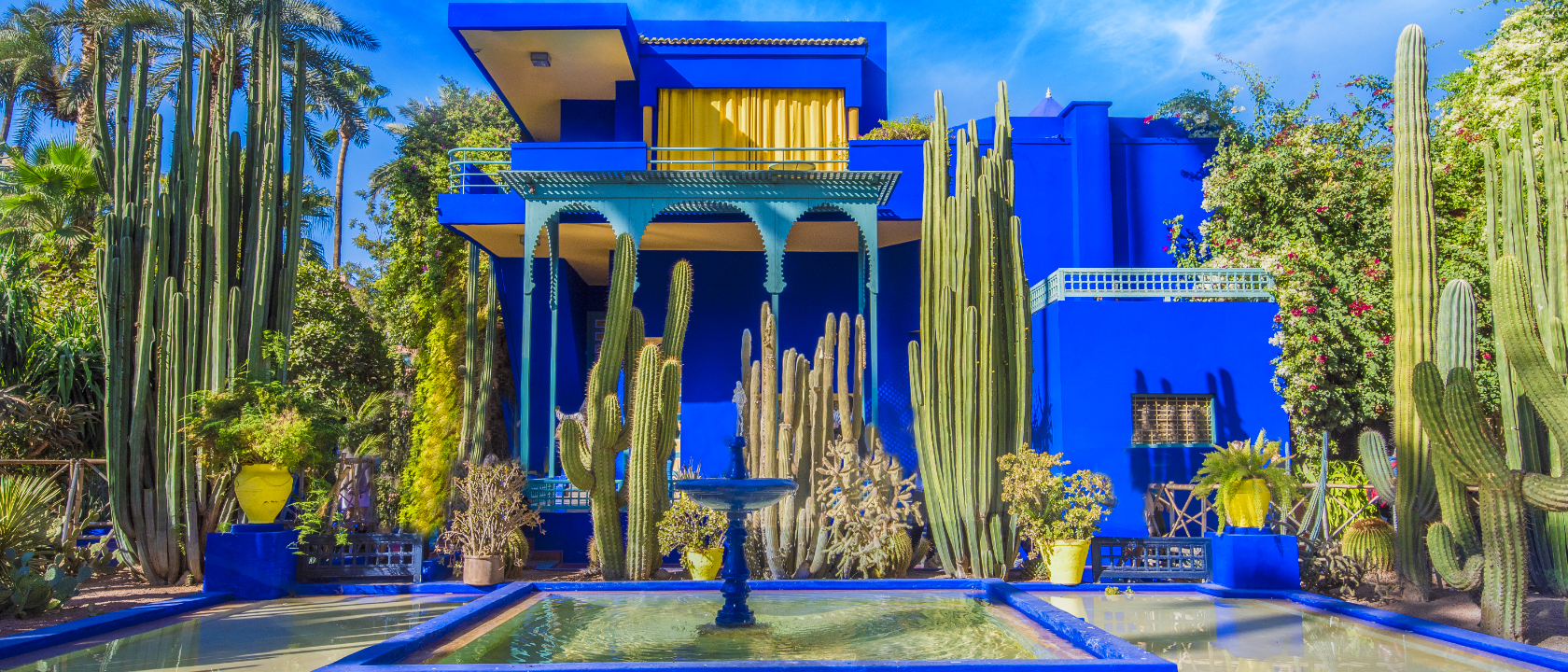 Spectacular Landscapes, Gardens, Imperial Cities & Kasbahs of Morocco 2027